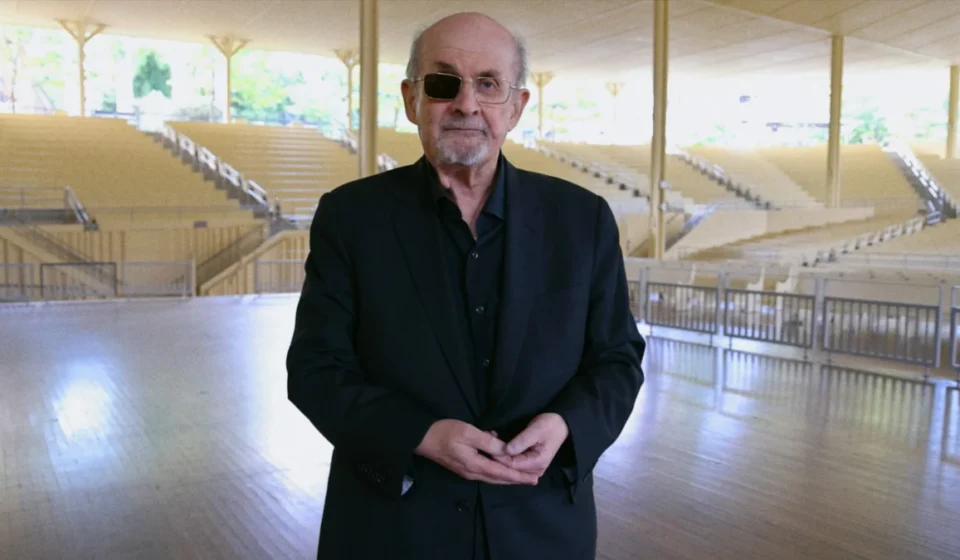

The image is as indelible as it is harrowing: the camera lingers on a mangled hand, tracing the "train-track" of surgical stitches that bisect a human torso. The right eye, once a tool for observing the world’s nuances, is reduced to a bloodied, sightless bulge. These are not the special effects of a Hollywood thriller, but the stark, unflinching reality of Salman Rushdie’s physical form in the aftermath of August 12, 2022.
In the new documentary Knife: The Attempted Murder of Salman Rushdie, which recently premiered at the Sundance Film Festival, acclaimed filmmaker Alex Gibney offers more than just a profile of a literary giant. He presents a visceral testament to survival. By choosing to showcase his scars—quite literally, through footage captured by his wife, the poet and artist Rachel Eliza Griffiths—Rushdie transforms his recovery into a political and philosophical statement. The film, a "visceral complement" to Rushdie’s own memoir of the same name, bridges the gap between the abstract concept of free speech and the brutal, physical cost of defending it.
Main Facts: A Convergence of Cinema and Trauma
Directed by Oscar and Emmy winner Alex Gibney, Knife marks a departure from the filmmaker’s usual "reporter-style" investigations into institutional power, such as his works on Scientology (Going Clear) or Enron. Here, the focus is singular and intimate. The documentary is anchored by Rushdie’s own voiceover, providing a narrative thread that begins with a "feverish" recreation of the attack at the Chautauqua Institution in upstate New York.
The assault, carried out by 24-year-old Hadi Matar of New Jersey, lasted only seconds but resulted in fifteen stab wounds. In the film, Matar is visualized not as a man, but as a "shadowy mass," a symbolic representation of the decades-long threat that has loomed over Rushdie since the 1989 fatwa. Rushdie’s decision to name his assailant only once in the film underscores a refusal to grant the attacker the notoriety he sought. Instead, the narrative belongs to the survivor.
The documentary’s power lies in its duality. On one hand, it is a tender, "diaristic" account of recovery, featuring intimate moments like a supportive phone call from filmmaker Wes Anderson. On the other, it is a rigorous historical accounting of how a work of fiction—1988’s The Satanic Verses—became a lightning rod for global religious extremism.
Chronology: From ‘The Satanic Verses’ to Chautauqua
To understand the weight of the 2022 attack, Gibney takes the audience back through a timeline of escalating tension and forced isolation:
- September 1988: Salman Rushdie publishes The Satanic Verses. The novel, a complex work of magical realism exploring the immigrant experience and the nature of revelation, is immediately banned in India and several Muslim-majority nations.
- February 14, 1989: Ayatollah Ruhollah Khomeini, the Supreme Leader of Iran, issues a fatwa calling for the execution of Rushdie and his publishers. A bounty is placed on his head, forcing the author into a decade of living under the protection of the British Metropolitan Police, using the alias "Joseph Anton."
- The 1990s: While Rushdie remains in hiding, the violence spreads globally. In 1991, the book’s Japanese translator, Hitoshi Igarashi, is stabbed to death; the Italian translator is seriously wounded, and the Norwegian publisher is later shot.
- The 2000s–2010s: Rushdie gradually re-emerges into public life, moving to New York City and becoming a symbol of free expression. The threat of the fatwa, while still technically active, is perceived by many as a relic of the past.
- August 12, 2022: During a lecture regarding the United States as a safe haven for exiled writers, Hadi Matar rushes the stage in Chautauqua, stabbing Rushdie repeatedly in the neck, chest, and eye.
- 2023–2024: Rushdie undergoes a grueling recovery process. He writes the memoir Knife and collaborates with Gibney on the documentary to document the "existential musings" prompted by his brush with death.
Supporting Data: The Global Fallout of a Narrative
The documentary utilizes scratchy, animated renderings of The Satanic Verses to highlight the "absurdity" of the violent response. Gibney contextualizes the 2022 attack within a broader history of censorship and murder. The "supporting data" of Rushdie’s life is a grim tally of the dangers posed by religious extremism:
- Casualties of a Book: Beyond the 2022 attack, the controversy led to the deaths of dozens of people during riots in Pakistan and India. The firebombing of bookstores in the United Kingdom and the United States served as a precursor to the modern era of domestic terrorism.
- The Psychological Toll: Gibney employs archival news footage and old interviews to explore Rushdie’s "identity-crisis-riddled early years." The film delves into the emotional abuse Rushdie suffered at the hands of his alcoholic father, suggesting that his resilience was forged long before the fatwa.
- The Physical Cost: The documentary does not shy away from the medical specifics. The loss of sight in one eye and the permanent nerve damage in his hand serve as a permanent "map" of the attack. By sharing his wife’s footage from the hospital, Rushdie forces the viewer to confront the "fleshy thud" of the knife—a sound design choice in the film that emphasizes the physical reality of ideological hatred.
Official Responses: A Rallying Cry for Free Speech
The 2022 attack and the subsequent release of Knife have triggered a wave of responses from the global literary and political community. The documentary captures the "tenacious" support of Rachel Eliza Griffiths, but the broader reaction reflects a world increasingly concerned with the safety of artists.
- Literary Organizations: PEN America, an organization Rushdie once led, described the attack as a "vicious assault on the very foundation of free speech." The documentary has been hailed by free expression advocates as a necessary reminder that the "long shadow" of the fatwa has never truly disappeared.
- Political Leaders: In the immediate aftermath of the stabbing, U.S. President Joe Biden released a statement praising Rushdie for his "refusal to be intimidated or silenced." French President Emmanuel Macron noted that Rushdie’s fight is "our fight, a universal one."
- The Cultural Community: Figures like Wes Anderson, who appears via phone call in the film, represent a community of artists who see Rushdie not just as a colleague, but as a vanguard. The documentary highlights that while the attack was an attempt to silence one man, it effectively galvanized a global defense of the "imagination as a product of freedom."
Implications: The Fragility of the Pen and the Resilience of the Mind
The overarching message of Gibney’s documentary is that artistic expression remains "frighteningly vulnerable." The 2022 assault shattered the illusion that the West provided an absolute sanctuary for those targeted by foreign autocracies or religious extremists.
The Paradox of Visibility
Rushdie spent years trying to move past the "fatwa years," wanting to be judged solely on his literary merits rather than his status as a victim. However, Knife suggests that the 2022 attack has inextricably linked his physical body to his bibliography. His scars are now part of his text. The implication for future writers is sobering: the "dangerous incursions upon life and liberties" are not confined to the past or to distant regimes.
The Evolution of Censorship
The film draws a subtle parallel between the religious extremism of the 1980s and the modern "American news cycle," where book bans and threats against educators are on the rise. While the documentary is "obligatorily sentimental" in its depiction of Rushdie’s recovery and his relationship with Griffiths, its subtext is a warning. If a world-renowned author can be nearly murdered on a public stage in broad daylight, the "civil society" that religious extremism threatens is more fragile than previously thought.
A Legacy of Defiance
Ultimately, Knife: The Attempted Murder of Salman Rushdie serves as a cinematic counter-attack. By controlling the "mic from the get-go" through his voiceover, Rushdie reclaims his narrative from his assailant. The film’s refusal to use "uncanny simulations" (a dig by the reviewer at Gibney’s use of AI in a previous Musk documentary) ensures that the human element remains at the forefront.
Rushdie’s reflection on death and fatalism reveals a man who, while physically diminished, remains intellectually unyielding. The documentary concludes not with a sense of closure, but with a sense of ongoing vigilance. As Rushdie’s "rock," Rachel Eliza Griffiths, continues to document their life, the film leaves the audience with the realization that the pen may be mightier than the sword—but only if there is a body brave enough to hold it.