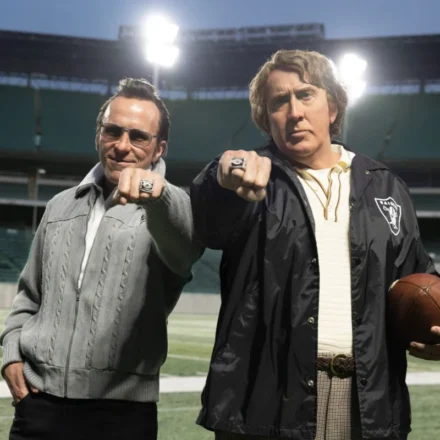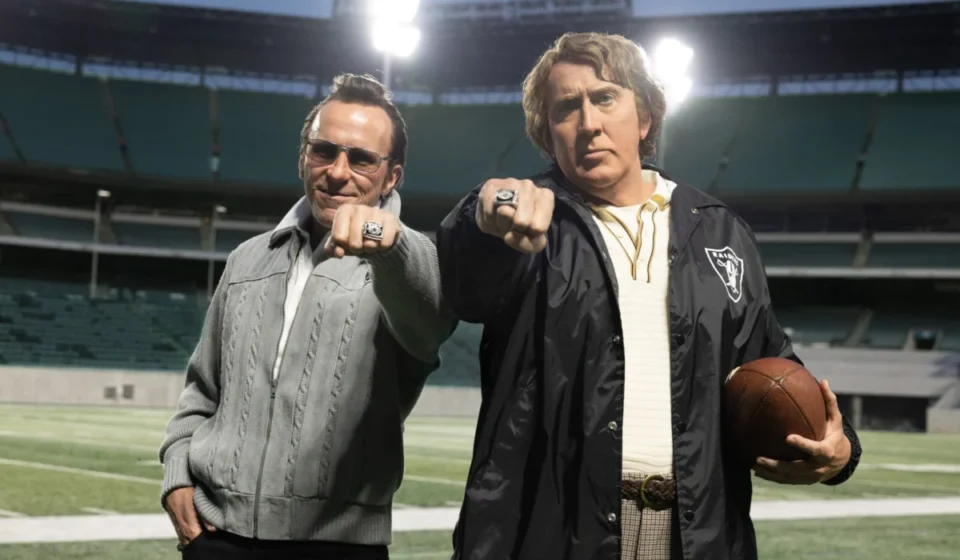

The world of sports cinema often oscillates between the reverent hagiography and the gritty underdog story. However, every so often, a film emerges that defies categorization, rewriting the rules of the genre through sheer force of personality and stylistic audacity. David O. Russell’s latest venture, Madden, is precisely that kind of cinematic anomaly. Starring Nicolas Cage as the titular John Madden—the legendary Oakland Raiders coach turned broadcasting icon and video game mogul—the film is a kaleidoscopic, high-energy exploration of an American original.
Buried under a jowly, synthetic prosthetics-heavy fatsuit that evokes a surreal blend of Jiminy Glick and John Candy, Cage delivers a performance that is equal parts meticulous impersonation and "Cage-ian" kabuki. The result is a "stunt biopic" that functions on cinematic amphetamines, blending the frantic energy of a Scorsese crime epic with the eccentric character studies that have defined Russell’s career.
Main Facts: A Bold Reimagining of a Sports Icon
Madden marks a significant return for director David O. Russell, whose career has seen both the heights of Silver Linings Playbook and the lows of the convoluted Amsterdam. In this project, Russell tackles the life of John Madden not through a traditional cradle-to-grave narrative, but through a stylized triptych that focuses on his most transformative eras.
The Casting Paradox
The centerpiece of the film is undeniably Nicolas Cage. The casting choice itself was met with skepticism, but Russell utilizes Cage’s inherent "inner gentleness" and "puppy-dog eyes" to ground a character that could have easily become a caricature. Cage’s Madden is a man of contradictions: a screaming sideline general who coached the infamous "mean-machine" Raiders of the 1970s, yet a man who possessed a "strangely innocent quality"—an overgrown child whose obsession with football bordered on a state of grace.
A Star-Studded Ensemble
The film features a supporting cast that mirrors the eccentricity of its lead:
- Christian Bale as Al Davis: Portrayed with a "shark mouth," receding hairline, and a "Jewish goombah accent," Bale plays the Raiders’ owner as a relentless businessman and Madden’s monomaniacal foil.
- Kathryn Hahn as Virginia Madden: Hahn provides the emotional anchor of the film, playing Madden’s tough-love wife who struggles to pull her husband out of the "football head" that threatens to consume their marriage.
- John Mulaney as Trip Hawkins: In a surprising narrative pivot, Mulaney portrays the founder of Electronic Arts (EA), representing the bridge between Madden’s analog genius and the digital future.
- Joel Murray as Pat Summerall: Capturing the stoic play-calling that served as the perfect straight-man foil to Madden’s "Wham! Bam!" broadcasting style.
Chronology: Three Acts of an Obsessive Life
The film is structured into three distinct sections, each capturing a pivotal shift in Madden’s career and the broader American cultural landscape.
Act I: The Raiders and the Curse of Success (1976–1979)
The film opens during the 1976 NFL season, the zenith of Madden’s coaching career. Russell captures the brutal, high-stakes environment of the Oakland Raiders, a team of "infamous ruffians" led by a coach who lived in a state of chronic dishevelment. While the Raiders were perennial winners, they were also viewed as "cursed," often falling just short of the ultimate prize.
The climax of this section is the victory in the AFC Championship Game followed by a Super Bowl win against the Minnesota Vikings. However, the film focuses less on the trophy and more on the internal cost. By 1979, the pressure had manifested as a bleeding ulcer, and the narrative shifts to Madden’s decision to retire from coaching to save his health and his marriage to Virginia.
Act II: The CBS Revolution and the Birth of a Personality
The second act chronicles Madden’s transition into the broadcast booth at CBS Sports. This segment is played as a "comedy of errors" that evolved into a game-changing triumph. The film highlights how Madden’s "unhinged" and "shoot-from-the-mouth" commentary—punctuated by his famous telestrator diagrams—initially baffled executives but eventually revolutionized how audiences consumed sports. His chemistry with Pat Summerall is depicted as a clash of styles that redefined the "color commentator" role.
Act III: The Digital Frontier and the EA Legacy
The final act introduces Trip Hawkins and the birth of Madden NFL. This is the film’s "wild card," devoting significant screen time to the development of the pioneering computer game. The audience watches as the "stubbornly analog" Madden tries to translate his massive binder of strategies—simply called "The Book"—into a digital interactive experience. This transition serves as a metaphor for the broader cultural shift from the physical gridiron to the "couch-potato vicariousness" of the modern era.
Supporting Data: Aesthetic and Stylistic Framework
David O. Russell employs a "jukebox-shuffle" editing style that keeps the film moving at a breakneck pace, reminiscent of Martin Scorsese’s Casino or Goodfellas.
Visual Storytelling Gambits
The film utilizes a variety of narrative techniques to maintain its high energy:
- Mock Documentary Interviews: Breaking the fourth wall to provide context and character depth.
- Interactive Diagrams: Scenes where Cage’s Madden diagrams plays directly onto the cinema screen, mimicking his real-life telestrator usage.
- Period Soundtrack: The film is "spanked along" by a carefully curated selection of 70s and 80s tracks, including "How Long" by Ace and "Evil Ways" by Santana, which underscore the grit and groove of the era.
The Prosthetic Dilemma
The film’s use of prosthetics is intentional in its "synthetic" appearance. Russell never asks the audience to forget they are watching Nicolas Cage in a costume. Instead, the film posits that Madden was such an outsized, un-self-aware character that a "prosthetic supergeek disguise" is the only way to tap into the "grandiose depths" of his personality. This stylistic choice emphasizes the "OCD about football" that defined Madden’s existence.
Official Responses: Critical Analysis and Market Outlook
Initial critical reactions to Madden have been polarized, reflecting the "love-it-or-hate-it" nature of David O. Russell’s filmography.
Critical Reception
Critics have noted that while the film is a "stunt biopic," it is crafted with enough intelligence and "filmmaking joy" to distinguish it from standard genre fare. The comparison to an SNL sketch shot by Scorsese highlights the film’s unique tone—high-brow technique applied to a populist, almost vulgarly American subject. While some argue the film holds the audience "at arm’s length" due to its frantic pace, others praise Cage’s ability to find the "inner gentleness" beneath the boisterous exterior.
Box Office vs. Streaming Potential
Industry analysts suggest that Madden faces an uphill battle in traditional theaters. Its "eccentric" nature and focus on sports figures of a "certain age" may limit its appeal to a broad theatrical audience. However, the film is widely expected to be a significant hit on streaming platforms. The "Madden" brand—largely sustained by the video game franchise—has immense cross-generational recognition, and the "memorable eccentricity" of Cage’s performance is tailor-made for the digital discourse that drives streaming viewership.
Implications: The Legacy of the "Slovenly Buddha"
Madden is ultimately more than a sports movie; it is a "turducken" of a film—a football saga stuffed inside a domestic drama, wrapped in a Wikipedia-style biopic on stimulants.
The Evolution of the Biopic
Russell’s film suggests a new direction for the biopic genre: one that prioritizes "thematic truth" and "stylistic energy" over chronological accuracy or physical realism. By embracing the "uncool" and "slovenly" aspects of Madden’s character, the film finds a "vulgarly American state of grace." It recognizes that Madden’s dysfunction—his inability to be "present" anywhere except inside his own football head—was precisely what made him a genius.
A Cultural Milestone
The film’s focus on the EA Sports deal highlights a pivotal moment in American history: the point where sports moved from the field to the living room. John Madden, the man who put the "turducken" (a turkey stuffed with a duck stuffed with a chicken) on the map, becomes a metaphor for American excess and ingenuity.
In conclusion, David O. Russell’s Madden is a movie crafted out of obsession, for the obsessed. It stays true to the spirit of a man who was a "sports fanatic who never grew up," and in doing so, it captures a specific brand of American brilliance that is as messy, loud, and impactful as the man himself. Whether viewed as a triumphant return for Russell or a bizarre experiment for Cage, Madden stands as a singular piece of filmmaking that refuses to play by the standard rules of the game.