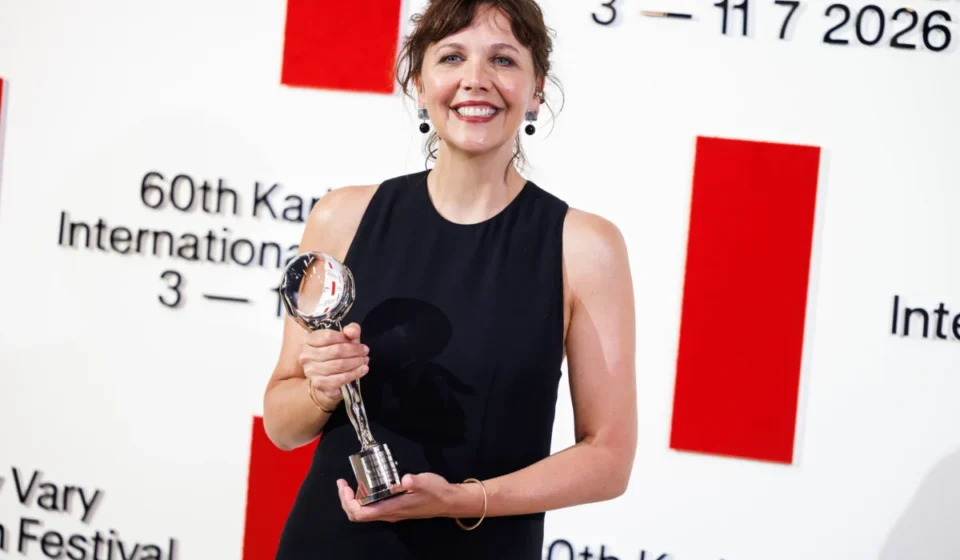

In the pantheon of contemporary filmmakers, few have made as decisive an impact in such a short span as Maggie Gyllenhaal. Having transitioned from a celebrated acting career to a formidable directorial presence, Gyllenhaal has, in just two features, dismantled over a century of entrenched cinematic stereotypes. Honored at this year’s Karlovy Vary International Film Festival with the prestigious President’s Award, the filmmaker sat down with the international press at the historic Grand Hotel Pupp to reflect on a career that is rapidly reshaping the landscape of modern storytelling.
The Evolution of a Visionary
Gyllenhaal’s directorial debut, The Lost Daughter (2021), was a watershed moment in the depiction of motherhood. By unflinchingly exploring the darker, often unspoken aspects of maternal ambivalence, she forced audiences to confront the complexities of a role traditionally romanticized or sanitized by Hollywood. She followed this with The Bride (2024), a bold reimagining of the Frankenstein myth that granted its titular character autonomy and agency, stripping away the passive, decorative nature often afforded to female monsters in film history.
At the Karlovy Vary Film Festival’s opening night ceremony on Friday, Gyllenhaal was presented with the President’s Award, a recognition that solidified her status as a singular voice in global cinema. During a subsequent roundtable in the neo-baroque surroundings of the Grand Hotel Pupp, she discussed the fundamental shift required to bring authentic female experiences to the screen.
“For most of the time that people have been making movies, they have been made by men,” Gyllenhaal observed. While she acknowledged that male directors have occasionally crafted fascinating female characters, she posited that a gendered gap in perspective is inevitable. “I don’t see how you have insight into all of a feminine experience, especially the parts of ourselves that we are ashamed of, that we hide, and that we don’t like to share.”
Chronology of a Creative Shift
Gyllenhaal’s journey into the director’s chair was born of a desire for artistic sovereignty. After years of navigating industry expectations as an actress, she found herself increasingly frustrated by the narrow parameters imposed on her creative output.
- The Catalyst: Her reading of Elena Ferrante’s novel The Lost Daughter served as a professional and personal turning point. “As a mother, I thought, ‘Oh, whoa, I can’t. Are you so fucked up? Hold on, I actually relate to what you’re saying,’” she recalled. The recognition she felt reading Ferrante provided a sense of validation—a realization that the internal conflicts she kept hidden were not solitary burdens, but shared, albeit unspoken, human realities.
- The Directorial Pivot: This realization propelled her into screenwriting and directing. She noted that she moved into the director’s chair precisely because she felt her artistic contributions were being stifled by directors who were uninterested in her specific interpretation of a role.
- The Current Phase: Following the ambitious The Bride, Gyllenhaal has secured a partnership with Warner Bros. to adapt Rachel Kushner’s critically acclaimed novel Creation Lake. Despite the project being in its infancy, it signals a continued commitment to challenging, high-concept literary adaptations.
The Philosophy of "Space-Making"
When asked by members of the press whether she views herself as a disruptor of industry barriers, Gyllenhaal rejected the premise. Instead, she characterized her work as a process of "making space."
“I’m not really trying to break down barriers; I’m just trying to make space for my own experience to be expressed, to make space for Jessie Buckley’s experience to be expressed, to make space for my production designer’s experience to be expressed,” she explained.
Gyllenhaal is keenly aware that her work is often perceived as taboo-breaking, but she attributes this to the historical scarcity of female directors. "It’s not that I’m interested in breaking taboos; I think it just comes off that way because there have been so few women making movies, so it seems like these things are off-limits. It’s just that they haven’t been explored. And I did not expect to make people so angry by exploring them."
She is notably uninterested in the industry standard of the "strong female character," a trope she finds reductive. Her interest lies in the "whole spectrum" of the feminine experience—a tapestry that includes strength, vulnerability, pleasure, terror, and the "beautiful weaknesses" that make a character recognizable.
Official Responses and Industry Support
Despite the mixed box-office performance of The Bride, Gyllenhaal’s professional standing remains robust. Her ongoing relationship with Warner Bros. is a testament to the trust placed in her by industry titans like Pam Abdy and Mike De Luca.
“I really love Pam and Mike. They’ve been just wonderful as partners all the way through this process. They’re lovers of film and lovers of filmmakers,” she stated. This support is crucial, as it allows her the freedom to tackle complex, non-commercial subject matter.
Regarding the rumors surrounding the Creation Lake adaptation, Gyllenhaal expressed surprise at the speed with which the news reached the public. “I’m at the very, very beginning of playing with that project, and I’m at the place where it’s really private,” she said, emphasizing that she is currently in the process of internalizing Kushner’s material. “It’s about me bouncing around ideas on this incredibly interesting material… bouncing it off my own mind and my own heart.”
Implications for Future Filmmaking
Gyllenhaal’s approach to directing is defined by a radical generosity toward her actors. Having spent her career protecting her "real estate"—the small, authentic corners of a character that she fought to keep alive—she now makes it her mission to offer that same agency to her collaborators.
She views cinema as a language, one that is constantly evolving. “You can jump in whenever you want, but it’s probably in a different language than you’re used to. Isn’t that an interesting invitation? Is that an interesting hand to hold out? That’s what I like.”
The implications of Gyllenhaal’s work are profound for the next generation of female directors. By proving that internal, subjective experiences—even the ones marked by shame or contradiction—can serve as the bedrock for compelling, large-scale cinema, she is expanding the vocabulary of film.
As she continues to develop her craft, her process remains rooted in deep introspection. “My films reflect a really honest expression of what’s on my mind,” she concluded, “and I have to figure out what’s on my mind first.”
For the industry, Maggie Gyllenhaal’s presence represents a shift from the exterior, performative nature of filmmaking toward an interior, investigative one. As she continues to turn the camera toward the parts of the human experience that have long been relegated to the shadows, she ensures that the "space" she is creating will be occupied by voices that, until recently, were largely silenced. Whether through the lens of a monster finding her voice or a mother confronting her own limits, Gyllenhaal’s body of work stands as a testament to the power of artistic authenticity in an industry that has too often preferred the comfort of the status quo.