The Ghost in the Machine: Andrew Scott’s Brilliance vs. the Hollow Shell of ‘Elsinore’

In the pantheon of contemporary performance, few actors possess the crystalline, mercurial intensity of Andrew Scott. At 49, the Irish actor has cultivated a career defined not by mere range, but by a haunting, off-center vulnerability that makes his characters feel as though they are holding back a profound, potentially dangerous secret. From the sociopathic precision of his Tom Ripley to the soul-stirring longing of the "Hot Priest" in Fleabag and the ethereal, grief-stricken isolation of All of Us Strangers, Scott has consistently proven himself to be an artist of the highest caliber.
However, his latest endeavor, director Simon Stone’s Elsinore, serves as a stark reminder that even the most formidable talent can be subsumed by a production that favors stylistic artifice over emotional resonance. In this biopic of the late Scottish actor Ian Charleson—who died from complications related to HIV/AIDS in 1990 while famously playing Hamlet at the National Theatre—Scott delivers a performance of immense, committed gravity. Yet, the film itself is an exercise in "prestige" filmmaking that ultimately loses the human being beneath the heavy layers of directorial affectation.
The Life and Legacy of Ian Charleson: A Chronology of a Star
To understand the weight of the task Scott undertook, one must look at the trajectory of Ian Charleson. A titan of the British stage, Charleson’s public image was defined by his athletic, disciplined, and often stoic performances. He broke into the mainstream consciousness with his role as an Olympic runner in the 1981 Best Picture winner Chariots of Fire, following it up with a compelling turn as an Anglican priest in the 1982 epic Gandhi.
Long before his mainstream success, however, Charleson was a fixture of the avant-garde, notably appearing in the 1978 film Jubilee, directed by his former lover, the queer visionary Derek Jarman. While his career was punctuated by these high-profile film credits—and his brief, memorable appearance in Dario Argento’s giallo masterpiece Opera—Charleson remained, at his core, a creature of the stage.
The tragic final chapter of his life began in the late 1980s as the AIDS crisis reached a fever pitch in the UK. Even as his health failed, Charleson refused to step away from the limelight. His 1990 performance as Hamlet at the National Theatre, directed by Richard Eyre, became the stuff of legend—a final, defiant act of artistic expression performed under the shadow of a terminal diagnosis. At the time, Charleson was not publicly out; he resisted immense pressure from his inner circle to disclose his condition, fearing the professional stigma that defined the era. It is this tension—the duality of the public performer and the private, dying man—that Elsinore attempts to capture.
Anatomy of a Misstep: The Structural Flaws of ‘Elsinore’
While Andrew Scott brings a blond-headed, urgent commitment to the role of Charleson, the film around him is fundamentally broken. Director Simon Stone, known for his work in both theater and cinema, appears to have fallen into the trap of "opening up" a story that was already cinematic in its inherent tragedy.

The primary failure of Elsinore lies in its editorial rhythm. The screenplay, penned by playwright Stephen Beresford, is crowded with potential emotional beats—the visceral reality of Kaposi’s sarcoma lesions, the agonizing medical care provided by the dedicated Dr. Margaret Johnson (a typically formidable Olivia Colman), and the backstage camaraderie of the London theater scene. Yet, Stone opts for a relentless, frenetic editing style that treats these moments as a series of staccato jump cuts.
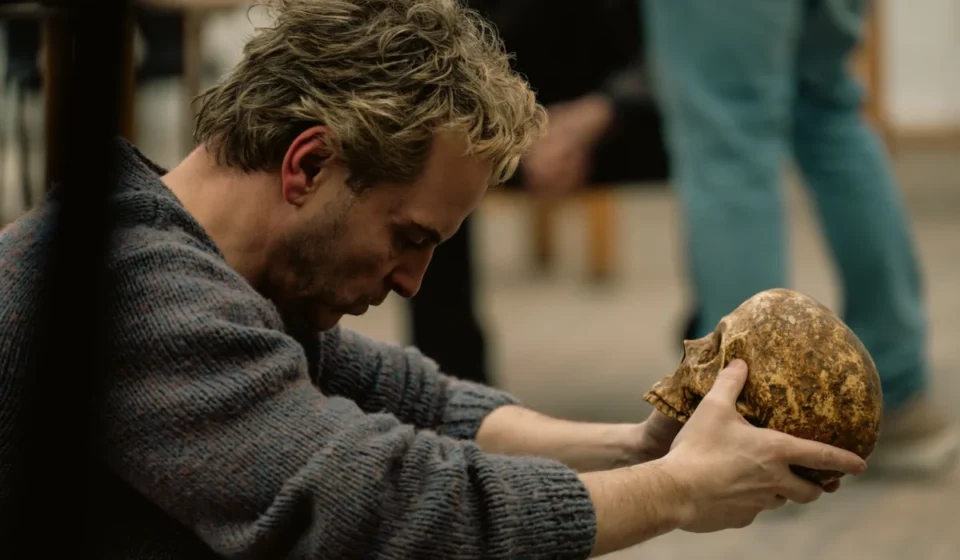
In one sequence, the audience is treated to a glimpse of the grueling rehearsal process for Hamlet. We see Charleson struggling, sweating, and fighting against the physical decay of his body. But just as the scene begins to breathe, it is snatched away, replaced by a jarring montage. The film, which takes its name from the Danish town where Hamlet is set and where its tragic hero meets his end, seems terrified of stillness. By refusing to let the audience sit with the pain or the triumph of Charleson’s swan song, the film renders his ultimate sacrifice less a moment of profound artistic closure and more a footnote in a music-video-style montage.
The "Awards-Bait" Dilemma: Exploitation or Education?
Elsinore inevitably invites comparison to a long line of "AIDS dramas" that have frequented the awards circuit—from the earnest, Oscar-winning gravitas of Philadelphia to the more clinical, calculated performances of Dallas Buyers Club.
For the modern queer viewer, the presence of these tropes is impossible to ignore. There is a reflexive suspicion: is this a genuine attempt to educate younger generations about the devastation of the 1980s and early 90s, or is it a calculated attempt to harvest "prestige" by placing a brilliant actor in a state of terminal decline?
The reality is that it is likely both. However, Elsinore leans dangerously toward the latter. The film populates its background with a "who’s-who" of British gay luminaries, including a tender, wounded performance by David Dawson as Derek Jarman and Johnny Flynn as a composite of the theatrical establishment. These interactions are intellectually fascinating but narratively hollow. The film captures the aesthetic of the era—the gray, pallid cinematography of Mike Eley, the rain-slicked streets of London—but it lacks the internal heat of a project like Robin Campillo’s Beats Per Minute. Where Campillo’s masterpiece felt like an urgent, throbbing, political outcry, Elsinore feels like a museum piece, meticulously curated but lacking a heartbeat.
Implications for Queer Cinema
The failure of Elsinore highlights a persistent issue in modern cinema: the tendency to flatten the queer experience into a singular narrative of tragedy. While it is vital to document the toll of the HIV/AIDS epidemic, the "prestige drama" format often strips away the agency and the joy that existed alongside the sorrow.

Charleson’s story is one of profound resilience. He was a man who, until his very last breath, was defined by his work, his friendships, and his complex, unstated desires. By focusing so heavily on the medicalized, dying body, the film loses the man. Even in the scenes where Scott shares a screen with Colman—scenes that suggest a deep, complex history between the patient and the physician—the film retreats into cold, efficient storytelling.
The tragedy of Elsinore is that it had all the components for greatness. It had an actor in Andrew Scott who is capable of inhabiting the nuances of such a complex, closeted figure. It had a historical foundation that is as haunting as any Shakespearean play. Yet, the film settles for being a "worthy" project rather than a transformative one. It speaks to us about death, but it rarely invites us into the life that preceded it.
Final Assessment: A Missed Opportunity
As it stands, Elsinore is a C-grade effort—a film that remains watchable primarily due to the sheer magnetism of its lead actor. Andrew Scott does everything in his power to elevate the material, showing us, in fleeting moments, the man beneath the legend. He captures the frustration of a performer who knows that the "editor’s knife" is the ultimate enemy of the actor’s truth. Ironically, it is the editor’s knife that proves to be the greatest enemy of Elsinore itself.
The film serves as a poignant reminder that while we have made advancements in the medical treatment of HIV/AIDS, our cinematic approach to the history of the disease remains stuck in a cycle of repetition. We continue to seek "Oscar-bait" narratives that privilege misery over complexity.
Elsinore premiered to a mixed reception at the 2026 Telluride Film Festival. As it heads toward a wide release on November 20, audiences will undoubtedly flock to see Scott’s take on a tragic icon. They will see a performance that is technically flawless, deeply felt, and occasionally breathtaking. But they will leave the theater feeling as though they have witnessed a ghost—a faint, flickering image of a man whose real, vibrant, and messy life was obscured by a director who couldn’t trust the audience to look directly at the pain.
Ultimately, the film acts as a cautionary tale: true artistic legacy cannot be manufactured through prestige, nor can the weight of a life be measured by the frequency of one’s edit points. Ian Charleson deserved a film that honored the quiet, enduring power of his final performance. Instead, he received a beautiful, cold, and ultimately forgettable frame.