Beyond the First Order: Domhnall Gleeson Reflects on the Legacy and Demise of General Hux

The Star Wars sequel trilogy stands as one of the most ambitious, contentious, and culturally significant undertakings in modern cinematic history. Between the introduction of new icons and the controversial reshuffling of legacy characters, the three-film arc from 2015 to 2019 redefined the scope of the franchise. Among the ensemble of the First Order, few characters underwent as radical a transformation as General Armitage Hux. Played with a mixture of fanatical fervor and pathetic insecurity by Irish actor Domhnall Gleeson, Hux began as a formidable antagonist and concluded his arc as a disgruntled, exposed traitor.
In a recent exclusive interview regarding his upcoming project, The Incomer, Gleeson opened up about his departure from the Star Wars universe in The Rise of Skywalker. His reflections provide a rare, candid look at what it means to be a cog in the machine of a multi-billion-dollar space opera, and how a performer processes the unceremonious conclusion of a character they spent years building.
The Arc of a Villain: From Starkiller to Spy
To understand the weight of Hux’s death, one must first appreciate the scale of his initial impact. In J.J. Abrams’ The Force Awakens (2015), Hux was presented as the primary military authority of the First Order. His cold, calculated delivery of the Starkiller Base firing order—a moment that obliterated the Hosnian System—cemented him as one of the most prolific mass murderers in the Star Wars canon. Despite his relative lack of Force sensitivity or combat prowess, he commanded fleets and oversaw the destruction of entire planetary populations.
However, as the trilogy progressed into Rian Johnson’s The Last Jedi (2017), the character took a sharp turn toward the comedic and the humiliated. Once the fierce, barking ideologue, Hux became the target of Poe Dameron’s wit and Snoke’s derision. By the time The Rise of Skywalker arrived, Hux had been relegated to a mole within the First Order, providing information to the Resistance not out of heroism, but out of a spiteful desire to see Kylo Ren fail.
The Final Act: A Career-Ending Execution
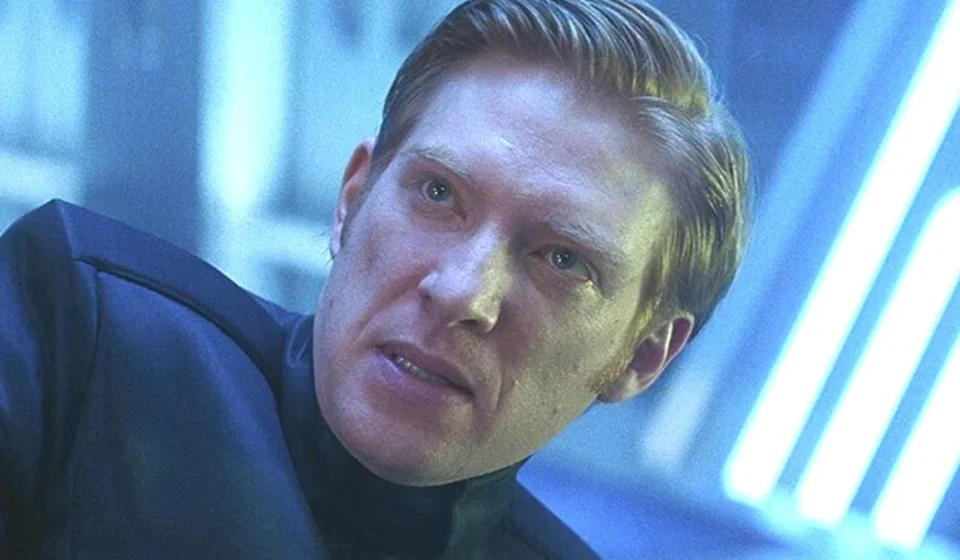
The climax of Hux’s journey occurred in The Rise of Skywalker, where he was confronted by Allegiant General Enric Pryde, played by the legendary Richard E. Grant. In a swift, brutal moment, Pryde unmasked Hux’s treason and executed him on the spot. It was a cold, efficient end to a character who had once dominated the screen with long-winded speeches and military posturing.
Speaking to /Film’s Ethan Anderton, Gleeson expressed a clear, bittersweet sentiment regarding this finale. "Devastating. Absolutely devastating," Gleeson admitted. "I wanted to be in that more and they killed me off. But they had to."
For the actor, the sadness was not merely about leaving a paycheck behind; it was about the completion of an arc he felt had more life in it. Yet, he acknowledged the narrative necessity. In the tightly wound, high-stakes environment of a Star Wars production, characters are often subject to the whims of the screenplay’s pacing. "If you’re going to die, having Richard E. Grant be the one who blasts you across a black corridor, that’s pretty cool," Gleeson noted. "Yes, I was happy it was Richard who did it, but I was sad to go."
![How Star Wars' Admiral Hux Actor Really Feels About His Death In The Rise Of Skywalker [Exclusive]](https://www.slashfilm.com/img/gallery/how-star-wars-admiral-hux-actor-really-feels-about-his-death-in-the-rise-of-skywalker-exclusive/l-intro-1788466733.jpg)
Stunt Work and the Art of the "Face Plant"
A recurring theme in Hollywood discourse is the boundary between the actor and the stunt performer. For major death scenes, productions often rely on professionals to execute the complex physical maneuvers required to sell the impact. Gleeson, ever the pragmatist, revealed that his death in The Rise of Skywalker was a collaborative effort.
"They pulled me back on some of it and I had to do a fall back, but the big drag back was a stunt performer who did a great job," the actor explained. He drew a parallel to his experience in The Last Jedi, where his character’s physical interactions—such as being Force-choked or thrown—were elevated by the work of stunt doubles.
"When the stunt performers are that amazing, I’m more than happy to hand it over," he said. This acknowledgment highlights a professional humility often overlooked in blockbuster filmmaking: the recognition that the spectacle on screen is a collective effort, and the actor’s role is to ground the performance while the stunt team creates the visual reality.
The Complex Legacy of The Rise of Skywalker
The demise of General Hux cannot be separated from the broader context of The Rise of Skywalker. The film remains the most financially successful, yet critically polarized, entry in the modern trilogy. Following the intense division caused by The Last Jedi, Lucasfilm and Disney found themselves at a crossroads. The original vision for the trilogy’s conclusion, which was set to be directed by Colin Trevorrow under the working title Duel of the Fates, was abandoned.
The subsequent return of J.J. Abrams to the director’s chair signaled a pivot toward a more traditional, perhaps safer, narrative structure. In this high-pressure environment, supporting characters like Hux were often caught in the crossfire of rapidly shifting scripts and editorial decisions. Hux’s death, while satisfying in terms of narrative irony—the traitor dying at the hands of a loyalist—felt to some fans like an abrupt end for a character who had once been central to the First Order’s hierarchy.
Implications for Future Star Wars Narratives
Does this mean we have seen the last of General Hux? In the modern era of Star Wars, the answer is rarely a definitive "yes." Through flashback sequences, spin-off television series on Disney+, and canonical novels, the franchise has shown a willingness to revisit deceased characters.
However, Gleeson’s assessment seems to align with the reality of the character’s lack of Force connection. Unlike Palpatine, who utilized ancient Sith technology to cheat death, or characters who appear as Force ghosts, Hux is a mortal man in a galaxy of god-like powers. His demise appears to be, as he suspected, a permanent one.
![How Star Wars' Admiral Hux Actor Really Feels About His Death In The Rise Of Skywalker [Exclusive]](https://www.slashfilm.com/img/gallery/how-star-wars-admiral-hux-actor-really-feels-about-his-death-in-the-rise-of-skywalker-exclusive/intro-1788466733.jpg)
The discourse surrounding Hux’s end is a microcosm of the larger debate over the sequel trilogy’s legacy. Was it a cohesive, planned saga, or a reactionary series of films? The fact that a lead actor is still reflecting on the "devastating" nature of his character’s exit years later underscores how personal these roles become for the cast, regardless of the fan reception.
Looking Forward: Gleeson’s Post-Star Wars Career
As Gleeson moves forward, his career continues to evolve with diverse projects like The Incomer, slated for release in late 2026. Transitioning away from the shadow of the First Order has allowed him to tackle a variety of roles that distance him from the rigid, icy persona of General Hux.
The story of Hux serves as a reminder of the fleeting nature of stardom within a massive franchise. Actors often spend years becoming synonymous with a single character, only to have that character extinguished in a matter of seconds for the sake of the plot. Yet, for Gleeson, the experience remains a "cool" chapter in a career defined by versatility.
While fans may continue to debate the merits of The Rise of Skywalker for years to come, the human element—the genuine emotion of an actor saying goodbye to a character he inhabited for nearly half a decade—remains an essential, often overlooked part of the Star Wars phenomenon. Hux may have been an unceremonious villain, but his end, and the actor’s perspective on it, adds a layer of depth to the galaxy far, far away that extends well beyond the screen.
As the franchise prepares for future installments and new eras, the lessons of the sequel trilogy—including the importance of character arcs and the necessity of satisfying conclusions—will undoubtedly inform the creative decisions of those who take the helm next. For now, General Hux rests in the annals of Star Wars history, a testament to the turbulent, exciting, and occasionally "devastating" world of Hollywood blockbusters.