

Filmmaking has long been tethered to the myth of scale. Legendary director Cecil B. DeMille famously boasted that he could craft a compelling motion picture with nothing more than two pages of the Bible, while Jean-Luc Godard’s (albeit frequently misattributed) mantra suggested that all a filmmaker truly needs is "a girl and a gun." In the modern era of blockbuster cinema, these maxims often feel like relics of a bygone age. Today’s major studio outputs are defined by nine-figure budgets, thousands of visual effects artists, and sprawling, multiversal narratives.
Yet, despite the industry’s pivot toward maximalism, the most poignant and terrifying entries in the science fiction genre often eschew the spectacle of war for the crushing weight of solitude. When a filmmaker traps a character within a high-tech box or on a desolate moon, they strip away the distractions of the outside world, forcing the audience—and the characters—to confront the most uncomfortable of human conditions: isolation.
The Philosophy of the "Bottle Movie"
In film production, a "bottle movie" is a feature shot almost entirely in one location, typically designed to minimize costs and logistical complexity. While budgetary constraints are often the catalyst for this narrative choice, the result is frequently a more intimate, psychological exploration of the human psyche.

Science fiction is uniquely suited to this format. By creating a vacuum—whether it be a prison, a spacecraft, or a subterranean sub—filmmakers can externalize internal turmoil. When a character is geographically separated from humanity by lightyears or concrete walls, the silence becomes a character in itself. This article explores five essential works that prove that in the realm of sci-fi, less is almost always more.
1. The Platform (2019): A Vertical Descent into Class Warfare
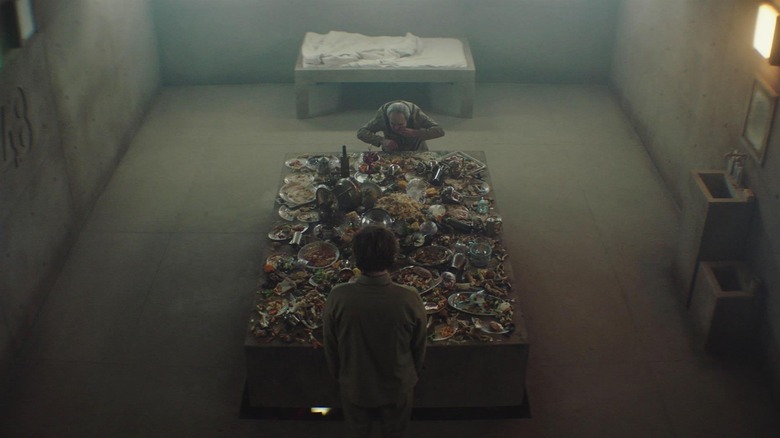
Galder Gaztelu-Urrutia’s The Platform stands as a masterclass in using a singular, brutalist set to articulate a complex sociopolitical critique. The film introduces the "Vertical Self-Management Center," a dystopian prison tower featuring an unknown number of levels.
The Mechanism of Inequality
The structure is defined by a massive, central rectangular shaft. Once a day, a concrete slab laden with a decadent feast descends from the top floor to the bottom. Those at the top eat their fill; those below are left to scavenge the remnants, while the lowest levels are forced into cannibalism or starvation.

Societal Implications
The genius of The Platform lies in its cyclic cruelty. Prisoners are randomly reassigned to different levels periodically, yet the cycle of greed and suffering never breaks. The film argues that the "top-down" structure of society is maintained not just by the oppressors, but by the apathy and desperation of the oppressed. By trapping characters in a concrete silo, Gaztelu-Urrutia transforms a simple premise into a scathing indictment of human nature and economic disparity.
2. Moon (2009): The Sisyphean Nightmare of Corporate Utility
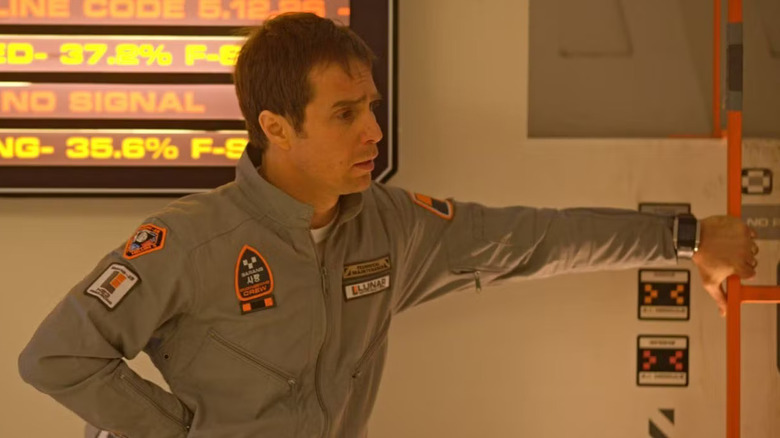
Duncan Jones’ directorial debut, Moon, offers a more introspective take on the isolation trope. Sam Bell (Sam Rockwell) is the sole human occupant of a lunar mining facility, tasked with harvesting helium-3 to solve Earth’s energy crisis.
The Psychology of Solitude
For three years, Bell has endured silence, broken only by the chirpy, disingenuous responses of GERTY, the station’s AI assistant. When a routine accident leads to the discovery of a doppelganger, the film shifts from a character study into a harrowing exploration of identity and corporate disposability.
Supporting Data: The Human Cost
The film’s power is derived from Sam Rockwell’s performance. Because the set is intentionally sterile and small, the audience is forced to focus entirely on Bell’s deteriorating mental state. Moon functions as a cautionary tale about the future of labor, where human worth is measured solely by output, and where isolation is used as a tool to prevent the realization of one’s own expendability.
3. Cube (1997): The Mathematical Maze
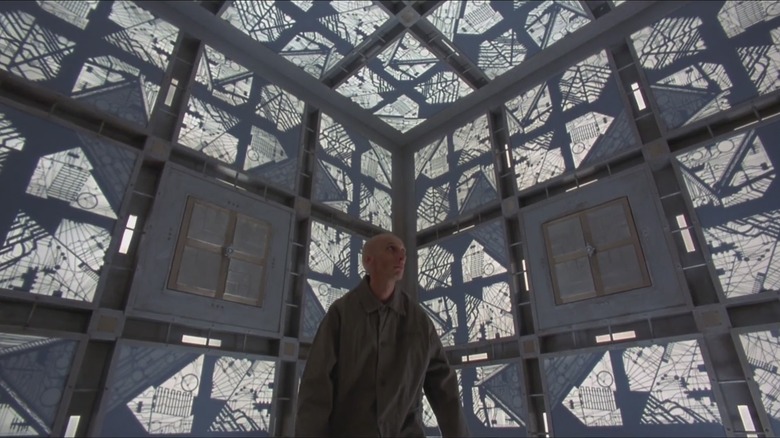
Vincenzo Natali’s Cube remains the gold standard for "low-budget, high-concept" filmmaking. Produced for a modest $350,000 (CAD), the film relies on a single, reconfigurable set—a series of interconnected, booby-trapped rooms.
The Mechanics of the Cube
The narrative follows six strangers who awaken in a vast, mechanical maze. The brilliance of the design is its simplicity: by changing the colored lighting in the modular set, the filmmakers created the illusion of an infinite, shifting prison. The lethal traps within each room—ranging from acid sprays to razor-wire meshes—turn the space into a puzzle that demands both intellect and cooperation.
Chronology of Despair
As the film progresses, the characters’ descent into paranoia mirrors the complexity of the cube itself. The film posits a terrifying question: Is there a grand design, or is the universe an indifferent, murderous machine? The lack of an external world forces the characters to turn on one another, highlighting how quickly social cohesion dissolves when survival becomes the only objective.
4. Iron Lung (2026): The New Wave of Indie Horror
Markiplier’s Iron Lung represents a significant shift in the production landscape. As mainstream IP-driven films faced a decline in quality and box-office performance, independent creators began leveraging digital-first sensibilities to capture visceral, low-cost horror.
A Descent into the Unknown
The film follows a prisoner, Simon, confined to a rusted, claustrophobic submarine at the bottom of an alien ocean composed entirely of blood. The setting is intentionally oppressive; the craft is small, leaking, and technologically primitive.
Official Responses and Industry Shift
The critical reception of Iron Lung highlighted a growing audience fatigue with "blockbuster bloat." By focusing on the sensory experience of claustrophobia—the sound of dripping water, the flashes of an x-ray camera, the feeling of crushing pressure—Fischbach proved that an audience’s imagination is often more effective than a CGI budget. It serves as a case study for the future of indie sci-fi: high stakes, low overhead, and a focus on psychological dread.
5. Dark Star (1974): Nihilism as Comedy
John Carpenter’s debut feature, Dark Star, is perhaps the most unconventional entry on this list. While it deals with themes of extreme isolation, it approaches them through the lens of dark, absurdist humor.
The Boredom of Godhood
The crew of the Dark Star has been in deep space for two decades (relative time), tasked with destroying unstable planets. They have become profoundly indifferent to their mission, their lives, and the universe. The film’s climax—a philosophical debate with a sentient, nuclear bomb—is a brilliant subversion of the "ticking clock" trope.

Implications of the Existential Void
Dark Star suggests that when human beings are removed from society for too long, their values inevitably collapse. The "beach ball" alien and the bickering crew are reflections of the absurdity of human endeavor. It is a film that finds humor in the void, suggesting that while the universe may be uncaring and our lives may be fleeting, there is a strange, kooky freedom in accepting our own insignificance.
Synthesis: Why We Need Small-Scale Sci-Fi
The common thread connecting these five films is the deliberate use of spatial limitations to amplify narrative tension. When the setting is constrained, the story becomes a crucible. The characters are forced to address the core elements of the human experience—greed, identity, mortality, and sanity—without the safety net of external support.
In an age where the cinematic landscape is increasingly dominated by expansive, CGI-heavy spectacles, these films serve as a vital reminder of the medium’s potential. They demonstrate that the most effective special effects are not digital renderings of destruction, but the nuanced, terrifying silence of a human being left alone in the dark. Whether it is a concrete prison or a blood-filled ocean, these locations do more than house the story; they define it. As the industry looks toward the future, it would do well to remember that some of the most profound sci-fi experiences ever captured on film were built with little more than a set, a script, and the courage to stare into the abyss.