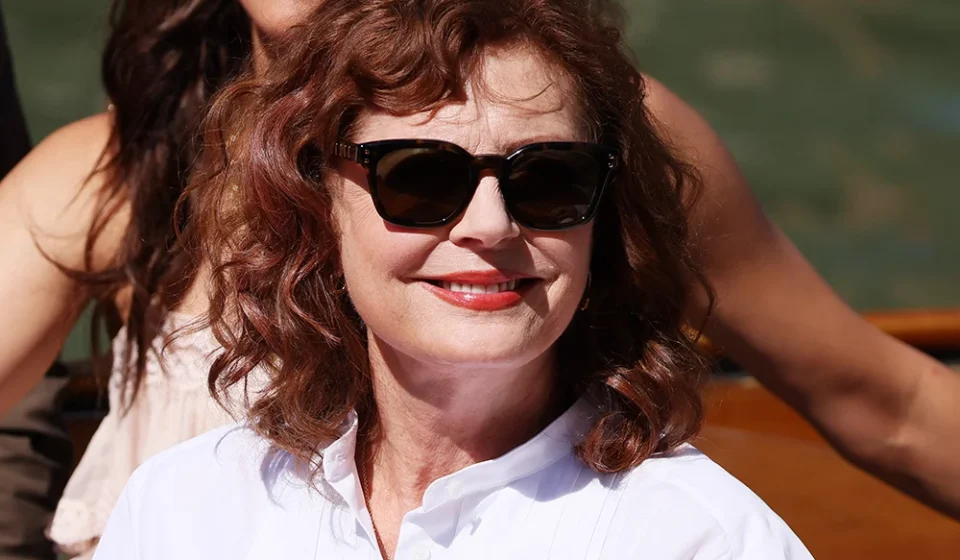

VENICE, Italy — Standing at the center of a cinematic and political firestorm, Oscar-winning actress Susan Sarandon has once again brought the contentious intersection of Hollywood politics and the Israel-Hamas war to the forefront. During a press conference at the Venice Film Festival on Sunday, the legendary performer, appearing to promote her latest project, The Echo Chamber, revealed that she remains the target of industry-wide repercussions due to her vocal, long-standing support for the Palestinian cause.
The remarks serve as a potent reminder of the fragility of professional standing in an industry currently grappling with deep ideological fractures. For Sarandon, the consequences have been tangible, affecting her career trajectory even as she finds solidarity within the international independent film community.
The Venice Disclosure: A Career Under Siege
Speaking to a packed room of journalists at the Lido, Sarandon was prompted to assess whether the cultural climate in Hollywood regarding the conflict in Gaza has shifted over the past year. Her response was both defiant and candid.
"I’ve still had movies taken away recently because there are agencies that are telling people not to hire me still," Sarandon stated, addressing the persistent "whisper campaigns" she suggests are being orchestrated against her. "But that’s the power structure. I think within the people, certainly internationally, I feel welcome."
The actress highlighted the specific defiance of director Andrea Pallaoro, who helmed her current film, The Echo Chamber. According to Sarandon, Pallaoro was explicitly advised against casting her, yet he chose to proceed regardless. "I thank Andrea for that, because he doesn’t listen to the warnings," she noted.
Sarandon’s comments painted a picture of a binary landscape: a rigid, exclusionary power structure within the executive echelons of Hollywood, contrasted with what she describes as a more receptive and informed international public. She asserted that the "historical relevance of Palestine" and the complexities of the U.S.-Israel political alliance have become a "major revelation" for the general public, even if institutional gatekeepers remain unmoved.
Chronology of a Conflict: From Rally to Reprisal
To understand the current impasse, one must trace the timeline of events that led to Sarandon’s professional alienation. The friction began in earnest in late 2023, following the October 7 Hamas-led attacks and the subsequent Israeli military campaign in Gaza.
- November 2023: Sarandon attended a pro-Palestinian rally in New York City. Her presence and subsequent comments regarding the nature of the conflict drew immediate, widespread condemnation from pro-Israel advocacy groups and segments of the entertainment industry.
- Late November 2023: The fallout was swift. United Talent Agency (UTA), which had represented the actress for years, officially severed ties with her. While the agency did not provide an exhaustive public explanation, the timing and context made it clear that her political advocacy had become untenable for her professional representatives.
- Early 2024: Throughout the spring and summer, reports began to surface suggesting that Sarandon was being "shunned" by major studios and production houses. Sarandon herself began to speak more openly about being "blacklisted," describing a quiet, systemic exclusion from mainstream projects.
- September 2024 (Venice): Sarandon’s appearance at the Venice Film Festival marked the most direct public confrontation of these allegations to date. By naming the existence of "Zionist-held positions" within the industry, she signaled that she is no longer interested in quiet diplomacy, but rather in exposing what she perceives as a form of ideological policing.
The Weight of Advocacy: Supporting Data and Context
The situation involving Sarandon is not an isolated incident but a high-profile case study in the broader polarization of Hollywood. Since the events of October 7, the entertainment industry has faced immense pressure to take a stance. This has led to a series of high-stakes conflicts:
- The Talent Agency Exodus: Multiple agencies have seen high-level staff departures or internal friction over how to handle clients who express strong views on the Gaza conflict.
- The "Blacklist" Allegations: While official blacklisting is rarely documented, industry insiders have noted a rise in "cautionary casting." Studios, wary of boycotts or public relations crises, are increasingly conducting "risk assessments" on high-profile talent based on their political speech.
- Public Opinion vs. Corporate Policy: Polling data from organizations such as Pew Research and Gallup has shown a generational shift in American attitudes toward the Israeli-Palestinian conflict, particularly among younger demographics. Sarandon’s belief that she is "welcome" internationally aligns with broader trends in global public opinion, which have increasingly tilted toward advocacy for Palestinian human rights.
However, the power structure in Hollywood—largely driven by corporate boards, institutional investors, and established studio executives—often operates on a different frequency, prioritizing stability and brand safety over ideological expression.
Institutional and Professional Responses
The response from the industry has been largely characterized by silence. UTA and other major agencies have refrained from issuing detailed rebuttals to claims of political discrimination, typically citing the standard "confidentiality of client relations."
Industry observers note that the lack of public defense for Sarandon from her peers is a reflection of the "fear factor." In an industry where one’s livelihood is contingent on being hireable, many actors and directors are choosing to self-censor. By contrast, international directors like Pallaoro represent a different model of filmmaking—one that is less reliant on the American studio system and therefore more insulated from the pressures of the Hollywood "power structure."
The Echo Chamber, which is based on the final screenplay of the late, legendary director Bernardo Bertolucci, serves as a testament to the kind of prestige project that can still survive outside the traditional Hollywood mainstream. The film’s production in Italy and Belgium underscores the shift toward European financing and distribution as a potential refuge for artists whose political views make them "untouchable" in Los Angeles.
The Implications: A New Era of Hollywood Politics
The case of Susan Sarandon highlights several profound implications for the future of the arts:
1. The Erosion of Artistic Independence
If actors are being effectively banned for their political stances, the inevitable result is a chilling effect on discourse. When creators fear that their next paycheck depends on silence, the breadth of stories told in cinema is likely to narrow.
2. The Global Shift
Sarandon’s success in finding work internationally suggests that the Hollywood monopoly on global film culture is waning. If American talent begins to look toward Europe, Asia, and the Global South for creative freedom, it could lead to a long-term erosion of Hollywood’s status as the sole global arbiter of cultural influence.
3. The Definition of "Professionalism"
The ongoing conflict has forced a debate over what constitutes "professionalism." Is it the obligation of a performer to remain neutral to ensure a film’s commercial viability? Or is it a fundamental right for an artist to engage in civic life without fear of professional retaliation?
Sarandon seems to have landed firmly on the latter. "There has been a change in terms of the general public," she concluded at the Venice press conference, "but there are still positions in my industry that are held by Zionists who have not relaxed their feelings towards me. But I found my family, I found my people, and I’m OK."
As the industry moves forward, the "Sarandon Case" will likely be cited by both sides: for some, as an example of the necessary consequences of divisive speech; for others, as a cautionary tale about the dangers of ideological purity tests in the creative arts. What remains clear is that the bridge between the political world and the silver screen is currently more volatile than at any time in recent memory, and the ripples of this specific dispute are unlikely to settle anytime soon.