
In the landscape of 2026 television, branding is everything. When the title "Baba Yaga" was first proposed for Kat Sandler’s new eight-episode series, the reaction among the demographic of thirty-something males was immediate and predictable: "Wait, the one from John Wick?"
The confusion was so pervasive that it dictated the show’s final title. Dropping the "Baba" to become simply Yaga, the series attempts to pivot away from the high-octane gun-fu of Keanu Reeves’ legendary assassin and toward something more ancient, folkloric, and potentially sinister. However, as the series begins its run on AMC+, it becomes clear that the title is not the only thing that feels incomplete. Despite its pedigree and a premise rich with potential, Yaga struggles to find its footing, landing somewhere between a procedural and a supernatural thriller without fully committing to either.
The Core Premise: Folklore Meets the Precinct
Adapted from Kat Sandler’s original play, Yaga reimagines the Slavic myth of Baba Yaga—a figure who, depending on the oral tradition, acts as either a benevolent, wise grandmother or a terrifying, child-devouring forest monster. Sandler transplants this duality into a modern-day detective mystery, set in the damp, atmospheric coastal regions of Canada.
The narrative engine is triggered by the disappearance of Henry Park (Hudson Williams), the heir to a massive local fishing empire. In a small town where everyone knows everyone, Henry’s absence is a tremor that threatens to topple the local hierarchy. Williams, who previously garnered attention in the Crave production Heated Rivalry, pulls double duty here, playing both the entitled, party-throwing Henry and his quiet, fawning roommate, Logan. While neither character is given substantial screen time, Williams manages to distinguish the two with a subtle, effective physicality.
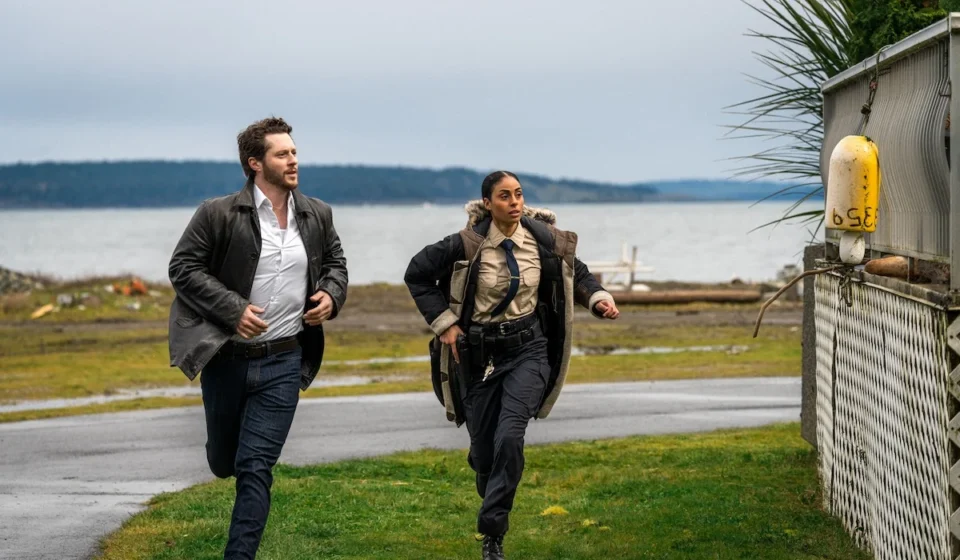
The investigation falls to two mismatched detectives: Carson (Clark Backo), a by-the-book local officer whose personal life remains a frustrating narrative void, and Rapp (Noah Reid), a private investigator brought in by the Park family to bypass local law enforcement.

A Study in Character Dynamics and Clichés
The chemistry—or lack thereof—between Carson and Rapp serves as the series’ primary, if somewhat tired, engine. Upon his arrival via helicopter, Rapp presents a caricature of the "cool" city detective: black skinny tie, leather jacket, and an unearned air of superiority. While Carson views the outfit with deserved skepticism, the series seems to want us to buy into the mystery of his character.
Rapp is insufferable by design. He is a man who operates outside the law, chasing personal theories and sleeping with suspects, all while maintaining a slick, faux-casual demeanor that the show insists is charming. When he arrives at the crime scene and immediately slips in the mud, it offers a fleeting moment of schadenfreude that the audience desperately craves. But as the episodes progress, the show fails to dismantle his ego. Instead, it allows his "magic" to continue unchecked.
The narrative choice to have Rapp charm the town’s women while constantly undermining the local police is a trope that feels outdated in 2026. If the series aimed to comment on the nature of toxic masculinity, it fails to provide the necessary counterweight. Carson, our supposed protagonist, remains a blank slate. Without a strong, grounding presence to challenge Rapp’s behavior, the show’s internal tension deflates, leaving the audience to wonder why they should care about the outcome of the case.
Supporting Data: The Atmosphere of the Occult
The show is not entirely without its high points. Carrie-Anne Moss provides a compelling, if underutilized, turn as Katherine, a professor who happens to be an expert on bones—and who has written a book titled Sexy Bones. Moss brings a level of gravitas and dry wit that Yaga desperately needs. Her interactions with the male characters, particularly the "fuckboys" that populate the town, are a welcome, if infrequent, highlight.
The aesthetic of the series attempts to bridge the gap between the mundane and the magical. There are moments of genuine intrigue: disturbing hallucinations, ominous, disembodied narration, and the recurring question of whether the town’s inhabitants are victims or predators. Are they helping the detectives, or are they leading them into a trap? By keeping these two interpretations alive, Sandler successfully maintains a level of mystery that keeps the viewer guessing, even if the surrounding drama lacks the same urgency.

Official Context and Production Background
Yaga is a product of the ongoing collaboration between Canadian streamer Crave and AMC+. Given the success of previous genre-bending projects in this partnership, expectations were high for a series that could balance social commentary with supernatural horror.
However, the execution feels stretched. At eight episodes, each clocking in at roughly 30 minutes, the series often feels like a feature-length film that has been artificially inflated. The pacing suffers, and the "whodunit" element drags, relying on crime drama tropes that feel worn out. The series seems to be building toward a grand commentary on the historical persecution of women and the danger of powerful, unchecked men, but the subtext is rarely given room to breathe. By the time the viewer reaches the end of the seventh episode—the last one made available for critical review—the feminist underpinnings feel more like an aesthetic choice than a cohesive argument.
Implications for Genre Television
The failure of Yaga to fully realize its potential highlights a recurring issue in contemporary streaming content: the "prestige" trap. By attempting to marry the grit of a police procedural with the abstract horror of folklore, the show ends up diluting both.
If a show is going to tackle the myth of Baba Yaga—a figure of profound, terrifying, and transformative power—it needs to be "weird." It needs to embrace the cauldron-bubbling, forest-dwelling absurdity of its namesake. Instead, Yaga remains grounded in the gray, rainy streets of a Canadian town, playing out a standard investigation that could have existed in any number of generic crime shows.
The series asks us to consider whether the "witchy" elements are real or merely a projection of a town’s collective guilt. While this is an intellectually stimulating question, it is not a particularly frightening or engaging one. The show lacks the "bewitching" quality required to hold the audience’s attention for eight weeks.

Final Assessment: A Missed Opportunity
Ultimately, Yaga is a series of incantations without the enchantment. It has the right ingredients—a talented cast, a compelling myth, and a stylish visual palette—but it lacks the cohesive spirit to bring them together.
For viewers hoping for a dark, folkloric deep dive, Yaga will likely prove a disappointment. It is a show that is constantly telling us how dangerous and mysterious its world is, while simultaneously playing it safe with traditional storytelling beats. As we look at the trajectory of the series, it serves as a reminder that tone is the most important element of any supernatural drama. If you cannot make the audience believe in the monster, the detective’s ego becomes the only thing left to look at—and that, as it turns out, is not enough to sustain eight episodes.
Grade: C
Yaga premieres Friday, October 23, on AMC+, with two episodes dropping at once. Subsequent episodes will be released weekly, concluding with a two-episode finale on Friday, November 27.