
The Ghost of Harrenhal: Unmasking the True Identity of Alys Rivers in ‘House of the Dragon’

Warning: This article contains major spoilers for the House of the Dragon Season 3 finale.
The sprawling, fire-drenched saga of House of the Dragon has never shied away from the supernatural, but with the conclusion of its third season, the series has pivoted from political maneuvering to something far more ancient and eldritch. After two seasons of ambiguity, the Season 3 finale has finally pulled back the veil on one of the most enigmatic figures in the Game of Thrones universe: Alys Rivers. Played with haunting intensity by Gayle Rankin, the "witch of Harrenhal" has finally revealed the origin of her unnatural longevity, her mystical tether to the Riverlands, and her role as a silent architect of the Targaryen downfall.
The Core Revelation: A Century of Silence
For seasons, fans have speculated whether Alys Rivers was a forest witch, a Targaryen bastard, or simply a figment of the protagonists’ fractured psyches. The Season 3 finale provided the long-awaited clarification, though it arrived in the form of a devastating, melancholic confession.
During a pivotal exchange with a desperate, self-loathing Aemond Targaryen, Alys revealed that she is not merely a healer or a seer. She is, in fact, a remnant of the tragedy that birthed the legend of Harrenhal itself. Over a century ago, when Aegon the Conqueror descended upon the fortress on the back of the dragon Balerion the Black Dread, he incinerated Harren the Black and his entire line. History books in the world of Westeros suggest that Harren’s line was completely extinguished. Alys’ revelation corrects this: she was a mother to an infant son, a secret heir to the House of Harren.

In her final scene of the season, Alys recounts the futile, desperate "older cures" and forbidden incantations she employed to save her dying child from the fires of the dragon. Her failure to save him left her cursed—a specter anchored to the stone walls of Harrenhal, destined to serve as a perpetual witness and counselor to whoever occupies the seat of the ruined castle.
Chronology of a Cursed Existence
To understand the gravity of this reveal, one must look at the timeline of Alys’s influence on the current conflict:
- The Age of Conquest: Alys lived through the fall of Harrenhal at the hands of the Targaryens. Following the death of her son and her own failed attempts at salvation, she became a permanent, spectral fixture of the castle, existing outside the normal flow of time.
- Season 2 – The Daemon Influence: Alys first appeared as a guide to Daemon Targaryen, leading him through a series of psychological trials. She facilitated the visions that culminated in Daemon seeing the rise and fall of Daenerys Targaryen, subtly influencing the Rogue Prince’s perspective on the Iron Throne.
- Season 3 – The Aemond Connection: Following a similar pattern to her work with Daemon, Alys began to manipulate the psyche of Aemond Targaryen. By preying on his guilt regarding his kinslaying and his insecurity, she effectively "claimed" him as the latest lord of the castle she is bound to serve.
- The Finale – The Truth Unveiled: As the chaos of the Battle of Tumbleton unfolds, Alys sheds her mask. She confronts Aemond with the truth of her immortality, framing their relationship not as a casual alliance, but as a predestined cycle of service and suffering.
Supporting Data: Lore Divergence and the "Fire & Blood" Canon
The revelation surrounding Alys Rivers represents one of the most significant departures from George R.R. Martin’s source material, Fire & Blood. In the novel, Alys is widely believed to be an illegitimate daughter of Lord Lyonel Strong, the former castellan of Harrenhal. However, Martin writes from the perspective of "unreliable narrators"—maesters and court gossips who often speculate on events they did not witness.
The showrunners have opted for a more metaphysical interpretation. By linking Alys to the original tragedy of Harrenhal, the series elevates her from a minor historical footnote to a primary antagonist—or perhaps, a neutral force of nature—who represents the literal "curse" of the castle. This creative choice aligns with the show’s recurring theme that the architecture of Westeros, particularly the cursed, blood-soaked stones of Harrenhal, possesses an agency of its own.

Official Responses and Creative Direction
While HBO has remained tight-lipped regarding the specific mechanics of Alys’s "curse," the show’s creative team has previously emphasized that the House of the Dragon narrative would lean into the magical undercurrents of the Targaryen era.
In post-finale interviews, showrunners have hinted that Alys is meant to serve as a mirror for the Targaryen Princes. Where Daemon and Aemond seek power, Alys represents the cost of that power. Her presence in the narrative is a constant reminder of the "Sins of the Father" motif. By making her a survivor of the Conquest, the writers have successfully bridged the gap between the era of Aegon I and the Dance of the Dragons, reminding the audience that the Targaryen dynasty was built on a foundation of ash and ghosts.
Implications for Season 4: The Final Reckoning
The Season 3 finale concludes on a cliffhanger that sets the stage for a tumultuous final season. The arrival of Aegon II on the back of his dragon, Sunfyre, disrupts the uneasy equilibrium established between Alys and Aemond.
1. The Power Struggle at Harrenhal
With the rightful King now physically present in the same location as the man who has been acting as his regent, the tension at Harrenhal will likely explode. Alys, having tethered herself to the "lord" of the castle, now finds herself in a position of supreme influence. Will she play the two brothers against one another, or is she the true power broker of the Riverlands?
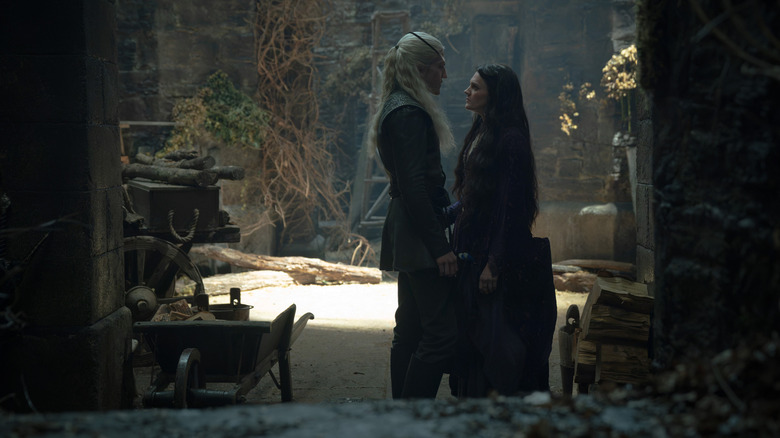
2. The Nature of the Curse
The implication that Alys is bound to serve the castle’s inhabitants suggests a "Faustian" dynamic. If Alys made a bargain to prolong her life or to attempt to cheat death, the cost of that bargain is likely coming due. As the war approaches its zenith, the series must address whether Alys can ever be free of her tether, or if her ultimate goal is to see the Targaryen line suffer a fate similar to that of her own house.
3. A Departure from Prophecy
Alys’s knowledge of the past—specifically the fall of her own son—suggests that she possesses a form of foresight that is arguably more accurate than the Targaryen dreams. If she is indeed an elemental entity of the castle, her influence could shift the outcome of the war entirely. The writers have signaled that in the final season, the "Game" is secondary to the "Blood and Fire." Alys Rivers is the living manifestation of that blood and fire.
As House of the Dragon prepares to enter its fourth and final chapter, the reveal of Alys Rivers’ backstory serves as a grim reminder that in Westeros, history is never truly dead. It is merely waiting in the ruins of Harrenhal, watching for its moment to settle the score. Fans must now wait to see if the "Witch of the Riverlands" will be the architect of the Targaryen restoration or the final nail in their dragon-forged coffin.