Shadows in the Fog: Phuttiphong Aroonpheng’s ‘The Burning Giants’ and the Cinema of Displacement

The Venice Film Festival has long served as a prestigious stage for the avant-garde, and this year’s Orizzonti sidebar was no exception. Among the most anticipated entries was The Burning Giants, the third feature film from Thai visionary Phuttiphong Aroonpheng. Following the critical success of his 2018 debut Manta Ray, which took home the top prize in the same section, Aroonpheng returns with a work that is as visually intoxicating as it is narratively challenging. The Burning Giants is a woozy, dystopian mystery that blurs the lines between political reality and mythological fable, solidifying Aroonpheng’s position in the "post-Apichatpong Weerasethakul" wave of Thai cinema—a movement characterized by cryptic storytelling, lush landscapes, and a deep-seated preoccupation with the ghosts of the nation’s past.
Main Facts: A Dystopian Vision of Ancestral Loss
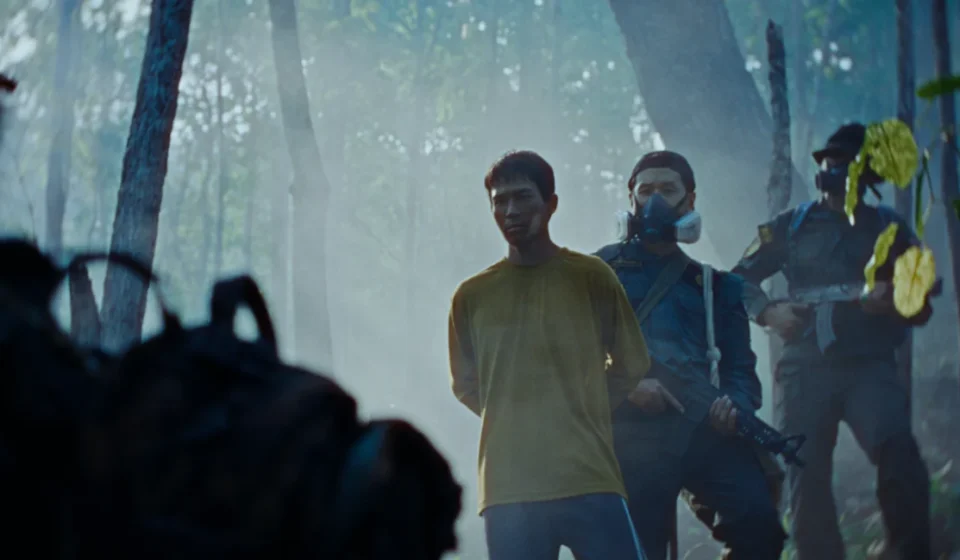
The Burning Giants presents a world shrouded in a literal and metaphorical haze. Captured by cinematographer Emo Weemhoff in what can only be described as a menacing "ayahuasca haze," the film utilizes fog-strewn forests and liquidy purple skies to create an atmosphere of constant disorientation. The story, or rather the "breadcrumbs of a story," centers on the violent ousting of indigenous people from their ancestral lands, a theme that resonates deeply within the current Thai sociopolitical climate.
The film stars Awat Ratanapintha as Yak, a man caught in the crosshairs of a mysterious environmental and political catastrophe. Supporting performances by Pakapol Srirongmuang (Lak), Phunthida Phairuangkij (Aepoh), and Waywiree Ittianunkul (Aeva) weave together a tapestry of displacement that moves from the rugged mountains to the sterile, indifferent urban centers of Thailand.
While the film has been praised for its aesthetic audacity and defiant refusal to "hand-hold" the viewer, it has also faced criticism for its "arcane worldbuilding" and a rhythm that some critics found to be "weirdly flat." Despite these divisive reactions, The Burning Giants remains a significant work of political art, drawing its primary inspiration from a tragic real-world event: the 2014 disappearance and murder of indigenous rights activist Porlajee "Billy" Rakchongcharoen.
Chronology: From Mountain Strongholds to Urban Afterlives
The narrative structure of The Burning Giants is intentionally fragmented, mirroring the fractured lives of its protagonists. The film unfolds in three distinct yet overlapping movements:
1. The Mountain Siege and the Toxic Fog
The film opens in a purgatorial hillside where Yak, a man presumed to be "infected," scurries through the underbrush. He is pursued and eventually detained by armed mountain police clad in gas masks—an image that immediately invokes a sense of totalitarian dread. The world is plagued by a mysterious sickness caused by a toxic fog that burns the skin upon contact. While Yak shows signs of mild discoloration, the film provides a visceral contrast in the form of a police officer whose body is covered in raw, bubbling blisters, seen in agonizing close-up. This segment concludes with the state-sanctioned burning of a cottage, an act of arson that serves as a chilling metaphor for ethnic cleansing.
2. The Displacement and the City
Just as the viewer settles into the rhythm of a totalitarian thriller, Aroonpheng executes a "hard pivot." The film shifts focus to Lak, a young, somewhat clueless policeman, and his romance with Aepoh, a woman who is later revealed to be a victim of the very mountain clearings Lak’s unit oversees. This section moves into naturalistic vignettes of urban life. Aepoh works a market stand, navigating a world that feels alien to her. Simultaneously, we follow Aeva, another Karen woman, who works as a nanny for a wealthy middle-class family while her own child remains in a makeshift daycare. These sequences explore the "afterlives" of the dislocated, illustrating the quiet, weary nature of their forced assimilation into a society that views them as "other."
3. The Mythological Descent
In its final movement, the film winds back up the mountain. Aeva searches for Yak amidst the ruins of their decimated village. Here, the narrative dissolves into a surreal, misshapen web. Accompanied by the haunting, mystic score of Christine Ott and Mathieu Gabry, the film enters a hidden world of ancient Thai deities residing within the mountain’s caves. Warriors in golden light glide through the shadows until a tusked ogre escapes into the "civilized" world. This supernatural register serves as a final, painful metaphor for the cycle of assimilation and the loss of cultural identity.
Supporting Data: The Real-World Tragedy of Porlajee "Billy" Rakchongcharoen
To understand the weight of The Burning Giants, one must look at the historical context that birthed it. Phuttiphong Aroonpheng has explicitly stated that the script was inspired by the 2014 murder of Porlajee "Billy" Rakchongcharoen.
Billy was a prominent leader and spokesperson for the Karen ethnic group, an indigenous community living in the Kaeng Krachan National Park in western Thailand. The Karen have inhabited these forests for generations, but their presence has long been a point of contention for the Thai State, which sought to clear the land for "conservation" purposes.
Timeline of the Billy Case:
- April 17, 2014: Billy was detained by park officials, led by then-park chief Chaiwat Limlikitaksorn, for allegedly being in possession of "illegal wild honey." He was never seen alive again.
- 2014–2019: For five years, the State denied any wrongdoing. Authorities claimed Billy had been released after a brief interrogation.
- September 2019: The Department of Special Investigation (DSI) found bone fragments inside a burnt oil drum submerged near a bridge in the national park. DNA testing confirmed the remains were Billy’s.
- September 2023: Nearly a decade after the crime, Chaiwat Limlikitaksorn was sentenced to three years in prison for misconduct related to the arrest, though he was initially acquitted of murder due to a "lack of evidence"—a verdict that sparked international outrage.
The "burning giants" of the film’s title likely refer to the massive trees of the Kaeng Krachan forest, but also to the "scorched earth" tactics used by the Department of National Parks, which reportedly burned down over 100 Karen houses and granaries in 2011 to force the community out.
Official Responses and Critical Reception
The reception of The Burning Giants at the Venice Film Festival was a mixture of awe at its technical prowess and frustration with its elliptical nature.
Critical Voices
The film has been described by Variety as a "bit of a letdown" compared to the more cohesive Manta Ray, citing a "weirdly flat rhythm" that occasionally dulls the impact of its narrative swerves. However, critics also acknowledged that the "disorientation isn’t without potency." The cinematography by Emo Weemhoff has been universally praised for its ability to transform the Thai landscape into a fever dream of purple and grey.
The "Slow Cinema" Debate
Aroonpheng’s work sits firmly within the "slow cinema" tradition. In Thailand, this style is often a necessity rather than just an aesthetic choice. Faced with strict censorship laws and a volatile political climate, filmmakers often use metaphor, mysticism, and "cryptic fables" to criticize the State without inviting direct retaliation. By framing the Karen struggle through a dystopian lens of "toxic fog" and "ancient deities," Aroonpheng bypasses the literal to reach a more profound, emotional truth about state violence.
Implications: The Future of Thai Political Cinema
The release of The Burning Giants comes at a pivotal moment for Thailand. As the country continues to grapple with the rights of indigenous groups and the legacy of military-backed governance, Aroonpheng’s film serves as a haunting reminder of those who have been erased.
1. Human Rights and Land Rights
The film highlights the ongoing struggle of the Karen people, who are currently fighting for Kaeng Krachan to be recognized not just as a UNESCO World Heritage site, but as a site of indigenous heritage where they have the right to live. The Burning Giants forces the audience to confront the human cost of "conservation" when it is used as a tool for displacement.
2. The Artistic Legacy of Displacement
Cinematically, the film suggests that the "post-Apichatpong" wave is evolving. While Weerasethakul’s work often feels like a gentle dream, Aroonpheng’s work is increasingly feeling like a nightmare. The Burning Giants suggests that for the displaced, there is no "clearing of the fog"—only a transition from one form of haunting to another.
3. Global Perspective vs. Local Context
The film’s refusal to "hand-hold" non-Thai viewers is a political statement in itself. It suggests that the tragedy of the Karen people does not need to be translated or simplified for a Western audience to be valid. However, as the film travels to other international festivals, the challenge remains: can a film so rooted in a specific, "arcane" local tragedy find the "fog-clearing" clarity needed to spark global action?
In conclusion, The Burning Giants is a difficult, beautiful, and ultimately mournful piece of cinema. It is a film that demands much from its audience, offering no easy answers and few narrative comforts. Yet, in its very opacity, it mirrors the experience of the marginalized—lost in a forest of state bureaucracy, shrouded in the fog of historical denial, and waiting for the giants to stop burning.