A Legacy Reimagined: Isabella Rossellini Reflects on Art, Nature, and the Locarno Excellence Award

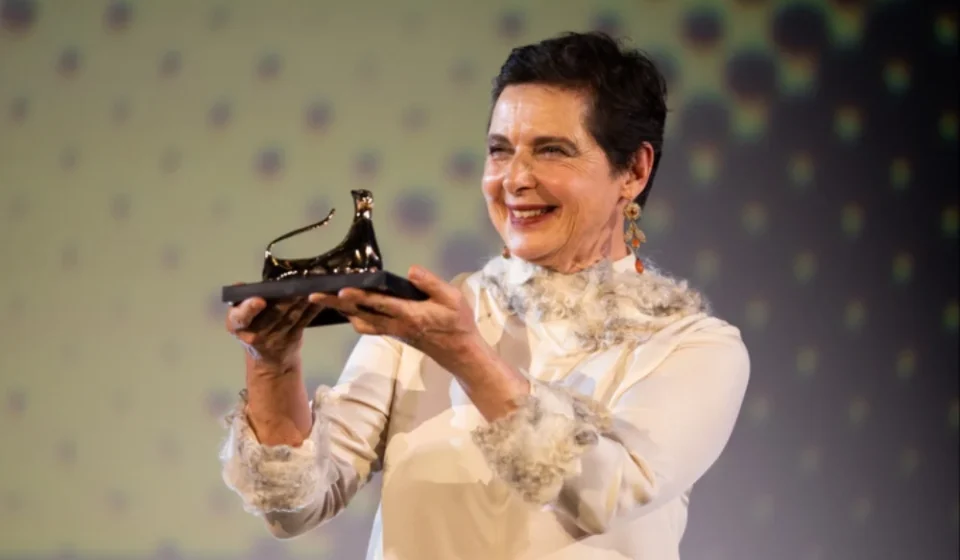
The Locarno Film Festival, a prestigious bastion of independent cinema nestled in the Swiss Alps, recently served as the backdrop for a poignant homecoming of sorts. Isabella Rossellini, an icon whose career has spanned high fashion, avant-garde cinema, and the rigorous academic pursuit of animal behavior, was honored with the festival’s prestigious Excellence Award.
For Rossellini, the recognition was not merely a professional milestone; it was a profound emotional bridge connecting her to her cinematic lineage. Standing before an audience during the festival’s opening ceremony, the actress, director, and conservationist reflected on the weight of the honor.
“The prize I’m receiving tonight is for excellence, which is something I haven’t heard very often,” she remarked with characteristic wit. “I’m very proud of it and, above all, so moved because my father received this back in 1948 for his film Germany, Year Zero. And then, four years ago, my brother Renzo [Rossellini], who was a great producer of Fellini and Scola. Being on par with my father and my brother fills me with so much emotion.”
The Chronology of a Multifaceted Icon
To understand Isabella Rossellini is to understand a life lived in chapters, each defined by a transition between her two primary passions: the performative arts and the natural world.
Early Beginnings and the Shadow of Giants
Born to two of the 20th century’s most towering figures—filmmaker Roberto Rossellini and actress Ingrid Bergman—Isabella did not immediately set out to conquer the silver screen. Her initial career path began behind the camera as a costume designer, working on her father’s projects. Her transition to acting was somewhat serendipitous, spurred by a desire for proximity to her mother rather than a burning ambition for stardom. When Bergman was cast in the film A Matter of Time, Rossellini took a small role simply to spend time with her mother, famously noting, “I didn’t think I would become an actress.”
The Modeling Years and the Crucible of Criticism
The road to acting was fraught with early professional setbacks. Discouraged by initial critical reception—most notably following her work in The Meadow—Rossellini pivoted to modeling and journalism. It was in the world of high fashion that she found an unexpected sanctuary. Under the lens of legendary photographer Richard Avedon, she learned the nuances of non-verbal storytelling.
“Models are like silent movie stars,” Avedon once told her. “You have no lines, but I shoot the emotion.” This period of her life provided the validation she needed to return to film, buoyed by the realization that her lineage was not a shackle, but a doorway.
The Lynchian Breakthrough
The mid-1980s marked a radical departure for Rossellini when she met director David Lynch. Their collaboration on the 1986 cult masterpiece Blue Velvet remains one of the most significant moments in modern film history. Rossellini recalls a humorous, almost surreal first meeting at a restaurant where, in a moment of irony, Lynch remarked that she looked like Ingrid Bergman. When informed of the truth, the interaction set the stage for one of cinema’s most intense director-actor partnerships.
Rossellini’s performance in Blue Velvet was not just a career-defining turn; it was a testament to her willingness to tackle controversy and ambiguity. “David was not so famous back then, and he really showed his mysterious world there,” she recalled. “The plot was not so important. Some hated it and some loved it.”
Scientific Curiosity: The Muse of the Animal Kingdom
Perhaps the most unique facet of Rossellini’s life is her pivot in middle age to formal academic study. Holding a master’s degree in Animal Behavior and Conservation, Rossellini has successfully bridged the gap between scientific inquiry and artistic expression.
Her web series, Green Porno and Seduce Me, are perhaps the most singular examples of her "no-tech" philosophy. By focusing on the bizarre and beautiful mating rituals of the animal kingdom, she has managed to educate and entertain while maintaining an aesthetic that harkens back to the pioneer of special effects, Georges Méliès.
Biology as Inspiration
During her masterclass at Locarno, Rossellini emphasized that her artistic choices are driven by a genuine fascination with biological diversity rather than a desire to make overt political statements.
“I am just fascinated by biology and diversity,” she explained. “When someone says: ‘It’s against nature to be gay or trans’—it’s not! I don’t sit down to write something political or poetic, but I discover that some worms are hermaphrodites. I am just always so surprised. That’s my inspiration—not politics.”
This scientific grounding has provided her with a unique perspective on human existence. By observing the natural world, she finds refutations for human prejudices, presenting biology as a vast, complex, and inclusive spectrum.
Supporting Data: A Career of Versatility
Rossellini’s filmography is a tapestry of varied experiences, ranging from the experimental to the mainstream. Her resume includes collaborations with industry titans such as Robert Zemeckis, David O. Russell, Taylor Hackford, and James Gray.
Her recent work continues to garner critical acclaim, proving that her artistic evolution is far from complete. Her nomination for an Academy Award as Best Supporting Actress for Edward Berger’s Conclave stands as a recent testament to her enduring relevance. Reflecting on her professional philosophy, she notes, “I never think about someone’s ‘style.’ I think about what I want to say.”
Official Responses and Personal Reflections
Throughout the Locarno festival, the tone of the conversations surrounding Rossellini was one of reverence. The Excellence Award is not just a nod to her past performances, but an acknowledgment of her contribution to the global cinematic discourse.
However, even in the midst of celebration, the realities of the outside world weigh heavily on her. As a resident of the United States, she is not immune to the anxieties of the current political climate. Yet, her commitment to her farm and her animals—a grounding force in her life—keeps her anchored. “We are thinking of going back, but I have sheep, I have land. Should I abandon everything? I just hope things will improve,” she shared.
Implications for the Future
As Rossellini looks toward the future, she expresses a desire to focus more heavily on directing. She approaches this new chapter with the same humility and self-reflection that has characterized her entire career.
“The thing is, I did everything late,” she admits. “I became a director in my 50s. I would have liked to start everything earlier, because I am always 10 years too late!”
Despite her playful self-deprecation, the implications of her career path are clear: Isabella Rossellini serves as a vital reminder that one’s life trajectory is never fixed. Whether through the lens of a camera or the study of a species, she has demonstrated that curiosity is the most potent engine of creativity.
Her presence at Locarno served to remind the industry that excellence is not just about the technical mastery of a craft, but about the intellectual and emotional integrity one brings to their work. As she moves forward into her next projects, the cinematic world watches with the anticipation that has followed her for over four decades, eager to see what new, strange, and beautiful truths she will uncover next.