
By Editorial Staff
November 16, 2026
The cinematic landscape of 2026 has been marked by a singular, ambitious undertaking: the dual-feature exploration of Charles de Gaulle, the man who stood as the bedrock of French resistance during the Second World War. With the release of the final US trailer for De Gaulle – Part II: Liberty, Samuel Goldwyn Films has signaled the impending conclusion of a historical epic that has already garnered significant attention since its premiere at the 2026 Cannes Film Festival. Directed by the acclaimed Antonin Baudry, this two-part project—comprising Resistance and Liberty—represents one of the most comprehensive portrayals of the French statesman ever committed to film.
The Man Behind the Myth: Understanding the Scope
To understand the gravity of Baudry’s work, one must first appreciate the magnitude of the subject matter. Charles de Gaulle is not merely a political figure in France; he is a symbol of national survival. De Gaulle – Part II: Liberty, which arrives in US theaters and VOD platforms on December 4, 2026, focuses on the climax of this struggle: the liberation of France, the D-Day invasion, and the complex political maneuvering required to establish a provisional government.
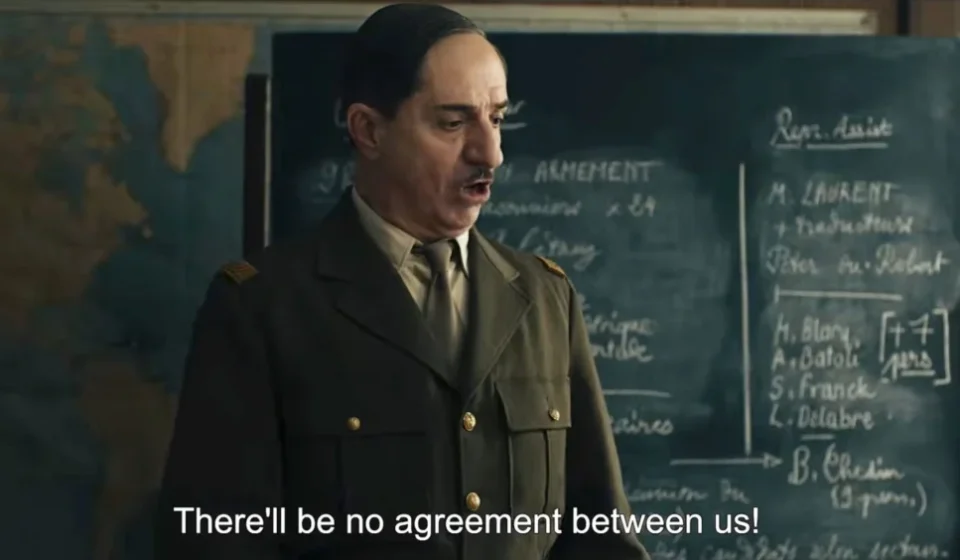
Starring Simon Abkarian, whose performance has been described by critics as both commanding and deeply introspective, the film chronicles the transition from a government-in-exile to a reclaimed sovereign nation. The narrative does not shy away from the friction between De Gaulle and the Allied leaders, specifically highlighting the precarious diplomatic dance with Winston Churchill and Franklin D. Roosevelt. As the final trailer underscores, the film is framed not just as a war movie, but as a study of leadership under the most extreme pressures of the 20th century.
A Chronology of Conflict: From Collapse to Liberation
The narrative arc of the duology is structured to mirror the real-time degradation and subsequent resurgence of the French state.

Phase One: The Collapse (1940)
The story begins in June 1940, a moment of profound national trauma. As France falls to the Nazi advance and signs the armistice, the film captures the isolation of De Gaulle. Alone, without an army, and lacking the support of a paralyzed political establishment, he flees to London. This segment, explored in Part I: Resistance (titled Tilting Iron in France), documents the birth of the "Free French" movement. It is a story of an "irrational conviction"—the belief that a nation’s soul is not found in its borders, but in the refusal to surrender.
Phase Two: The Resurgence (1944)
Part II: Liberty (titled The Sovereign Edge in France) picks up the thread as the tide of the war begins to shift. This is the "General’s war"—a period defined by the logistical and political challenges of the D-Day landings. The film details the internal French struggle as De Gaulle battles to maintain the legitimacy of his leadership against political rivals such as General Henri Giraud, played with nuanced coldness by Thierry Lhermitte.
The military subplot is equally gripping, focusing on the exploits of General Leclerc (Niels Schneider). The inclusion of the L Force’s daring campaigns against the German Panzerarmee in southern Tunisia—specifically at the Mareth Line and Ksar Ghilane—adds a visceral, tactical layer to the film that elevates it above a standard political biopic.
Supporting Data: Production and Creative Vision
The scale of this production is substantial, reflecting the high stakes of its subject. Antonin Baudry, who previously stunned audiences with his 2019 directorial debut The Wolf’s Call (Le Chant du Loup), has once again proven his ability to handle high-tension, large-scale narratives.
- Directorial Approach: Baudry utilizes a grounded, almost documentary-like intensity. By working from scripts written by Bérénice Vila and himself, he has crafted a narrative that relies heavily on the historical documentation provided by Julian Jackson’s definitive biography, De Gaulle: A Certain Idea of France.
- The Cast: Simon Abkarian’s transformation into De Gaulle is supported by a robust ensemble cast. The chemistry between Abkarian and Lhermitte is the film’s emotional anchor, representing the fundamental conflict between those who viewed the war as a matter of military survival and those, like De Gaulle, who viewed it as a matter of national identity.
- Release Strategy: Samuel Goldwyn Films has opted for a staggered release, allowing audiences to digest Resistance (released November 6, 2026) before confronting the high-octane political resolutions of Liberty in December.
Official Responses and Critical Reception
Since the premiere at Cannes, the critical discourse has been largely favorable, with particular praise directed toward the film’s avoidance of hagiography. While the film is undeniably patriotic, it does not paint De Gaulle as a flawless figure. Instead, the "official" portrayal—if one can call it that—is one of a man burdened by the necessity of being difficult.

"The secret army is rising and will soon strike," the trailer promises, a line that encapsulates the film’s tone: urgent, defiant, and deeply rooted in the philosophy of the resistance. Audiences who viewed the early French screenings have noted that the film’s success lies in its ability to balance the global geopolitical stage with the intimate, often agonizing decisions of the men in the field.
The Implications of a Modern Historical Epic
Why does a two-part, multi-hour film about a mid-20th-century French general resonate in 2026? The implications of De Gaulle extend beyond the historical. In an era where global alliances are being re-evaluated and the concepts of national sovereignty are constantly in flux, the film serves as a mirror.
1. The Lesson of Leadership
The film posits that true leadership often requires being the most unpopular person in the room. By showcasing De Gaulle’s defiance of both the Nazi occupiers and his own uneasy allies, the film highlights the cost of maintaining a "certain idea of France."
2. The Mechanics of Resistance
The film effectively demystifies the "Resistance." It shows it not as a monolithic force, but as a fractured collection of students, soldiers, and rebels, all connected by a shared thirst for liberty. This provides a contemporary audience with a look at how grassroots movements can, under the right leadership, sway the outcome of global conflicts.
3. The Future of the Biopic
Baudry’s approach—splitting the narrative into two distinct, thematic halves—challenges the traditional constraints of the biopic. By refusing to condense the life of a titan into a single two-hour window, the filmmakers have allowed for a level of character development that is rare in modern historical dramas. It is a model that may well influence how studios approach complex historical figures in the future.

Conclusion: A Must-Watch for History Enthusiasts
As the year draws to a close, De Gaulle – Part II: Liberty stands as the final major historical event on the cinematic calendar. It is a film that demands attention, not only for its technical prowess and the sweeping scale of its production but for the questions it raises about the nature of courage.
Whether you are a student of history, a fan of political thrillers, or simply an admirer of high-stakes drama, the conclusion of Antonin Baudry’s epic is an essential viewing experience. As the dust settles on the battlefields of Tunisia and the provisional government takes its first uncertain steps in Paris, the audience is left with a singular, lingering thought: how many individuals does it take to save a nation? According to this film, it starts with one man’s irrational conviction that the battle is neither over, nor lost.
De Gaulle: Resistance is currently available in theaters and on VOD. De Gaulle – Part II: Liberty follows on December 4, 2026. For those looking to prepare, the initial French trailers and the newly released US trailer provide a comprehensive glimpse into the visual and narrative intensity that awaits. As the tagline suggests: "The Resistants must unite." In 2026, the story of De Gaulle is not just being retold—it is being redefined.