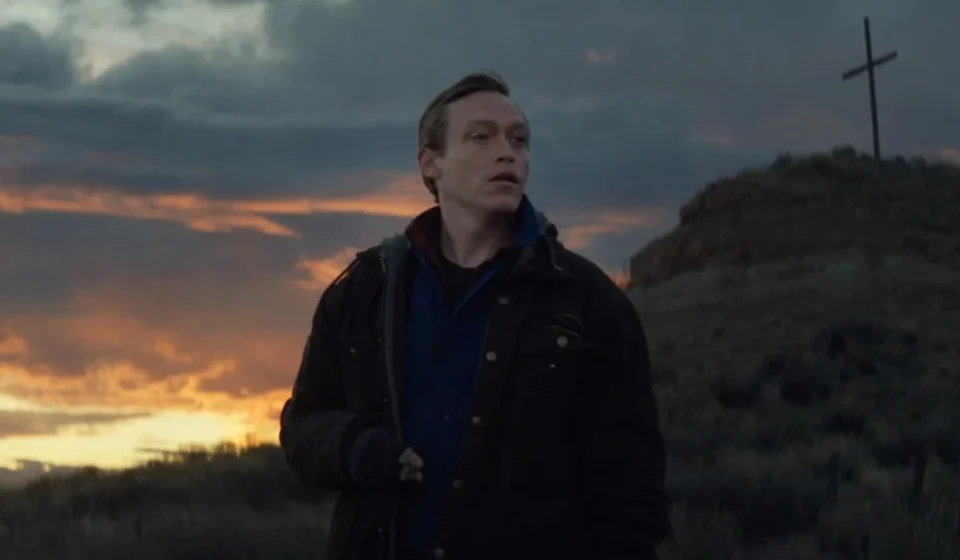
The Anatomy of Decency: Caleb Landry Jones and the Moral Fractures of Modern America in ‘Down the Arm of God’

LOCARNO — In the landscape of contemporary cinema, few actors have cultivated a reputation for the unsettling quite like Caleb Landry Jones. From his breakout role as a sneering white supremacist in Jordan Peele’s Get Out to his harrowing, Cannes-winning portrayal of mass murderer Martin Bryant in Nitram, Jones has become the go-to vessel for characters defined by their alienation, volatility, and moral decay. However, at the recent world premiere of Down the Arm of God in Locarno’s prestigious Piazza Grande section, audiences were introduced to a radical departure for the actor: a man of quiet, unwavering, and increasingly desperate decency.
Directed by Austrian filmmaker Peter Brunner and co-written by Jones himself, Down the Arm of God is a searing social drama that uses the microcosm of a small Texas town to examine the macro-crises of the United States. It is a film that begins as a delicate, observational study of faith and poverty before spiraling into a heated, politicized melodrama that mirrors the very divisions it seeks to critique.
Main Facts: A Subversion of Persona and Setting
Down the Arm of God represents the second collaboration between Caleb Landry Jones and Peter Brunner, following their 2018 psychodrama To the Night. This latest project, however, carries the weight of a personal manifesto. Produced in part by French titan Luc Besson—who also directed Jones in the upcoming Dracula—the film is a French-American co-production that seeks to bridge European arthouse sensibilities with the raw, aesthetic grit of the American South.
The narrative centers on Nick (Jones), a young, idealistic priest assigned to a parish in the Texas Panhandle. Unlike the grotesque or villainous figures Jones is known for, Nick is a character defined by his "common decency." Yet, as the film unfolds, Brunner and Jones posit a troubling thesis: in an increasingly individualistic and divided America, decency is neither common nor particularly welcome.
The film’s backdrop is a squat, featureless town characterized by "freeze-dried lawns and stripped, skeletal trees," captured in ironic widescreen grandeur by cinematographer Peter Flinckenberg. The setting serves as a visual metaphor for the spiritual and economic stagnation of the region, where the radiant winter light provides a cold, piercing beauty that offers no actual warmth to the town’s most vulnerable inhabitants.
Chronology: From Outreach to Outrage
The narrative trajectory of Down the Arm of God is split into two distinct movements, shifting from documentary-style realism to high-stakes social conflict.
The First Act: The Ministry of the Marginalized
The film opens with Nick’s arrival in the Panhandle, a transition marked by the "face-slapping cold" of a Texas winter. Assigned by the Church to a congregation of insular, white Christian conservatives, Nick initially attempts to bridge the gap between his sermons and the reality of the town’s outskirts. He discovers a makeshift settlement of homeless individuals struggling to survive the elements.
Among them is Raven, portrayed by newcomer India Marie Cross in a performance critics are calling a "superb discovery." Raven is the uncompromising leader of this displaced community, wary of the young priest’s intentions. The first half of the film meticulously charts Nick’s efforts to earn their trust, employing a "documentary-infused observational drama" style reminiscent of Chloé Zhao’s early work (Songs My Brothers Taught Me, The Rider).
The Second Act: The Sanctuary Conflict
The inciting incident occurs as temperatures drop to life-threatening levels. Nick, realizing that his congregation’s charity has strictly defined boundaries, proposes a radical solution: sheltering the homeless community inside the town gymnasium or the church itself.
This proposal is met with a wall of "NIMBYism" (Not In My Backyard) and thinly veiled racial prejudice. The opposition is led by an "ultra-Aryan" couple, Anna (Mena Suvari) and Chris (Nick Stahl), who represent the most hostile elements of the parish. When Nick chooses to override the will of his donors and moves the homeless into the "House of God," the film segues into a "violently heated, politicized melodrama." The war of words inevitably escalates into physical confrontation, involving "very American weapons" and testing Nick’s commitment to "turning the other cheek."
Supporting Data: Production Context and Social Realism
The authenticity of Down the Arm of God is bolstered by its production choices. This was a "passion project" for Jones, who not only co-wrote the script but also brought his father, John Jones, into the production for a brief but pivotal cameo. This personal investment is reflected in the film’s "worn, steadfast integrity," which keeps the narrative grounded even when the script veers into polemical territory.
Cinematic Language
Cinematographer Peter Flinckenberg utilizes the widescreen format not to romanticize the Texas landscape, but to emphasize the isolation of the characters within it. The contrast between the "radiant winter light" and the "squat, featureless" architecture highlights the disconnect between the town’s professed Christian values and its cold reality.
Social Underpinnings
The film concludes with a series of title cards regarding the homelessness crisis in the United States—a move that anchors the fictional drama in contemporary statistics. According to the U.S. Department of Housing and Urban Development (HUD), homelessness increased by 12% between 2022 and 2023, reaching record highs. By framing the story around a "settlement on the edge of the parish," Brunner highlights the "desperate economic inequality" that defines the MAGA era, viewed through the "skeptical outsider’s eye" of an Austrian director.
Official Responses: Critical Reception at Locarno
The reaction following the Locarno premiere has been largely positive regarding the performances, though critics have noted a shift in the film’s tonal consistency.
The Performance of Caleb Landry Jones:
Critics have praised Jones for his restraint. After a career of "playing men not to be touched with a ten-foot pole," his portrayal of Nick is seen as a revelation of his range. Variety noted that the film is "kept on track by the worn, steadfast integrity of Jones’s performance," suggesting that his star power will be the primary driver for the film’s distribution.
The Narrative Shift:
While the first half of the film earned comparisons to high-end social realism, the second half has been described as "less convincing" due to its reliance on "flatly hateful stereotypes." The characters of Anna and Chris (Suvari and Stahl) have been criticized as being "nuanceless antagonists," which some feel robs the drama of its complexity. However, others argue that in the current "fractious era," such polarization is a realistic reflection of the American political climate.
Commercial Prospects:
Industry analysts expect the film to secure "arthouse distribution or a streaming deal on both sides of the Atlantic," thanks in part to the involvement of Luc Besson and the cachet of the Locarno premiere. However, its "stolid, downbeat nature" may limit its appeal to broader audiences, positioning it more as a "moving PSA" or a "work of urgent polemic" rather than a traditional blockbuster.
Implications: Faith and Friction in the Modern Era
Down the Arm of God serves as a stark reminder of the limitations of institutional religion when it clashes with political identity. The film suggests that the "foundational democratic values" of the United States have been compromised by "bitter ongoing conflicts of race and class."
The "Outsider" Perspective
By having an Austrian director (Brunner) interpret the Texas Panhandle, the film provides a "skeptical outsider’s view of the land of the free." This perspective allows for a critique of American "individualism" that might feel too close to home for a domestic director. It highlights how "racially coded prejudice" can be disguised as "community safety" or "parish tradition."
The Evolution of the "Social Drama"
The film’s transition from a character study to a "war of words and weapons" reflects a broader trend in cinema where the personal is inherently political. Like other recent works such as Civil War or The Florida Project, Down the Arm of God refuses to let its audience remain comfortable. It posits that in a world where "the time taken to see your opponent’s side might come at the expense of someone more worthy of grace," the act of being a "good man" is a revolutionary, and potentially dangerous, choice.
Ultimately, Down the Arm of God is a testament to Caleb Landry Jones’s evolution as an artist. By stepping away from the "harvester of disease" and the "white supremacist" archetypes, he has found perhaps his most challenging role yet: a man trying to be decent in a world that has forgotten how to be. As the film prepares for its international rollout, it stands as a grim, beautifully shot, and urgent reflection of a nation at a moral crossroads.