The Architecture of Absence: Beatrice Gibson’s At Night Redefines Autofictional Cinema

“I am a tone of voice.”
These words, projected onto the screen in stark, silent typography, serve as the evocative threshold for Beatrice Gibson’s latest feature, At Night. The statement is more than a mere opening line; it is a declaration of intent. Borrowed from the work of poet Alice Notley—specifically her feminist epic The Descent of Alette—the phrase anchors a film that oscillates between the tactile reality of the street and the ethereal, fragmented nature of human consciousness.
Gibson, a filmmaker whose career has been defined by the sophisticated appropriation of radical literary voices, has crafted a work that defies traditional genre categorization. By weaving together the disparate threads of Notley’s poetry, the avant-garde spirit of Kathy Acker, and the lived experiences of a diverse chorus of women, At Night emerges as a profound, if melancholic, meditation on the impossibility of a monolithic "womanhood."
The Genesis: From Poetry to the Moving Image
The Descent of Alette is a seminal text in feminist literature, renowned for its radical subversion of grammar. Its stanzas are punctuated by quotation marks that bifurcate almost every phrase, a rhythmic, stuttering device that forces the reader to confront the mechanics of language. In At Night, Gibson engages with this text not through literal adaptation, but through a structural dialogue.
When Notley’s voice is eventually heard, the rigid, visual punctuation of the poem evaporates. The words are instead batched in near-subliminal, fluid sequences, suggesting that the poem’s true power lies in its sonic vibration rather than its ink-on-page geometry.
Gibson is no newcomer to this practice of literary excavation. Her previous films have served as vessels for the words of CA Conrad and Eileen Myles, treating literature as a raw material for cinematic inquiry. In At Night, she expands this methodology to include fragments of Kathy Acker’s Don Quixote. The film’s subterranean imagery—shot with painterly precision by Ben Rivers—recalls the "man in the subway" from Notley’s poem, effectively transforming the London transit system into a liminal, mythical underworld.
Chronology of a Wandering Soul
The film’s narrative—if one can call it that—follows B, a character portrayed by Gibson herself. B is an artist and mother, caught in the grueling, isolating process of location scouting for a film that feels perpetually just out of reach.

The Scouting Phase
The opening act depicts B navigating the city, distanced from her partner and child. This state of professional and domestic displacement renders her despondent. In a revealing voicemail, she confesses a profound creative malaise: she has mastered the art of the "good image," yet she remains haunted by the feeling that she has found nothing of substance. "It is easy to make good images," she remarks with a blend of fatigue and self-awareness.
The Encounter
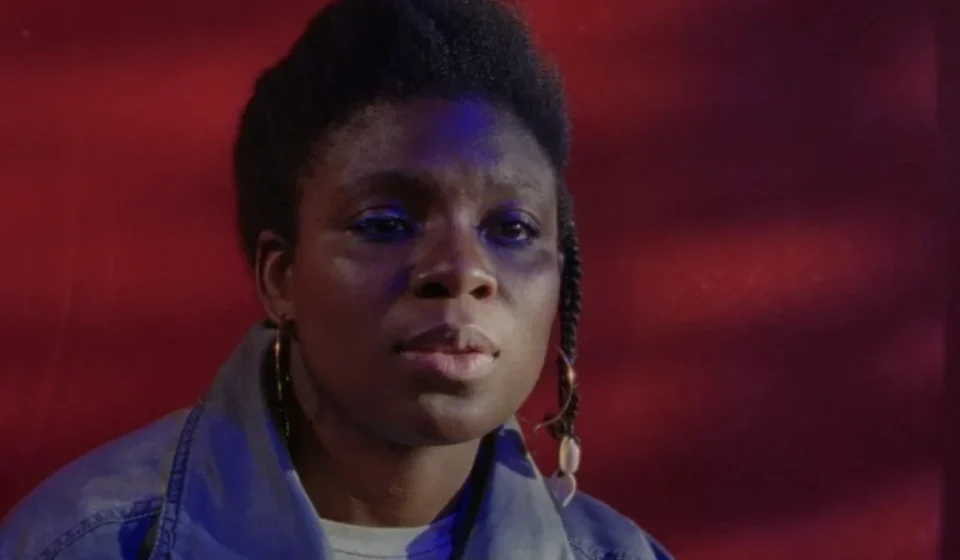
The narrative shifts when B encounters Didi (Diocouda Diaoune), an immigrant and single Black mother. Their relationship is the film’s moral and intellectual fulcrum. Once close, they are now separated by the vast, often invisible chasms of race and class. A chance meeting at a convenience store forces a confrontation that neither woman can fully resolve. When B attempts to voice her "white guilt" regarding her relative success, Didi’s retort is devastatingly sharp: "You think you win, and you think I lose… but I don’t see the point of playing a game where you’re always winning."
The Expansion
As the night deepens, the film moves away from the dyad of B and Didi, expanding into a chorus of six women. This ensemble—comprising psychologists, sex workers, mothers, and artists—forms the heart of the film. The central set piece is a ten-minute conversation held at a restaurant, captured with a handheld, restless camera that mimics the spontaneity of a Frederick Wiseman documentary.
Supporting Data: The Craft of Intimacy
The success of At Night hinges on its commitment to what might be termed "autofictional realism." While the film is meticulously planned in pre-production, the execution feels accidental, almost eavesdropped.
- The Soundscape: The audio design is as vital as the cinematography. Elvin Brandi’s score, which mimics the screeching, metallic dissonance of the metro, provides a rhythmic backdrop to the women’s conversations.
- The Absence: The film’s most powerful presence is, paradoxically, an absence. Alice Notley was intended to appear on screen, but her physical unavailability adds a layer of spectral longing to the project. Her voice haunts the film, appearing diegetically rather than as a standard voiceover.
- The "Big Light": One of the most resonant motifs in the film is the discussion of being seen naked under a bedroom’s "big light." This mundane, domestic detail serves as a metaphor for the harsh, unflinching way society observes and judges women’s bodies.
Official Responses and Festival Reception
At Night has garnered significant critical attention during its 2026 festival run. Following its premiere at the Locarno Film Festival, it made a strong impression at the Toronto International Film Festival.
Critics have praised Gibson’s ability to balance high-concept literary theory with raw, human vulnerability. While some viewers may find the lack of a traditional plot alienating, the consensus among independent film circles is that At Night represents a significant evolution in the essay-film format. As of late 2026, the film is actively seeking U.S. distribution, with industry insiders anticipating a limited theatrical release in the coming months.
Implications: The Failure of the Sanctuary
Perhaps the most significant aspect of At Night is its refusal to provide a tidy conclusion. There is a persistent, underlying hope in the film that women might find a unifying, divine space—a gender-separatist sanctuary where their shared experiences could dissolve their differences.

However, as the light shifts and the night extends, this hope dissolves. Gibson makes it clear that there is no "monolithic womanhood." The disparate identities of her subjects—defined by their varying access to power, resources, and freedom—cannot be collapsed into a single, harmonious image.
Instead, the film acts as an invitation to wander. By including the queer, defiant perspective of the artist Adam Christensen—who performs under the alter ego Madam—Gibson acknowledges that the "woman’s experience" is not a closed circle. When she includes Christensen’s account of being harassed for his gender expression, she forces the viewer to acknowledge that the struggle for space and self-definition is a human project, not merely a gendered one.
The film ultimately lands on the second half of the Notley quote, a mantra of inclusion that defines the film’s sprawling, kaleidoscopic nature: "Warming, shifting, pausing, changing, including, asserting, exulting, including, including, turning and including."
Beatrice Gibson has not created a film that answers the question of what it means to be a woman; she has created a film that honors the messy, contradictory, and beautiful process of trying to find the answer. At Night is a challenging, necessary work that demands to be heard—and, more importantly, to be felt—in the dark.
Grade: B+