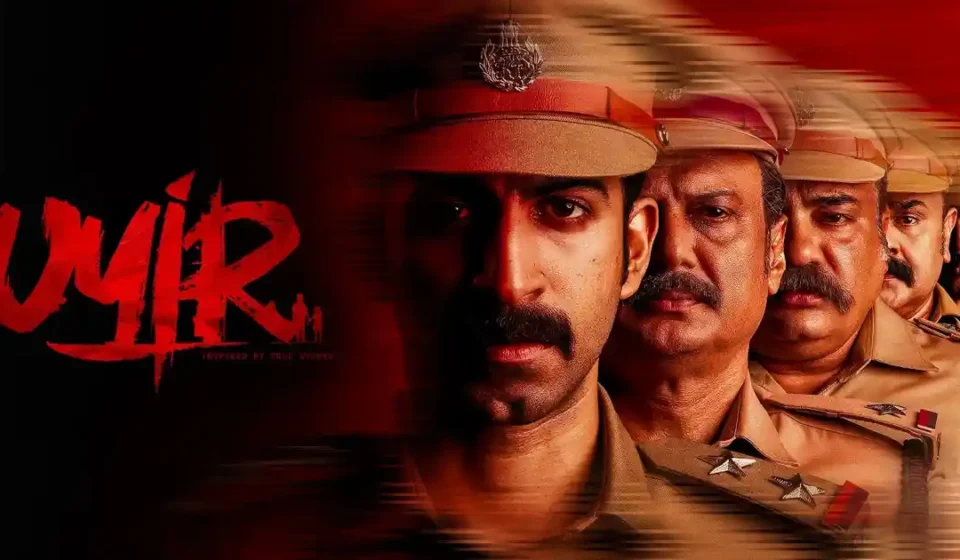
"Uyir" Premieres to Mixed Reviews: A Deep Dive into J.V. Premkumar’s Latest Offering

FOR IMMEDIATE RELEASE
CHENNAI, INDIA – July 4, 2026 – J.V. Premkumar’s highly anticipated drama, "Uyir," starring Roshan Mathew and Pauly Valsan in pivotal roles, hit theaters today, generating considerable discussion among critics and audiences alike. The film, produced by Leona Lishoy, who also features in a significant role, has received a moderate reception, with 123telugu.com awarding it a 2.5 out of 5 rating. This lukewarm critical consensus positions "Uyir" as a film with notable strengths but also discernible shortcomings that prevent it from achieving its full potential.
The narrative of "Uyir" reportedly centers around complex human relationships and the intricate dynamics within a family grappling with unforeseen challenges. Roshan Mathew leads the ensemble as Arjun, a man navigating personal turmoil, while Pauly Valsan portrays the resilient matriarch, Janaki, whose quiet strength anchors the family amidst adversity. Leona Lishoy’s character, Maya, is said to be a crucial catalyst, driving much of the film’s dramatic tension. The film promised a poignant exploration of themes such as resilience, sacrifice, and the often-unseen struggles that define modern familial bonds. However, initial reactions suggest that while the intentions were noble, the execution faltered in certain key areas.
The Journey to the Silver Screen: A Chronicle of "Uyir’s" Production
The conception of "Uyir" began nearly two years ago when director J.V. Premkumar, known for his nuanced storytelling in independent cinema, envisioned a deeply personal tale of human endurance. Sources close to the production indicate that Premkumar was particularly keen on exploring the emotional landscape of ordinary individuals facing extraordinary circumstances, a recurring motif in his previous acclaimed works. The script, penned by Premkumar himself, underwent several drafts to refine its emotional core and ensure authenticity in its portrayal of characters.
Pre-Production and Vision:
The initial phase involved extensive research into the psychological impact of loss and the intricate mechanisms of family support systems. Premkumar sought to craft a narrative that felt both universal and intimately personal. Casting was a meticulous process, with Roshan Mathew being an early choice for the lead, lauded for his ability to convey vulnerability and internal conflict with subtlety. Pauly Valsan’s casting as the matriarch was strategic, leveraging her formidable presence and experience to ground the film’s emotional weight. Leona Lishoy, beyond her acting prowess, took on the mantle of producer, a move that allowed her significant creative input and ensured the film aligned closely with Premkumar’s artistic vision. The ensemble was rounded out with talents like Anand Sami, Vishnu Govind, and Maala Parvathy, each reportedly bringing distinct flavors to their respective roles.
Principal Photography and Challenges:
Filming for "Uyir" commenced in late 2025, primarily across picturesque yet challenging locations in rural Kerala and parts of Tamil Nadu. Cinematographer A.K. Vimal Kumar was tasked with capturing the raw beauty of these settings while maintaining a visual language that complemented the film’s somber yet hopeful tone. The production faced its share of logistical hurdles, including unpredictable weather conditions and the intricate coordination required for emotionally demanding scenes. Mathew and Valsan, in particular, spent considerable time immersing themselves in their characters, undergoing workshops to develop a believable rapport and convey the profound history shared by their on-screen family. The director’s hands-on approach and emphasis on natural performances meant many scenes relied on improvisation within a structured framework, allowing for organic character development.
Post-Production and Technical Craftsmanship:
The post-production phase saw editor Rahul Raj meticulously weaving together the narrative threads, aiming for a coherent and impactful pacing. Manikandan Ayyappa’s musical score was developed in parallel, designed to underscore the emotional beats without overshadowing the performances. His work, often praised for its evocative quality, was crucial in establishing the film’s atmospheric depth. The sound design, handled by a dedicated team, focused on creating an immersive auditory experience, allowing ambient sounds to contribute meaningfully to the storytelling. The trailer, released a few weeks prior to the premiere, offered a glimpse into the film’s intense dramatic core, generating a moderate buzz among cinephiles. The choice of a July 4th release, a typically competitive window, indicated the producers’ confidence in the film’s ability to stand out.
Supporting Data: A Detailed Critique of "Uyir’s" Elements
The 2.5/5 rating from 123telugu.com points to a film that is neither a resounding success nor a complete failure, but rather a work that shows promise while struggling with inconsistencies. A closer examination of its various components sheds light on this mixed reception.
Plot and Screenplay (The Narrative Core):
"Uyir" unfolds as a multi-layered family drama, reportedly beginning with a tranquil setting that is soon disrupted by a tragic event. The initial premise, though not entirely novel, holds potential for emotional depth. The screenplay attempts to explore the ripple effects of this tragedy on individual family members, particularly Arjun and Janaki. However, critics suggest that the narrative suffers from an uneven pace. While some segments are deeply engaging, others feel protracted, leading to moments of narrative inertia. The exploration of sub-plots, intended to enrich the family’s tapestry, occasionally deviates from the main emotional arc, creating a sense of disjointedness. The film’s attempts at incorporating twists, particularly concerning Maya’s character, are said to be somewhat predictable, lessening their impact. The overall arc, while concluding on a note of tentative hope, doesn’t always justify the emotional journey undertaken by the characters, leaving some resolutions feeling unearned.
Performances (The Human Element):
- Roshan Mathew as Arjun: Roshan Mathew delivers a commendably sincere performance as Arjun, the character burdened by responsibility and grief. His portrayal of internal conflict and suppressed emotions is lauded as one of the film’s strongest assets. Mathew skillfully navigates Arjun’s transformation, showcasing a range from quiet despair to determined resilience. His nuanced expressions and restrained body language effectively convey the character’s journey without resorting to melodrama. However, some critics felt that the script occasionally underutilized his potential, leaving him with less to do in certain segments.
- Pauly Valsan as Janaki: Veteran actress Pauly Valsan shines as Janaki, the stoic matriarch. Her performance is described as powerful and authentic, embodying the quiet strength and unwavering love characteristic of a mother figure. Valsan’s ability to convey profound emotion through subtle gestures and piercing gazes is a masterclass in understated acting. She commands the screen with her presence, making Janaki a memorable character whose emotional struggles resonate deeply. Her chemistry with Roshan Mathew forms the backbone of the family’s dynamic.
- Leona Lishoy as Maya (and Producer): Leona Lishoy, in her dual capacity as producer and actress, demonstrates her commitment to the project. Her performance as Maya is noted for its intensity and pivotal role in the narrative. Maya’s character is complex, serving as both a source of conflict and eventual resolution. Lishoy brings a certain gravitas to the role, effectively portraying the character’s enigmatic nature. While her acting is generally solid, the character’s motivations and arc are sometimes underdeveloped by the script, preventing a full connection with the audience.
- Supporting Cast: Anand Sami, Vishnu Govind, and Maala Parvathy, among others, contribute competently to the film’s fabric. Anand Sami’s portrayal of a skeptical relative adds a layer of realism to family interactions, while Vishnu Govind’s character provides moments of levity. Maala Parvathy, in a brief but impactful role, leaves her mark. Their collective performances ensure that the supporting characters feel organic to the story, even if their individual narratives are not extensively explored.
Direction (J.V. Premkumar’s Vision):
J.V. Premkumar’s direction is characterized by a strong artistic sensibility and a clear vision for the film’s emotional landscape. He demonstrates a commendable ability to handle sensitive themes with maturity. The director’s strength lies in extracting naturalistic performances from his lead actors, particularly Roshan Mathew and Pauly Valsan. However, the 2.5 rating suggests that Premkumar struggled with maintaining a consistent pace and tightening the narrative. The film occasionally meanders, and some scenes, while visually appealing, do not always advance the plot or character development effectively. The balance between character study and plot progression appears to be an area where the film could have benefited from a more rigorous approach.
Technical Aspects (Crafting the Experience):
- Music Direction (Manikandan Ayyappa): Manikandan Ayyappa’s musical score is a highlight, effectively enhancing the film’s emotional depth. His compositions are subtle yet powerful, providing an atmospheric backdrop that resonates with the narrative’s mood. The background score, in particular, is praised for its ability to heighten tension and evoke empathy without being overtly manipulative.
- Cinematography (A.K. Vimal Kumar): A.K. Vimal Kumar’s cinematography is consistently strong, capturing the diverse settings with an artistic eye. The visual palette is rich, utilizing natural light to create an authentic and often melancholic atmosphere. His framing choices contribute significantly to the storytelling, often conveying unspoken emotions through carefully composed shots. The visuals are arguably one of the most polished aspects of "Uyir."
- Editing (Rahul Raj): Rahul Raj’s editing is generally proficient, maintaining narrative flow, but struggles with the overall pacing. While individual scenes are well-cut, the film’s longer runtime of 2 hours and 25 minutes, combined with certain drawn-out sequences, suggests that a tighter edit could have significantly improved the audience experience.
- Production Design & Sound Design: The production design, though not explicitly mentioned as a highlight, effectively establishes the film’s various settings, from humble homes to more expansive landscapes, adding to the realism. The sound design team also contributes to the film’s immersive quality, ensuring that dialogue is clear and ambient sounds add to the film’s texture, though no specific innovation was noted.
Official Responses: Navigating Critical Waters
The 2.5/5 rating from 123telugu.com reflects a critical consensus that places "Uyir" squarely in the "average" category. This suggests a film that achieves some of its objectives but falls short of being a truly compelling cinematic experience. In the competitive landscape of regional cinema, such a rating often translates to a mixed bag of audience opinions.
Industry analysts often view a 2.5 rating as a signal for potential viewers to approach with cautious optimism. It means the film possesses redeemable qualities – strong performances, good technical work – but is hampered by narrative flaws or pacing issues. For a director like J.V. Premkumar, who has a history of critically appreciated independent films, this might be seen as a minor setback, a film that didn’t quite hit the high notes expected. Producer Leona Lishoy, having invested creatively and financially, might acknowledge the constructive criticism while highlighting the film’s strengths.
Comparing "Uyir" to other recent family dramas, its score places it among films that attempt to tackle serious subjects but struggle with consistent execution. It lacks the universal appeal or groundbreaking narrative structure that would elevate it to a higher tier of critical acclaim, yet it avoids the pitfalls of being entirely dismissible due to its strong central performances and technical competence.
Implications: The Ripple Effect of "Uyir"
The mixed critical reception of "Uyir" carries several implications for its creators, its box office prospects, and its place within the broader cinematic discourse.
Box Office Potential:
A 2.5/5 rating generally indicates a challenging road at the box office. While strong word-of-mouth can sometimes overcome initial critical skepticism, "Uyir" will likely depend heavily on its core audience, particularly those who appreciate realistic dramas and the performances of its lead actors. Without overwhelmingly positive reviews, attracting a wider commercial audience becomes an uphill battle. The film might find success in niche markets or through streaming platforms, where critical nuances are sometimes appreciated more than in a theatrical run.
Audience Takeaway and Thematic Resonance:
"Uyir" is undoubtedly a film for audiences who seek emotional depth and character-driven narratives rather than high-octane entertainment. Its exploration of family dynamics, grief, and resilience offers a poignant experience, particularly for those who connect with its central themes. However, the pacing issues might deter viewers accustomed to faster-moving plots. The film encourages introspection on the nature of human connection and the quiet strength found in adversity, making it a potentially impactful watch for the right demographic.
Career Implications:
For director J.V. Premkumar, "Uyir" represents another entry in his filmography that showcases his commitment to thoughtful storytelling, even if it doesn’t stand as his most polished work. It reinforces his reputation for working with strong actors and tackling serious subjects. For Roshan Mathew and Pauly Valsan, their performances are likely to be individually praised, further solidifying their positions as versatile and reliable actors. Leona Lishoy’s role as producer and actress highlights her burgeoning influence in the industry, demonstrating her willingness to back artistically driven projects. While the film’s overall reception is mixed, the individual contributions of its cast and crew remain noteworthy.
Overall Legacy:
"Uyir" might not achieve blockbuster status or widespread critical adoration, but it will likely be remembered as a sincere attempt to tell a deeply human story. Its strengths lie in its powerful central performances, particularly from Roshan Mathew and Pauly Valsan, and its commendable technical execution in cinematography and music. The film’s legacy will perhaps be defined by its earnest exploration of emotional themes, even if its narrative structure could have been more refined. It serves as a reminder that even films with flaws can offer valuable insights and resonant moments, contributing to the rich tapestry of regional cinema.
123telugu.com Rating: 2.5/5
Reviewed by 123telugu Team