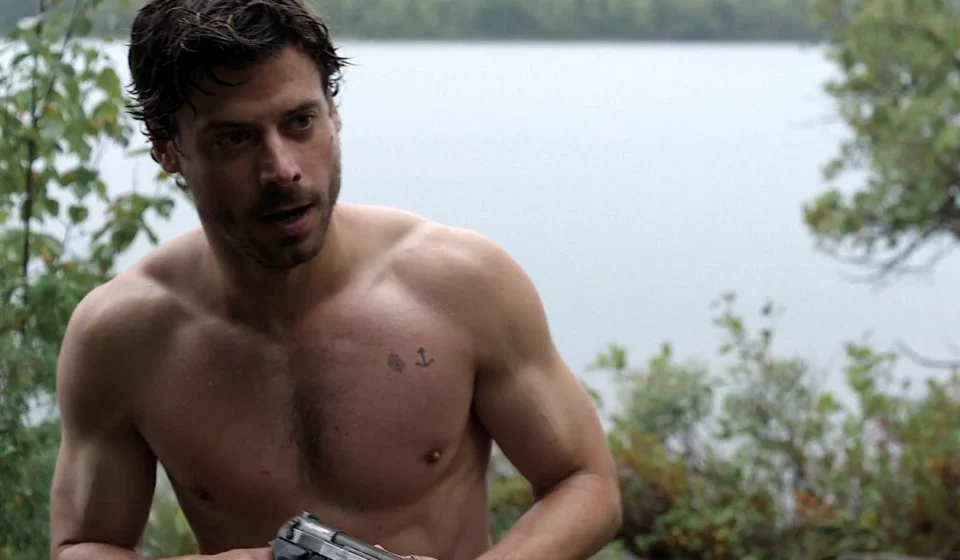
The Predator Within: Wiebke von Carolsfeld’s "Someone’s Daughter" Deconstructs the Ethics of Survival

In the vast, verdant expanse of Quebec’s Eastern Townships, director Wiebke von Carolsfeld has crafted a film that functions less as a traditional survival thriller and more as a claustrophobic, moral autopsy. Her latest feature, Someone’s Daughter, which premiered at the 2026 Fantasia Film Festival, strips away the survivalist tropes popularized by recent genre hits to reveal a darker, more uncomfortable truth about human complicity and the systemic failures of the justice system.
The film follows Sam (Pascale Bussières), a sharp, defense attorney, and Paul (François Arnaud), her former client—a man she successfully defended against accusations of sexual assault fifteen years prior. The two find themselves abducted and stranded in the wilderness by Mr. Borden (Peter Outerbridge), the father of a young woman whose life was irrevocably shattered by the aftermath of that very trial.
The Anatomy of an Abduction: A Chronology of Consequence
The premise of Someone’s Daughter is intentionally provocative, operating as a dark mirror to high-concept survival films like Sam Raimi’s Send Help. However, where Raimi’s film focused on the physical mechanics of escaping a crash site, von Carolsfeld’s narrative is anchored in the psychological wreckage of a legal system that favors the skilled orator over the pursuit of objective truth.

The story begins with an abrupt shift in power. Sam and Paul are snatched from their lives and brought to a remote island. Almost immediately, the film subverts expectations: Mr. Borden, the man who abducted them, does not linger to exact a prolonged, sadistic torture. Instead, he rows a short distance from the shore and, within view of his captives, ends his own life with a shotgun.
This act serves as the catalyst for the film’s true horror. The "villain" is removed from the equation within the first act, leaving Sam and Paul in a state of shock—and, more importantly, in total isolation. With their captor gone, the pair must navigate the wilderness together. What follows is not a race against the elements, but a slow, agonizing descent into the past. As they trek through the woods, the distance between them—the lawyer and the man she helped set free—shrinks, turning the vast wilderness into an inescapable, pressurized chamber.
The Psychological Wilderness: A Study in Complicity
The core of the film is found in the dialogue, which is sharp, cutting, and increasingly disturbing. As they traverse the landscape, the conversation inevitably drifts toward the woman who was the center of their legal history: Lydia.

Sam’s memory of the case is professional, detached, and framed by the realities of the legal system. Paul’s, by contrast, is chillingly self-serving. He refers to the woman he was accused of assaulting with a detachment that borders on the sociopathic, constantly steering the narrative back to his own "victimhood." Whether he is complaining about his fear of wolves or reminiscing about his days as a competitive swimmer, Paul remains the protagonist of his own warped story, unable or unwilling to acknowledge the destruction left in his wake.
Bussières plays Sam with a masterful, chilly precision. She is a woman who has built her life around being the smartest person in the room, a machine for problem-solving. But as the isolation of the forest sets in, her professional veneer begins to crack. She is forced to confront the reality of the man she once vouched for—a man who, in the crucible of the wild, reveals himself to be a liability and an enigma she thought she had solved years ago.
Supporting Data: The Evolution of Rape-Revenge Cinema
Someone’s Daughter enters the cinematic canon at a time when the "rape-revenge" subgenre is undergoing a profound identity crisis. For decades, films like The Last House on the Left and I Spit on Your Grave defined the genre through graphic violence, maiming, and cathartic, often exploitative, bloodshed.

Von Carolsfeld, co-writing with Doug Taylor, rejects this lineage entirely. She offers a "delicate experiment" in tension. There is no triumph in violence here; instead, the film functions as a philosophical interrogation. The brutality is not in the physical harm inflicted by the antagonists, but in the internal rot of the characters as they are forced to confront the uncomfortable truths they have spent years suppressing.
This approach aligns the film with the recent wave of "social thrillers," such as Emerald Fennell’s Promising Young Woman. In both films, the terror is derived from the realization that one is trapped with a predator who can easily blend into society. When Mr. Borden asks Sam to remove her makeup, his desire to see who she "really" is—"someone’s daughter"—is a poignant, albeit slightly on-the-nose, reminder that everyone is connected to the systemic cycles of violence that often go unpunished.
Official Responses and Critical Reception
Since its debut at Fantasia, the film has drawn significant praise for its restraint. Critics have noted that while the dialogue occasionally leans into the didactic—feeling more like a mouthpiece for the writers’ ethical arguments than natural speech—it is a minor trade-off for the film’s commitment to exploring the reach of violence.

François Arnaud’s performance has been widely lauded for its complexity. He balances the role of the charming, entitled man-child with the cold, calculating manipulator, never fully tipping his hand. This ambiguity keeps the audience in a constant state of uncertainty: Is Paul a victim of circumstance, or is he a wolf in sheep’s clothing? Bussières’ performance acts as the perfect counterweight, charting the erosion of her character’s confidence as she realizes that the "justice" she helped serve may have been a moral catastrophe.
Implications: The Predator in Plain Sight
The final act of Someone’s Daughter pivots away from the survivalist elements to focus on the terrifying ease with which predators walk among us. By the time the film reaches its conclusion, the wilderness has ceased to be an obstacle. Instead, it has become a metaphor for the societal vacuum that allows people like Paul to exist.
Von Carolsfeld’s return to the director’s chair after a decade-long hiatus is marked by a newfound, terrifying maturity. She does not offer easy answers or a cathartic ending where the good guys escape and the bad guys suffer. Instead, she presents a chilling portrait of human complicity. The film suggests that the "wolves" are not in the woods; they are the people sitting next to us, the people we represent in court, and the people we try to convince ourselves are "innocent."

As the film moves toward its Canadian theatrical release on October 23, it serves as a haunting reminder that in a world governed by a flawed system, the only thing more dangerous than a predator is the person who helps them hide. Someone’s Daughter does not just ask the audience to fear the woods; it asks them to look at the people they trust and wonder if, given enough time, their true nature might finally be exposed.
In a landscape dominated by blockbusters and loud, action-heavy thrillers, Someone’s Daughter stands out as a quiet, searing piece of filmmaking—a film that proves that sometimes, the most effective way to address the systemic rot of society is to strip away the distractions and leave two people alone in the dark to face the truth.