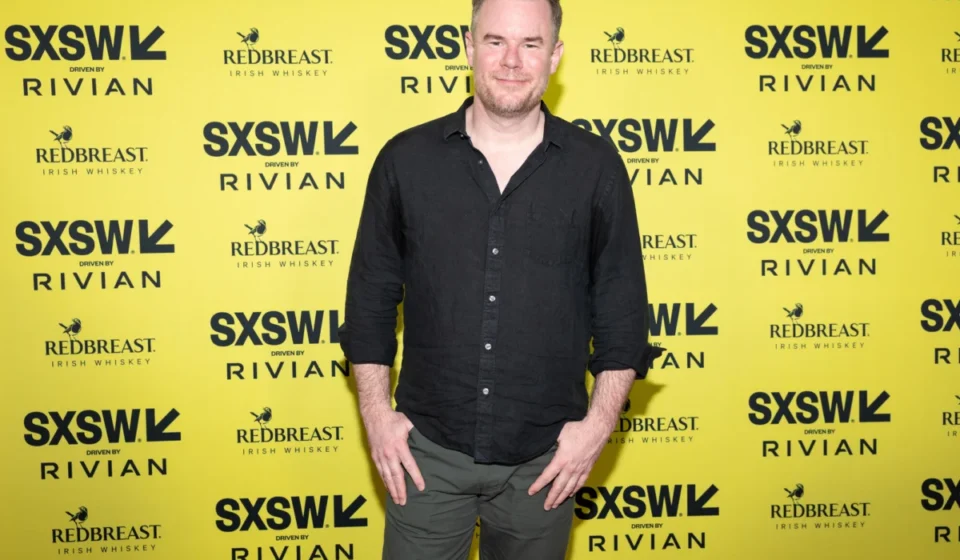
The Mumblecore Godfather Returns: Joe Swanberg on ‘The Sun Never Sets’ and the Evolution of Independent Cinema

Editor’s note: This interview was originally published on March 16, 2026, following the film’s premiere at the 2026 SXSW Film & TV Festival. The Independent Film Company is scheduled to release the film in limited theaters on Friday, August 28, with a planned national expansion to follow.
For nearly a decade, the landscape of American independent cinema felt a little less intimate. Joe Swanberg, the director often heralded as the "godfather of mumblecore," had stepped away from the feature-length format that defined his early career. After the 2017 release of the gambling drama Win It All on Netflix, Swanberg seemed to vanish from the director’s chair of feature films. However, as it turns out, the architect of low-budget, high-emotion realism had simply moved his workshop elsewhere.
With the premiere of his latest feature, The Sun Never Sets, at the 2026 SXSW Film & TV Festival, Swanberg has officially returned to the form that made him a household name among indie cinephiles. Starring longtime collaborator Jake Johnson alongside Dakota Fanning and Cory Michael Smith, the film is a bittersweet exploration of age-gap relationships, emotional baggage, and the complexities of modern intimacy.
The Quiet Years: A Pivot, Not a Retirement
To the casual observer, Swanberg’s decade-long absence from feature filmmaking might have looked like a retreat. In reality, it was a pivot to a different kind of creative endurance. Following his 2017 Netflix feature, Swanberg threw his energy into the third and final season of his critically acclaimed anthology series, Easy. The show, which offered a raw, improvised look into the sex lives and relationship dynamics of self-absorbed Chicagoans, served as a spiritual successor to the aesthetic he pioneered with films like Kissing on the Mouth (2005) and Hannah Takes the Stairs (2007).

"I was pretty spoiled," Swanberg reflected during an interview at SXSW. "Honestly, I had the greatest time of my life making Easy. Coming off of that show, it was difficult to imagine ever having it that good again. Netflix was so awesome to work for. I felt supported. I felt like a wave I’d been surfing for 15 years had finally peaked."
During the intervening years, Swanberg didn’t stop working. He directed for-hire television, acted in various microbudget projects, and opened a physical video store in his hometown of Chicago—a nostalgic, labor-intensive venture that signaled his commitment to the culture of cinema rather than just the industry of it. By his own admission, he didn’t have a "career strategy." He was simply busy, tired, and uninspired by the prospect of rushing into a new feature until the right story presented itself.
The Genesis of The Sun Never Sets
The Sun Never Sets is a return to the roots of Swanberg’s filmmaking philosophy: intimate, on-location, and character-driven. Shot on 35mm in Alaska, the film centers on Wendy (Fanning), a woman navigating the collapse of her relationship with Jack (Johnson), an older, divorced hedge fund manager. When Jack suggests they take a break, Wendy finds herself drawn back to her former flame, Chuck (Smith). What follows is not a standard romantic comedy, but a messy, authentic study of human desire and the shifting structures of modern commitment.
The inspiration for the project was deeply personal. "I started kicking this idea around in 2019, post-divorce," Swanberg explained. "I was dating a younger person and really wondering on her behalf whether our relationship was all that satisfying. I was in a relationship with [filmmaker] Kris Rey for 20 years. I felt old and almost calcified. I didn’t want to be alone, but I didn’t want to do the ‘whole big thing’ with a new person again."

Swanberg credits the physical environment of Alaska and the collaborative nature of his actors for shaping the script. "Ashley Sneed called me and asked if I wanted to make a movie in Alaska. I started talking to Jake, pitching him the idea, and telling him about a breakup I was going through. He was taking a lot of my raw input and helping shape that into a story."
The Changing Landscape of Indie Film
Swanberg’s return coincides with a seismic shift in the independent film market. When he last occupied the festival circuit in the mid-2010s, the "streaming wars" were in their infancy, and independent films were frequently acquired at festivals by major platforms. By 2019, he realized the landscape had changed entirely.
"I went back to my group of investors in Chicago and said, ‘You guys, I don’t know what’s going on out there,’" he admitted. "It was clear that streamers were going to start producing in-house rather than acquiring at festivals. I purposefully stepped out of the game at that point."
Now, re-entering the market feels like being a "first-time feature director" all over again. He notes that the current climate is confusing, yet there are rumors that major streamers are moving back toward acquisitions, perhaps because their internal production models haven’t yielded the results they desired. For Swanberg, the goal remains the same: to make films that feel authentic, even if that means navigating a market that is increasingly skeptical of adult-oriented, introspective dramas.

The #MeToo Effect and the Intimacy Debate
Perhaps the most significant change in the industry since Swanberg’s last feature is the formalization of intimacy coordination on sets. Swanberg’s early work was defined by its "ad-libbed sexual frankness," a style that would require a different approach in the post-#MeToo era.
"I’m not opposed to doing things differently," Swanberg said, "but my collaborations with Jake are inherently not ever super sexually focused. The four movies we’ve made together just don’t go there."
When discussing intimacy coordinators, Swanberg expressed a nuanced and somewhat contrarian view. On the set of The Sun Never Sets, his actors explicitly requested not to use one. "Some of them were specifically like, ‘I don’t want to work with an intimacy coordinator. I don’t like that. It makes me uncomfortable.’"
Swanberg argues that as long as intimacy coordinators are hired by studios, they function more as representatives of the studio’s interests rather than true advocates for the actors. "If that role is going to become an advocate for me, then I should hire that person, not the studio. As long as the studio is paying, I view that person as antagonistic, not as an advocate." He suggests that for the role to truly benefit the industry, the dynamic must shift to one where the actor—not the production—retains the agency to bring in their own support.

Implications for the Future of Indie Cinema
As The Sun Never Sets prepares for its late-August release, it serves as a litmus test for the viability of the "mumblecore" aesthetic in 2026. Can a film built on quiet introspection, improvisation, and non-traditional relationship dynamics still find a home in a multiplex-dominated world?
Swanberg remains optimistic, though grounded. He has walked away from $25-million studio projects in the past because he felt they wouldn’t result in a "great movie." For him, passion is the only currency that matters.
"I’ve never really been money-driven," Swanberg said. "In a marketplace right now where to get an adult-oriented, introspective drama out into the world is already a challenge, I know that unless I’m really deeply invested, that challenge becomes even harder."
For now, the godfather of mumblecore is content to stay in his lane. He is not interested in the studio machinery; he is interested in the portraits of people living their lives in Chicago or Alaska or anywhere else. As he looks toward the next few years, he anticipates more films, more collaborations, and perhaps, eventually, a new way of navigating the changing rules of the set. But one thing is clear: Joe Swanberg is back, and he is just as interested in the messiness of being human as he was two decades ago.