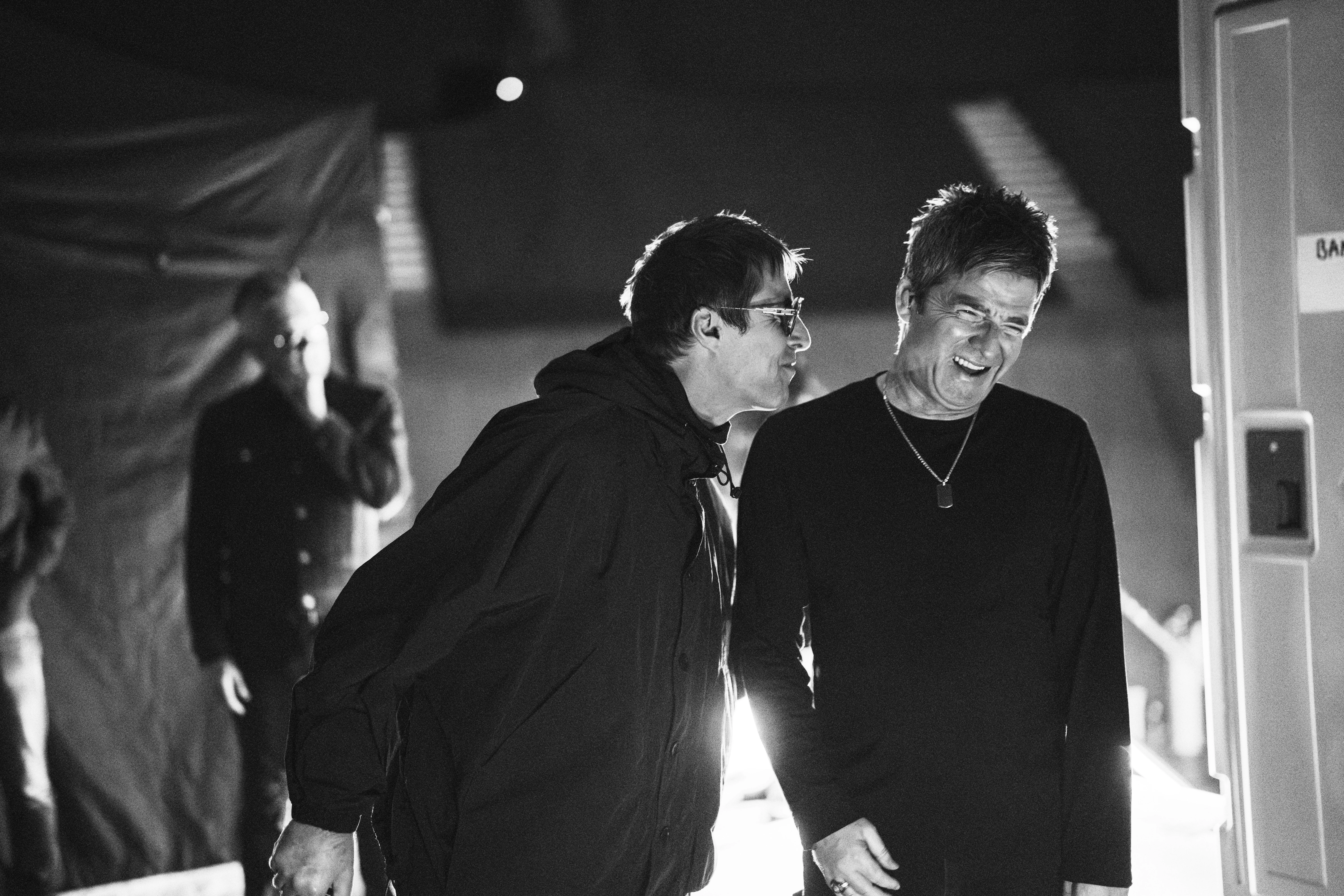
The Resurrection of Rock’s Greatest Rivalry: A Deep Dive into ‘Oasis: Don’t Look Back in Anger’

The myth of Oasis has always been defined as much by its fractures as by its anthems. For fifteen years, the silence between Noel and Liam Gallagher was the most immovable object in British pop culture. That silence was shattered with the announcement of their 2025 reunion tour, a cultural event of such magnitude that it required a cinematic document to match.
Premiering at the Venice Film Festival, Oasis: Don’t Look Back in Anger is that document. Directed by Dylan Southern and Will Lovelace—the duo behind the acclaimed Blur documentary No Distance Left to Run—and scripted by Peaky Blinders creator Steven Knight, the film attempts to capture the lightning of the 2025 reunion. However, as the film reveals, the "lightning" of middle age is a far more controlled, professional, and perhaps guarded force than the raw electricity of the 1990s.
Main Facts: A Cinematic Account of Reconciliation
Oasis: Don’t Look Back in Anger serves as the spiritual successor to the 2016 documentary Supersonic. While the earlier film focused on the band’s meteoric rise from Manchester council estates to the heights of Knebworth, it famously avoided the messy reality of the brothers’ 2009 estrangement. This new feature, however, places the conflict front and center, using it as the narrative engine for a two-hour exploration of legacy, nostalgia, and the business of rock and roll.
The film is not merely a concert movie; it is a high-stakes psychological study of two men attempting to co-exist in a confined rehearsal space after a decade and a half of litigation and public insults. Key production details include:
- Directors: Dylan Southern and Will Lovelace.
- Screenwriter: Steven Knight.
- Sound Design: Tarn Willers (Oscar winner for The Zone of Interest) and James Mather.
- Premiere: Venice Film Festival, followed by a global theatrical and streaming release.
- Core Narrative: The transition from the 2009 breakup at Rock en Seine to the 2025 rehearsal rooms and the subsequent stadium tour.
Chronology: From the Ashes of Paris to the Rehearsals of 2025
The film’s structure is designed to emphasize the passage of time and the weight of the brothers’ shared history.
The 2009 Rupture
The documentary opens with a visceral, grainy montage of the infamous night at the Rock en Seine festival in Paris. For years, fans have heard the stories of the smashed guitar and the backstage brawl, but the film provides a haunting look at the immediate aftermath—the empty stage, the confused crowd, and the palpable sense of an era ending in a flash of fraternal rage.
The Long Silence (2009–2024)
While the film moves quickly through the intervening years, it acknowledges the "cold war" period. It highlights how the absence of Oasis created a vacuum in the British music scene, one eventually filled by a longing for the perceived simplicity and optimism of the 1990s.
The 2025 Rehearsal Room
The heart of the film’s first act takes place in the summer of 2025. The camera lingers on the "confined space" of the rehearsal room, where the band has committed to six weeks of intensive practice. The filmmakers utilize "nifty editing" to heighten the anxiety; every glance between Noel and Liam is scrutinized for signs of the old volatility.
However, the "sparks" that many expected—or perhaps hoped for—remain largely absent. Instead, we see a Liam Gallagher described by bandmates as "uncharacteristically business-like." The fire is still there in the vocals, but the behavior is that of a seasoned professional protecting a massive financial investment.
Supporting Data: The Cultural and Technical Landscape
The film’s impact is bolstered by its technical pedigree and its deep dive into the demographics of the "Oasis Phenomenon."
Technical Excellence
One of the film’s undisputed strengths is its immersive audio. With Tarn Willers and James Mather at the helm of sound design, the concert footage is "appropriately very loud," capturing the wall-of-sound aesthetic that defined the Oasis live experience. The mix emphasizes the communal roar of the crowd, making the viewer feel like a participant in the "herd mentality" of the stadium.
The Fan Demographic
A significant portion of the runtime is dedicated to the fans, revealing a surprising statistic: despite Oasis being a 90s relic, the majority of the 2025 crowd consisted of fans under the age of 30. The film explores this "Gen Z" obsession, contrasting their "feverish" enthusiasm with the more detached, phone-filming behavior often seen at modern pop concerts.
Global Reach
To illustrate the band’s enduring global relevance, the filmmakers include vignettes from around the world:
- Brazil: A fan who named her dog after original guitarist Paul "Bonehead" Arthurs.
- South Korea: Two female divers who find a bond through the B-side anthem "Acquiesce."
- Manchester: A poignant, if polarizing, segment featuring a survivor of the 2017 Manchester Arena bombing, who found solace in "Don’t Look Back in Anger" during a city-wide vigil.
Official Responses: The Brothers’ "PR-Trained" Perspective
In new on-camera interviews, both Noel and Liam appear in what the film describes as a "guarded form." While they maintain their signature candid manner of speaking, there is a sense of a "PR-trained remove" that prevents the documentary from becoming a truly "unvarnished portrait."
Liam’s Philosophical Take
Liam provides the film’s most-quoted line when discussing the state of the world during the band’s hiatus. Over a montage of global unrest—ranging from Donald Trump and Elon Musk to the rise of AI—Liam asserts, "When Oasis split up, everything went to shit. People, more than ever now, they want to escape." This sentiment frames the reunion not just as a musical event, but as a necessary psychological release for a fatigued public.
Noel’s Professional Pragmatism
Noel, ever the "Chief," appears more focused on the musical integrity and the logistical scale of the operation. His comments are "anonymous" in their lack of emotional vulnerability, focusing instead on the craft and the "business" of being Oasis. This creates a tension between the fans’ desire for a sentimental brotherhood and the reality of two men executing a high-level corporate comeback.
Implications: Nostalgia, Class, and the "Cash Grab" Debate
The film does not shy away from the "financial raison d’être" of the reunion, though it occasionally struggles to reconcile this with the band’s "working-class hero" image.
The Politics of Nostalgia
The documentary suggests that the 2025 tour was a response to a series of national traumas in the UK, including Brexit and the pandemic. Oasis represents a "national pride and hope" that many felt had vanished. However, the film is criticized for only "briefly and somewhat ironically" touching on these world events, rather than constructing a deeper argument about why the band matters in the modern political landscape.
The Class Contradiction
One of the most biting critiques of both the film and the tour involves the "working-class origins" narrative. The film repeatedly emphasizes the brothers’ humble beginnings to strike a sentimental chord. Yet, as the film itself admits through a throwaway comment by Liam on stage—"Actually there are no cheap seats, sorry about that"—the reality of modern concert pricing has largely priced out the very demographic the band claims to represent. This creates a sense of "insincerity" that hangs over the more earnest moments of the film.
Conclusion: A Polite Monument to a Loud Band
Oasis: Don’t Look Back in Anger is a film of contradictions. It is a visually and sonically stunning record of a historic reunion, yet it is "po-faced" and "sentimental" in ways that feel "anathema to Oasis." By opting for a polite treatment of such a momentous event, the filmmakers may have stripped away the very "specificity and intensity" that made the Gallaghers icons in the first place.
For the fans who missed the tour, the film offers a chance to "relive the emotion." For those looking for the raw, unfiltered truth of the Gallagher relationship, the documentary serves as a reminder that in 2025, Oasis is no longer just a band—it is a meticulously managed, multi-million-dollar global brand. As the credits roll, the question remains: is the reconciliation real, or is it simply the most successful "business" move in the history of British rock?