
Since the release of Judd Apatow’s Knocked Up some twenty years ago, the cinematic depiction of childbirth has undergone a radical, if often nauseating, transformation. What was once a sanitized, soft-focus trope in Hollywood has shifted toward the visceral, with full-frontal, close-up shots of "crowning" becoming a bizarrely common shorthand for the gravity of parenthood. Yet, while mainstream comedies and dramas have pushed the boundaries of biological realism, director Hanna Bergholm’s latest genre exercise, Nightborn, renders those previous efforts almost quaint by comparison.
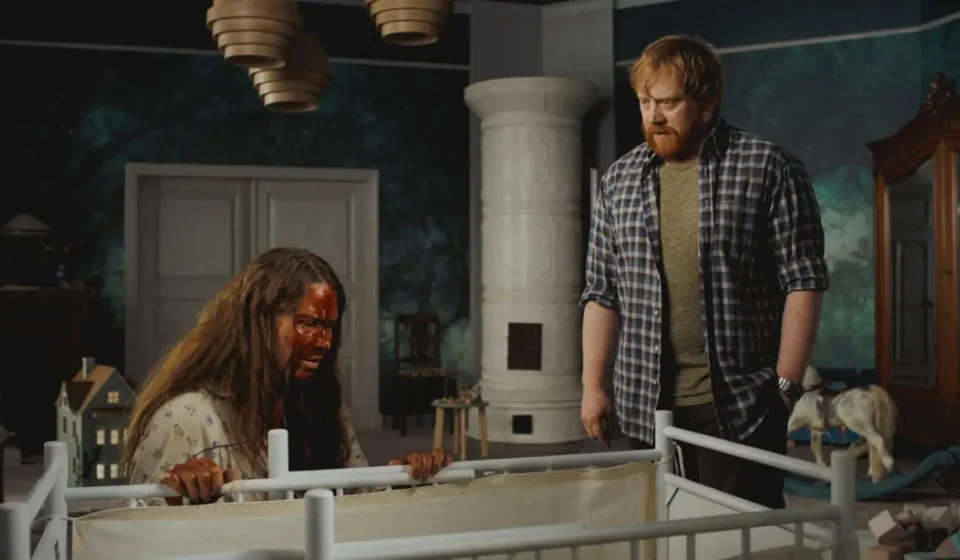
In Nightborn, the birthing process is not merely a medical event; it is an act of body horror so extreme it borders on the surreal. The film introduces its central conflict with a "money shot" that functions less like a cinematic birth and more like a tactical deployment of biological carnage. When the infant erupts from its mother with the force of a cannonball, the resulting splash of gore is so profound that it coats the father’s face in a grotesque, rictus grin—a moment of accidental slapstick that highlights the film’s unique, unsettling tone.
The Anatomy of a Genre-Bending Nightmare
At the center of this carnage is Jon, played by Rupert Grint, and his wife, Saga, portrayed with harrowing, raw intensity by Seidi Haarla. Grint, having transitioned from his iconic tenure at Hogwarts to a staple of the horror genre, brings a specific, unsettling quality to the role of the "baby daddy." His persistent, awkward smile—a vestige of his earlier, more innocent performances—is weaponized here, casting a pall of comic wrongness over the nightmare unfolding before him.
Nightborn is, at its core, a film that refuses to be categorized. It is a story about the transition into parenthood that oscillates between the primal, the terrifying, and the mundane. Before the film settles into the soul-crushing tedium of caring for a newborn, it lures the audience in with CGI-enhanced violence—a baby, for instance, who rips a grandmother’s hoop earring directly from her flesh with a predator’s instinct. Yet, Bergholm, who previously directed the acclaimed Hatching, seems less interested in a traditional "demon child" narrative like Rosemary’s Baby and more concerned with the existential exhaustion of motherhood.
A Chronology of Domestic Decay
The narrative begins with a classic, albeit rotting, premise: a young couple moves into the wife’s ancestral home, a decaying husk of a house buried deep within the Finnish forests. For Jon, an Englishman who remains linguistically isolated in this foreign landscape, the house represents a clean slate. For Saga, it is a return to roots that quickly turns into a prison.
The couple’s vision is idyllic: three children in five years, raised in a fairy-tale setting far from the pressures of modern life. They waltz through the skeletal remains of what will become their kitchen, intoxicated by the prospect of creating a family. When Saga whispers, "Make me a mother," the act is fulfilled, but the aftermath is anything but miraculous.

As the pregnancy progresses and culminates in the violent delivery, the film tracks the physical and psychological toll on Saga. The infant is not a cherubic addition to their home; it is a hairy, growling, demon-like imp that views its mother as a resource to be consumed. The infant literally chews through Saga’s nipples, forcing her into a state of physical degradation that leaves her reliant on a walker. The tragedy is compounded by the couple’s inability to communicate. Jon, frequently absent for work, remains blissfully, almost aggressively, detached from the reality of Saga’s suffering, his inability to speak Finnish mirroring his total failure to comprehend his wife’s maternal ordeal.
Supporting Data: The Metaphor of the "Sucked Dry" Mother
The brilliance—and perhaps the primary source of frustration—of Nightborn lies in its insistence on operating simultaneously as a literal monster movie and a metaphor for the postpartum experience.
In the real world, the "fourth trimester" is a period of immense physical and mental strain, often characterized by the feeling of being "sucked dry" by the needs of a newborn. Bergholm and screenwriter Ilja Rautsi take this common maternal sentiment and manifest it physically. Saga is not just feeling exhausted; she is being physically drained by a literal parasite.
This leads to a pervasive sense of Gaslighting that characterizes the film’s middle act. Saga’s own mother and her seemingly perfect sister represent the societal pressure to maintain a facade of maternal bliss. They refuse to acknowledge that Kuura (the name Saga chooses after hearing it on the wind) is a monster, despite the infant’s blatant physical abnormalities and its bizarre, biblical allergy to purified metal. The message is clear: society demands that mothers suffer in silence. If you are struggling, it is because you are failing, not because the situation itself is objectively monstrous.
Official Perspectives and Creative Intent
In interviews surrounding the film’s release on Shudder, the creative team has been transparent about their desire to explore "maternal ambivalence." Bergholm notes that while horror is a perfect vehicle for exploring the fear of parenthood, the true horror in Nightborn is the societal expectation that the process should be natural, beautiful, and inherently fulfilling.
The film serves as an interrogation of why we, as a culture, are so terrified of the negative realities of childbirth. By presenting a child that is an obvious, aggressive, and vampiric entity, the film highlights the absurdity of the "perfect parent" narrative. When Jon asks, "Does it look like a Christian to you?" while contemplating the child’s behavior, he is effectively asking the audience to reconcile the monstrous nature of their offspring with the traditional expectations of a nuclear family.

Implications: The "Yes, And" of Modern Parenting
Nightborn ultimately succeeds as a study of the space between the expectations of parenthood and the reality of its implementation. By forcing the characters to treat a literal monster like a normal, albeit difficult, baby, the film creates a "yes, and" scenario that keeps the audience off-balance.
The film’s implications are twofold:
- The Dehumanization of the Parent: The film suggests that the intensity of early childcare is so dehumanizing that it leads parents to view their own children with suspicion and, at times, genuine terror.
- The Resilience of the Maternal Bond: Despite the gore, the hair, the biting, and the psychological torment, there is an underlying, inescapable drive in Saga to continue. It is an exploration of the biological imperative that overrides reason, suggesting that even if a child were a literal demon, the maternal instinct might still find a way to justify the sacrifice.
While the film may be criticized for being long on dream imagery and short on traditional "jump scares," its atmospheric, moldy aesthetic effectively captures the airlessness of being trapped in a house with a newborn. The film is a portrait of all the things that are "scooped out" of a person’s life during the transition to parenthood—the identity, the body, and the sanity—all for the sake of a creature that will eventually depart and leave nothing behind but the scars of the experience.
In the end, Nightborn is a "silly-serious" work of art that captures a truth most parents understand implicitly: the process is grotesque, it is often thankless, and it is entirely transformative. That Saga would, despite every shred of evidence to the contrary, likely do it all over again is perhaps the most horrifying and profound aspect of the film.
Grade: B-
Nightborn is currently available for streaming on Shudder.