
The Art of Discernment: Why Donald Glover’s Philosophy on Entertainment Matters More Than Ever

In an era defined by the "infinite scroll" and the homogenization of content consumption, the line between high-concept artistry and mass-market entertainment has become increasingly blurred. Algorithms now serve us a buffet of media where a prestige television drama sits alongside a mindless reality television clip, often stripped of the context required to appreciate either.
Donald Glover—the 42-year-old polymath whose career spans sketch comedy, network sitcoms, visionary television authorship, and global musical success—has long been a vocal proponent of intentionality. In a profound 2022 self-interview for Interview Magazine, Glover offered a framework for how audiences might better engage with the work they consume: the importance of knowing the difference between a "smash burger" and "dry-aged wagyu."
A Career Built on Multidisciplinary Excellence
To understand the weight of Glover’s perspective, one must first appreciate the breadth of his professional evolution. Glover did not simply "happen" into success; he cultivated it through a relentless commitment to craft across vastly different mediums.
His trajectory began in the nascent days of the internet, where he honed his comedic instincts with the Derrick Comedy troupe. This early, scrappy work served as a foundation for his tenure as a writer on NBC’s 30 Rock, where he was part of a team that defined the rhythm of modern television comedy. However, Glover’s ambition was never restricted to one lane. While he was gaining mainstream recognition as the lovable Troy Barnes on Community, he was simultaneously crafting Mystery Team (2009), an independent feature that signaled his desire to control his own narrative.

The 2016 launch of FX’s Atlanta marked a seismic shift in his career. By creating, writing, directing, and starring in the series, Glover proved that he was a singular auteur. Atlanta was not merely a comedy; it was a surrealist, genre-defying exploration of the Black experience, earning him both an Emmy for acting and the distinction of being the first Black person to win the Emmy for Outstanding Directing for a Comedy Series.
Beyond the screen, his work as Childish Gambino has netted him multiple Grammys, while his contributions to major franchises—such as voicing Simba in The Lion King and portraying Lando Calrissian in Solo: A Star Wars Story—demonstrate his comfort in the highest echelons of blockbuster entertainment. This unique position, moving fluidly between indie-art experimentation and global commercial success, provides the vantage point for his philosophy on "the difference between things."
The Philosophy of the "Smash Burger" and "Wagyu"
In his Interview Magazine feature, Glover used a culinary metaphor to explain his aesthetic philosophy. He argued that there is a profound distinction between various forms of art, and that failing to acknowledge that distinction does a disservice to both the creator and the consumer.
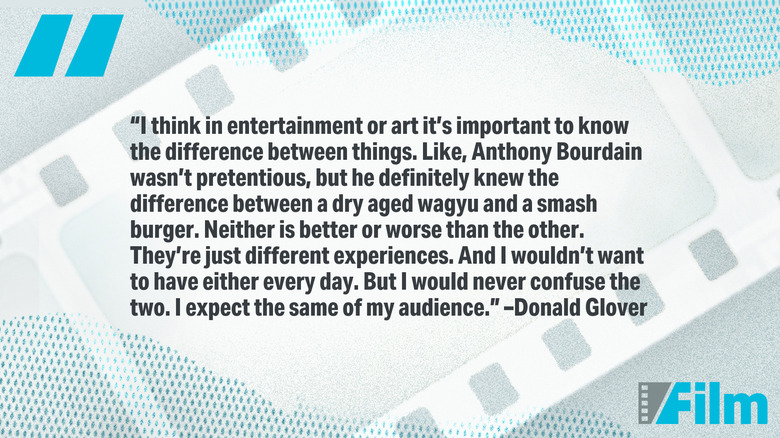
"I think in entertainment or art it’s important to know the difference between things," Glover noted. "Like, Anthony Bourdain wasn’t pretentious, but he definitely knew the difference between a dry-aged wagyu and a smash burger. Neither is better or worse than the other. They’re just different experiences. And I wouldn’t want to have either every day. But I would never confuse the two. I expect the same of my audience."

This statement serves as a critique of the modern "all-content-is-equal" mentality. In a digital ecosystem where everything is flattened into a thumbnail, audiences often lose the ability to categorize the intent behind a project. Is the work designed for immediate, ephemeral consumption, or is it designed to be studied, unpacked, and interrogated? Glover suggests that an audience that cannot distinguish between the two is an audience that is not truly engaging with the art at all.
The Responsibility of Critical Growth
The conversation continued with a poignant focus on communal growth, particularly within the Black creative community. When asked if asking for this level of discernment was a "lot to ask" of a large audience, Glover doubled down on the necessity of honesty.
"You have to be honest," he stated. "Especially with other Black artists… sometimes supporting each other is telling someone, ‘This isn’t good, to me.’ And you have to know why, and not be a hater, and they have to take that criticism in good faith. Then we can grow together. Then we can help each other’s recipes."
Glover’s argument is that "support" is not synonymous with blind praise. True support, in his view, is an active, critical process. If an artist produces a "homemade tuna sandwich" but markets it as a "sophisticated beef patty," the audience’s role—if they truly care about the artist’s evolution—is to point out the discrepancy. Without this feedback loop, the quality of art stagnates, and the creative community becomes trapped in a cycle of sycophancy rather than genuine innovation.
Implications for the Modern Consumer
What does this mean for the average viewer in 2026? It requires a shift in how we approach our "watchlist."
The modern consumer is bombarded with thousands of hours of content. The default setting is often passive: the "background watch," the "phone-scrolling-while-watching" habit. While Glover acknowledges that everyone deserves the right to turn their brain off after a long day, he challenges us to recognize when we are doing that and to distinguish that experience from a "good-faith attempt to engage" with complex material.
Consider the difference between a high-octane reality show and a dense, symbolic drama like HBO’s Chernobyl. If an audience approaches Chernobyl with the same casual, passive mindset they apply to a reality show, they will likely find it "boring" or "hard to follow." But the fault, in this context, lies with the viewer’s inability to adjust their intake method.
By applying a level of care that matches the artist’s intent, the audience becomes a partner in the creative process. If a showrunner has spent years building a complex narrative architecture, the audience honors that work by paying attention. If a filmmaker has created a "smash burger"—a piece of pure, visceral fun—the audience honors that by enjoying it for what it is, without forcing it to carry the weight of a high-art drama.

The Future of Artistry: A Call to Discernment
As the industry continues to experiment with AI-generated content and increasingly data-driven storytelling, Glover’s message is more vital than ever. The pressure to create "content" rather than "art" is immense. When studios and platforms prioritize engagement metrics over creative integrity, the nuance that Glover advocates for is the first thing to be sacrificed.
Discernment is the antidote to the algorithmic age. It is the ability to look at a piece of media and identify its purpose, its value, and its limitations. When we stop confusing the "smash burger" for the "wagyu," we reclaim our agency as viewers. We begin to understand that not everything needs to be a masterpiece, but everything deserves to be understood for what it intends to be.
Glover’s career has been a testament to this philosophy. Whether he is writing a tight, 30-minute sitcom episode or producing an experimental, multi-genre musical project, he is always aware of what the work is trying to achieve. He has consistently invited his audience to join him in that awareness, asking us to be as thoughtful in our consumption as he is in his creation.
In the end, the "difference between things" is the difference between being a passive vessel for advertising and entertainment, and being an active participant in culture. By embracing the critical, nuanced, and honest approach that Donald Glover suggests, we don’t just become better viewers—we become a more sophisticated, more demanding, and ultimately more satisfied audience. We help the "recipes" improve, we foster an environment where actual growth can occur, and we ensure that art—in all its varied forms—remains a vibrant, meaningful, and deeply human endeavor.