Growing Pains: Why ‘Avatar Aang: The Last Airbender’ Struggles to Capture the Original Magic

When "Avatar: The Last Airbender" premiered in 2005, it didn’t just introduce a generation to a meticulously crafted fantasy world; it redefined the potential of Western animation. Through its blend of East-Asian-inspired world-building, high-stakes martial arts, and a profound exploration of war, genocide, and the transition from childhood to maturity, the series became a cornerstone of modern television. Now, two decades later, the franchise has returned with "Avatar Aang: The Last Airbender," a feature film attempting to bridge the gap between the original series and its sequel, "The Legend of Korra." Despite its visual brilliance, the film serves as a poignant reminder that growing up—for both characters and franchises—is rarely as seamless as one might hope.
The Anatomy of an Emotional Hook
To understand why the latest installment feels like a departure, one must look at the foundation. The original series found its footing early with its third episode, "The Southern Air Temple." After the two-part pilot established the premise—a world where "benders" control the elements and a young messiah-figure, Aang, must restore balance—the third episode grounded the show in raw, human trauma.
Aang, a 12-year-old boy burdened with the mantle of the Avatar, returns to his home only to confront the cold, hard reality of his people’s extinction. His initial denial—chasing a winged lemur while ignoring the carnage around him—serves as a heartbreaking precursor to his eventual discovery of his father figure’s remains. The scene is a masterclass in tonal balance: the show allowed Aang to be a child, seeking comfort in a pet, while simultaneously forcing him to process the horrific weight of his legacy. That tension between the lightheartedness of youth and the darkness of global conflict was the "secret sauce" of the original series. It was a show that could move from a slapstick gag involving a boomerang to a nuanced meditation on the cost of war without missing a beat.
A Turbulent Path to the Screen
The release of "Avatar Aang: The Last Airbender" has been anything but straightforward. Following a tumultuous development cycle, the film faced a significant setback in April 2026 when the entire production was leaked online, a blow that undoubtedly impacted its commercial momentum. Originally intended for a wide theatrical rollout, the film was relegated to a streaming-only premiere on Paramount+, with a brief, token Oscar-qualifying run in New York and Los Angeles.
For many fans, the shift to a streaming-first model felt symbolic. The film, which clocks in at a modest 80 minutes, bears the hallmarks of a project constrained by its placement within a larger, established canon. It occupies the "middle space" between the end of the original series and the beginning of the Korra era, a timeframe previously relegated to mere mentions or brief flashbacks. The result is a film that often feels less like a cinematic event and more like a high-budget, elongated television episode—a "missing chapter" that lacks the space to breathe or the stakes to truly shift the status quo.

The Narrative Architecture: A Plot in Stasis
The film follows a now-adult Aang (voiced by Eric Nam), who has traded his childlike wonder for a more stoic, buffed-up demeanor. His primary objective is the creation of a multicultural Republic City, a project aimed at fostering peace. The inciting incident occurs when Aang returns to the Southern Air Temple and is ambushed by "The Denied," a militia of non-benders who believe they are being marginalized in this new world.
The mystery leads Aang to uncover the history of a past Avatar named Sonam, and eventually to Tagah (voiced with gravity by Dave Bautista), an ancient Air Nomad who has been frozen in ice for centuries. Tagah posits that they can restore airbending to non-benders using a mystical staff. While the premise offers a clear thematic conflict—the tension between preserving ancient culture versus the needs of a changing, modernizing world—the script, written by Tim Hedrick and Christopher Yost, struggles to elevate this beyond a standard action-adventure plot.
The film is constantly hamstrung by its need to avoid contradicting the established history of "The Legend of Korra." Because audiences already know where the world ends up, there is no genuine sense of jeopardy. We know the attempt to "fix" the world’s imbalance will fail, and we know these characters will essentially reset to their baseline. Consequently, the narrative feels like it is running on a treadmill, burning through action sequences without making any real progress.
Visuals vs. Heart: The Aesthetic Paradox
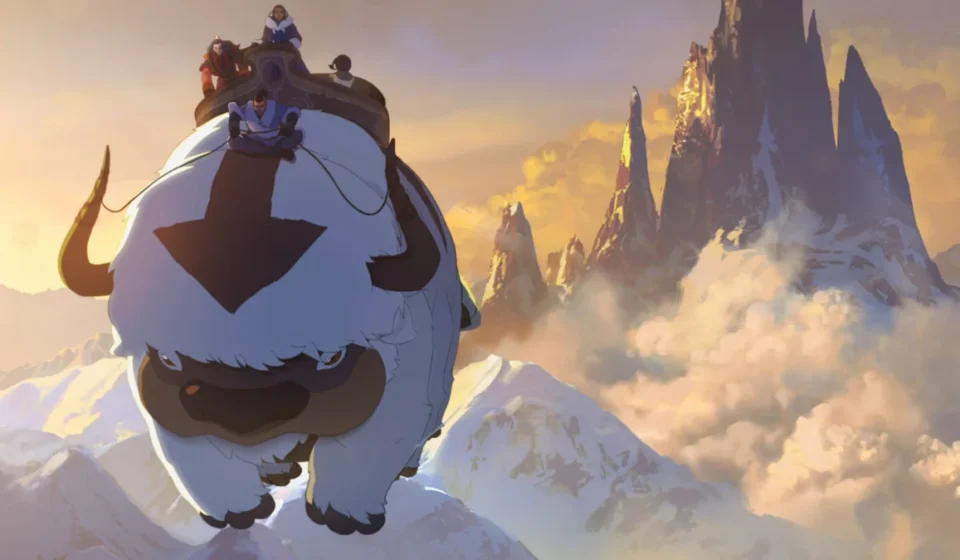
If the script is the film’s weakness, its aesthetic is undeniably its greatest strength. Produced by Flying Bark Productions and Studio Mir, "Avatar Aang" is a triumph of animation. The blend of crisp 2D character designs against seamless 3D environments is breathtaking, serving as a love letter to the visual language of the original series.
However, even here, there is a divergence. While the original series drew heavily from the mechanics of real-world martial arts to define its bending styles, "Avatar Aang" often leans into a more "super-powered" aesthetic. The choreography frequently devolves into beam-struggles and high-octane explosions reminiscent of "Dragon Ball Z." While visually spectacular, it loses the grounded, tactile sense of weight that made the original fights feel so unique and dangerous.

Supporting Cast and The Challenge of Adulthood
The film boasts a new voice cast, prioritizing performers of Asian and Indigenous heritage. Notably, the casting of Dionne Quan as Toph—a move that reflects the character’s own disability—is a commendable touch of authenticity. However, the film struggles to integrate these characters into the plot.
Sokka (Roman Zaragoza) remains the comedic relief, while Toph and Zuko (Steven Yeun) are relegated to glorified action figures. Katara (Jessica Matten), once one of the most complex and driven characters in the franchise, is sidelined into a role of moral support. Without the dynamic of the "found family" dynamic as children, these characters feel like static archetypes of their younger selves.
The most glaring omission is the absence of Suki, a baffling choice given her importance to the original team. Furthermore, the attempts at humor feel disjointed. The running gag regarding Sokka and Toph’s attraction to Tagah feels forced—a "Marvel-esque" quip that lacks the organic, character-driven charm of the original show’s banter.
Implications for the Future of the Franchise
The fundamental issue with "Avatar Aang: The Last Airbender" is one of identity. It attempts to cater to an audience that has grown up, yet it fails to provide the depth or emotional stakes that an adult audience expects. By removing the "whimsy" that made the original show special, the film loses the very thing that anchored its darkest moments.
The "Avatar" franchise is currently at a crossroads. Following the mixed reception of the 2010 live-action film and the 2024 Netflix adaptation, "Avatar Aang" was supposed to be a return to form. Instead, it highlights a recurring struggle: how to expand a universe without diluting its essence.

"Avatar Aang" succeeds as a piece of fan service—a visually stunning walk down memory lane filled with callbacks and beautiful animation. But as a standalone film, it suggests that perhaps some stories are better left as memories. By "aging up" the characters without granting them the complexity of true adulthood, the film inadvertently proves that the original series was a lightning-in-a-bottle moment—a perfect alignment of character, theme, and tone that cannot be recreated simply by placing the characters in a new setting.
Ultimately, "Avatar Aang: The Last Airbender" is a testament to the difficulty of legacy. It is a competent, pretty, and hollow addition to a beloved saga. For those who grew up with Aang, it may provide a fleeting sense of nostalgia, but it fails to capture the soul of the boy who once found a way to save the world while chasing a lemur in the snow. Growing up is, indeed, not all it’s cracked up to be.