The Temporal Vertigo of Creation: Hirokazu Kore-eda’s Live-Action ‘Look Back’

The act of creation is rarely a linear journey; it is a cycle of labor, inspiration, and eventual reflection. In the landscape of contemporary cinema, few stories capture this duality as poignantly as Tatsuki Fujimoto’s Look Back. After Kiyotaka Oshiyama’s 53-minute anime adaptation masterfully explored the tension between the time required to craft art and the time it takes to consume it, master filmmaker Hirokazu Kore-eda has returned to the source material. His 100-minute live-action iteration of Look Back does not merely repeat the feat; it reinterprets the passage of time itself, offering a contemplative, melancholic, and deeply humanistic expansion on a story that has already cemented its place in the modern canon.
The Core Narrative: A Portrait of Two Artists
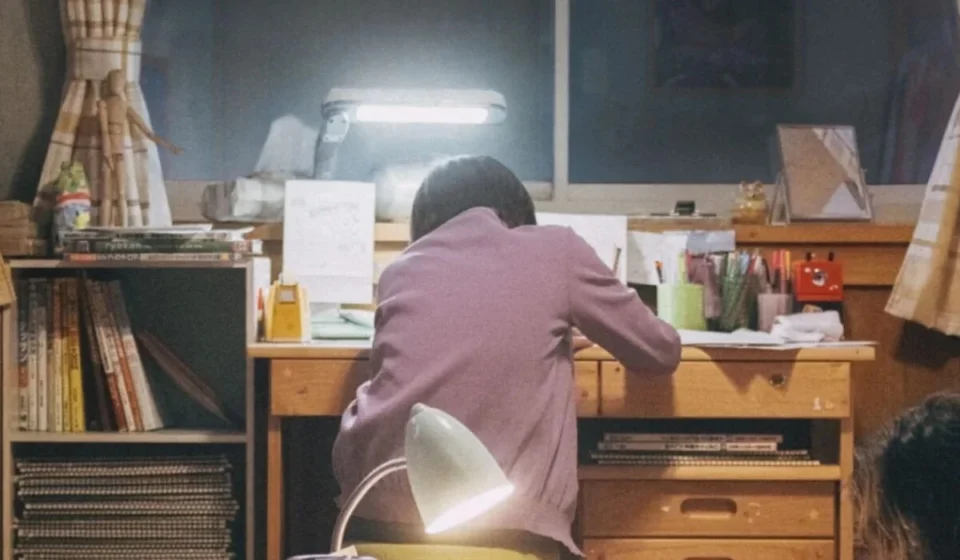
At its heart, Look Back remains a bittersweet exploration of the bond between two young girls in western Japan, united by their shared devotion to manga. Fujino, played with remarkable expressiveness by Furi Nanase, is the quintessential "gifted child"—boisterous, self-assured, and defined by the yonkoma (four-panel) cartoons she contributes to her school newspaper. Her worldview is shattered in fourth grade, however, by the arrival of Kyomoto, an agoraphobic recluse who begins submitting her own, highly detailed strips to the same paper.
While Fujino’s work thrives on wit and cultural relevancy, Kyomoto’s art is defined by obsessive, almost painful attention to background detail and line work. Their rivalry is as inevitable as it is formative. When fate—and a school diploma—eventually draws them into the same orbit, their competitive friction dissolves into a powerful creative partnership. The two girls, operating under the pseudonym "Kyo Fujino," embark on a journey that consumes their adolescence, transforming them through the shared exhaustion of late nights, creative breakthroughs, and the physical toll of their craft.
Chronology of an Artistic Evolution
The film unfolds with a deliberate, rhythmic cadence. The early, youthful rivalry sets the stage for a collaborative era that feels both fleeting and monumental. As the girls grow, they are seamlessly recast, with Natsuki Deguchi and Aju Makita stepping into the roles of the older Fujino and Kyomoto. This transition is one of the most fluid "baton-passes" in recent cinema, maintaining the emotional continuity of characters who are effectively evolving in real-time.

As the story progresses, the setting of Nikaho—a semi-rural idyll that served as the backdrop for Fujimoto’s own upbringing—becomes a character in its own right. Unlike traditional stories that treat such locales as "nowheresville," Kore-eda imbues the landscape with a natural beauty that mirrors the internal lives of his protagonists. The film was shot across an entire calendar year, capturing the atmospheric shift from emerald summer fields to the biting, blinding white of winter snow, effectively anchoring the girls’ creative fever-dream in the reality of the changing seasons.
Cinematography and the Aesthetics of Memory
Cinematographer Senzo Ueno deserves significant credit for the film’s visual language. His work creates a high-contrast, evocative mosaic that functions like a lucid memory. In one particularly striking sequence, Fujino and Kyomoto trudge uphill through such stark snow that the screen appears to become a blank sheet of paper, a visual metaphor for the creative void and the potential of a new beginning.
Kore-eda, a director known for his profound humanism, resists the temptation to turn the film into a mere stylistic exercise. His visual choices are always in service to the narrative’s emotional truth. By slowing the pace, he creates a "temporal vertigo." While the anime version moved with the momentum of a runaway train, Kore-eda’s film moves like a high-speed Shinkansen—traveling at such an intense velocity that it occasionally feels eerily still. This pacing allows the audience to sit with the film’s central, devastating twist in a way that feels both patient and profoundly unsettling.
The Implications of Time and Legacy
The fundamental question posed by Look Back is: Why do we create? In the original manga and the previous anime adaptation, the answer often leaned toward the cathartic or the existential. Kore-eda’s version, however, shifts the tonality toward a more urgent resolve.

The inclusion of subtle grace notes—such as the girls attending a screening of Murnau’s Nosferatu, where the projector’s light creates a haunting match-cut against the window of their train—adds a layer of cinephilic depth. These moments emphasize the weight of time, contrasting the years it takes to forge a friendship against the seconds it takes to lose one.
Unlike the anime, which used its brevity as a weapon to highlight the fleeting nature of life, Kore-eda uses the extended runtime to dwell on the "in-between" moments. He acknowledges that the act of drawing can be tedious—the hand cramps, the shading, the endless revisions—but he highlights the joy of the process. When Fujino finally upgrades to a digital tablet, the audience feels a visceral sense of relief, a validation of her evolution as an artist who has chosen to keep going rather than burn out.
Official Reception and Contextual Significance
Premiering at the 2026 Venice Film Festival, the film has been hailed as a triumph of adaptation. While some might have feared that a live-action version would struggle to capture the "lush nostalgia" of the manga, Kore-eda’s film succeeds by focusing on the material reality of his characters’ lives.
The score, composed by Yuta Bandoh, is measured and restrained, providing a tonal anchor that prevents the film from descending into melodrama. Even when the plot loops through the Möbius-strip-like structure of its emotional climax, the film remains grounded. It does not look for easy answers; instead, it frames the act of creation as a way to honor the past.

A Call to Action
Ultimately, Look Back is not just a story about two manga artists; it is an invitation to engage with one’s own existence. By stretching the plot and allowing the seasons to tick by with rhythmic, almost hypnotic regularity, Kore-eda creates a piece of cinema that asks us to cherish our "beautiful yesterdays."
The film suggests that the time we invest in our passions—and in each other—is never truly wasted, even when the outcome is tragic. In a world where tomorrow is never promised, Look Back serves as a poignant reminder that the work we leave behind is the only way we truly touch the future. Whether you are an artist, a dreamer, or simply someone who has ever looked back at a formative moment with both pain and gratitude, this film is an essential, stirring, and deeply necessary experience.
Grade: B+
“Look Back” premiered at the 2026 Venice Film Festival. GKIDS will release the film in theaters later this year.