The Macro-Crisis and the Micro-Drama: An Analysis of ‘How to Divorce During the War’

In the fractured, post-pandemic global landscape, the boundary between the personal and the political has never been more porous. We live in an era where the most intimate, domestic heartbreaks—the crumbling of a marriage, the friction of parenting, the search for professional identity—are inextricably linked to the hum of a world in crisis. We scroll through headlines of geopolitical upheaval, genocide, and total war on the same screens we use to negotiate our daily schedules and monitor our bank accounts.
Lithuanian director Andrius Blaževičius captures this profound, often agonizing, sense of cognitive dissonance in his third feature film, How to Divorce During the War. Premiering at the 2026 Sundance Film Festival to critical acclaim, the film serves as a mirror held up to the modern experience of middle-class apathy and the desperate, often selfish, pursuit of normalcy while the world outside is quite literally catching fire.
The Premise: Love in the Shadow of Sovereignty
The "war" in question is not an abstract concept for the characters of How to Divorce During the War. It is the 2022 Russian invasion of Ukraine. For a nation like Lithuania, the conflict is not merely a television event; it is a visceral, encroaching reality. The specter of military occupation looms over the borders, manifesting as a pervasive, low-frequency anxiety among the populace.
However, the film’s central conceit is a masterclass in irony. For its protagonists—the high-achieving, increasingly cynical Marija (played with sharp, brittle precision by Žygimantė Elena Jakštaitė) and her husband, the stagnant, disillusioned filmmaker Vytas (Marius Repšys)—the war serves as both a backdrop and an alibi. It is a massive, global distraction that allows them to defer the messy, painful labor of dismantling their failing marriage.

A Chronology of Disintegration
The film opens with a 20-minute prologue that functions as a clinical dissection of a dying relationship. We are introduced to the domestic status quo: Vytas, a once-promising artist who has been paralyzed by creative inertia for years, occupies the role of the primary caregiver for their precocious daughter, Dovile (Amelija Adomaitytė). Marija, meanwhile, is the breadwinner, navigating the soul-crushing corporate environment of a media firm that produces "short-form video slop."
The resentment is palpable. It is a slow-burn rot, ignited by Vytas’s lack of professional trajectory and fueled by a recent, failed affair. The breaking point is captured in a devastating sequence filmed from the static, claustrophobic perspective of the family car’s windshield. While waiting for their daughter, the two engage in a volcanic argument. Jakštaitė’s performance here is revelatory, as she strips away the layers of middle-class politesse to reveal a raw, ugly truth: "Life was supposed to be exciting, and it turned out to be some kind of bullshit." Vytas, wounded and defensive, pivots to character assassination, mocking her drinking and her obsession with status.
Then, the morning after this personal apocalypse, the news breaks: Russia has invaded Ukraine. The macro-world crashes into their micro-crisis, creating a bizarre synthesis where the characters’ divorce proceedings begin in tandem with the onset of total war.
Supporting Data and Character Dynamics
The narrative progression of the film is marked by how the war forces, or fails to force, changes in the protagonists. Neither Marija nor Vytas are presented as moral archetypes; they are, quite intentionally, flawed and often self-absorbed individuals.

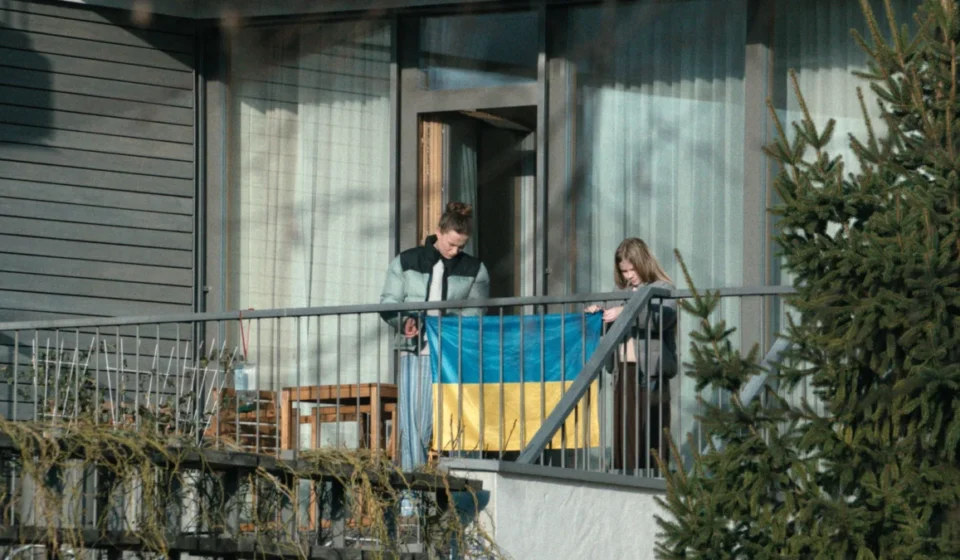
- The Performative Altruism: Marija takes in a Ukrainian refugee family, a gesture that initially appears noble but quickly devolves into a source of personal inconvenience and suppressed resentment. It is a biting critique of the "savior complex" often adopted by the affluent.
- The Creative Exploitation: Vytas, seeking to justify his existence, turns to activism. He packs supplies and participates in performance-art protests covered in red paint. Yet, the film suggests that his participation is, at least in part, a selfish attempt to reignite his "creative mojo" rather than an act of genuine, self-sacrificing solidarity.
- The Generational Divide: The film brilliantly explores the domestic friction of the war. Vytas’s parents, who spent their formative years living in Russia, are glued to pro-Putin propaganda. The intergenerational conflict serves as a microcosm of the political polarization sweeping across Europe.
Aesthetic Choices and Directional Intent
Blaževičius, alongside Director of Photography Narvydas Naujalis, makes the deliberate choice to film the couple with a documentary-style detachment. The camera remains at a distance, employing wide, still shots that emphasize the emotional isolation of the characters even when they are physically in the same room.
While the film is structurally sound, it is not without its controversies. Some critics have pointed to the use of an aggressively discordant piano score by Jakub Rataj as an aesthetic misstep—a heavy-handed attempt to force tension where the script and performances were already providing it in spades. However, this is a minor blemish on an otherwise unflinching, detail-oriented observation of human behavior. The film’s greatest strength lies in its refusal to judge. It observes the characters’ warped sense of priority—their ability to worry about their bank accounts or their reputations while missiles fall on their neighbors—with a clinical, almost anthropological gaze.
Implications: The Luxury of Apathy
The most damning, and perhaps most accurate, aspect of How to Divorce During the War is its ending. At the 100-minute mark, the film does not offer a grand resolution. There is no cathartic reconciliation, nor is there a total collapse. Instead, it captures the characters moving in cycles—acting, retracting, and retreating.
In the final, haunting sequence, Vytas and Marija sit on the couch with their daughter, watching television. They are surrounded by the comforts of their home, the noise of the war relegated to the background, and then, with a simple flick of the remote, they change the channel to a movie.

The implication is clear: the ability to turn off the news is the ultimate privilege of the comfortable. It highlights the disturbing ease with which the human mind can compartmentalize catastrophe. We are left with the uncomfortable realization that while the world is burning, the petty dramas of our lives—the divorces, the career anxieties, the family squabbles—continue to demand our full attention, often at the expense of our empathy.
Official Reception and Release
How to Divorce During the War has been praised for its refusal to rely on the typical "war movie" tropes. It does not focus on the battlefield; it focuses on the living room. By centering the story on a divorce in the shadow of a genocide, Blaževičius has created a film that is profoundly relevant to our current geopolitical moment.
Zeitgeist Films, which secured the rights to the feature, has scheduled a high-profile release in New York on August 21, 2026, followed by a national expansion. As the film prepares to hit wider audiences, it is expected to spark significant discourse regarding the ethics of personal grief in a time of global trauma. It is a film that asks us to look at ourselves, to recognize our own selfishness, and to wonder: when the sirens start to wail, are we really listening, or are we just waiting for the next commercial break?
Grade: B+