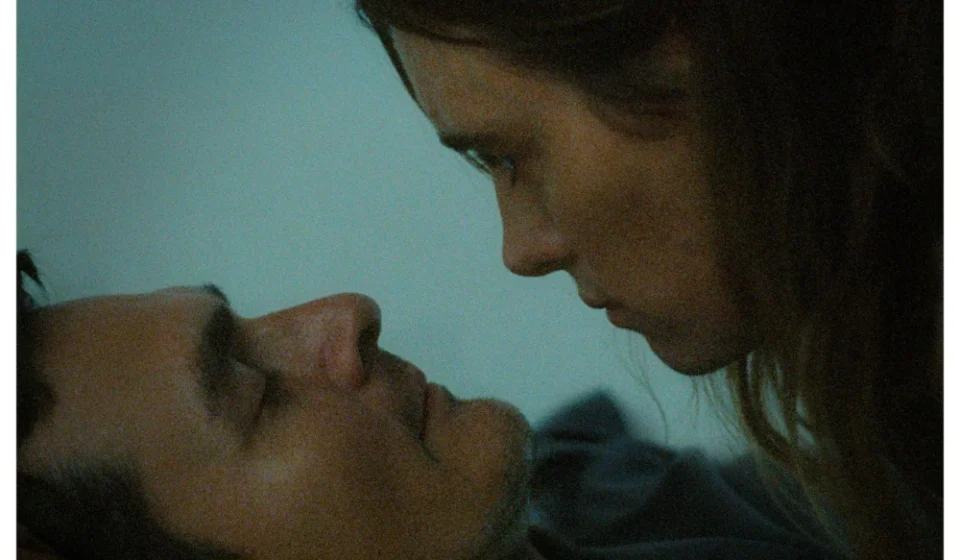

The intersection of domestic fragility and cosmic mystery has long been a fertile ground for auteur cinema. From Andrei Tarkovsky’s Solaris to Claire Denis’s High Life, the vastness of space often serves as a mirror for the impenetrable depths of the human psyche. Hungarian director Lili Horvát, following the international acclaim of her 2020 feature Preparations to Be Together for an Unknown Period of Time, returns to this evocative territory with My Notes On Mars.
A relationship drama that flirts with the boundaries of science fiction, the film presents an ambitious narrative that explores the disintegration of a marriage through the lens of an extraterrestrial enigma. While the film has garnered attention for its hypnotic visuals and a standout performance by Mackenzie Davis, it also serves as a case study in the challenges of sustaining a high-concept "slow cinema" narrative.
Main Facts: The Premise and Production
My Notes On Mars centers on Margot Fogle (Mackenzie Davis), a brilliant American astrophysicist who has recently relocated to the rural outskirts of Budapest with her husband, Sam (Rupert Friend). The move, intended to be a fresh start, instead becomes the backdrop for a profound psychological and physical disappearance.
Core Narrative Pillars:
- The Disappearance: During a hike in the Hungarian mountains—a trip intended to mend the couple’s fraying bond—Margot vanishes without a trace.
- The Return: Two months later, on the very day a memorial service is being held for her, Margot reappears at their home. She possesses no memory of her identity, her husband, or her whereabouts during the interim.
- The Obsession: The "new" Margot is driven by a singular, primal urge: to destroy the extensive research notes she compiled regarding the topography of Mars.
- The Creative Team: Directed by Lili Horvát and lensed by cinematographer Róbert Maly, the film features a score by Gábor Keresztes. The production marks a significant English-language foray for Horvát, utilizing an international cast to explore themes of alienation and linguistic/cultural displacement.
Chronology: From Academic Spark to Domestic Decay
The narrative structure of My Notes On Mars is intentionally elliptical, mimicking the fractured memory of its protagonist.
The Prelude to Vanishing
The film opens with a sensory-heavy sequence: Margot floating in a pool at her new Hungarian homestead. As the water muffles the world, the camera dives into her perspective—moving from the rural landscape to the microscopic textures of the Martian surface. This sets the stage for Margot’s state of mind: she is physically in Hungary, but intellectually and spiritually light-years away.
Before her disappearance, Margot is depicted as a woman on the edge of a breakthrough. She scrawls complex mathematical equations on her own skin, a manifestation of an "academic spark" that creates a chasm between her and Sam. Sam, an equestrian whose life is rooted in the physical and social world, grows increasingly resentful of Margot’s withdrawal into her work.
The Mountain and the Void
The "inciting incident" occurs during a reluctant mountain hike. Exhausted and emotionally distant, Margot falls behind and vanishes. The film skips the procedural elements of the search, jumping forward two months to the memorial. Her return is not a moment of relief but one of profound uncanny horror. Sam finds a version of his wife that is "human-adjacent"—she recognizes the world through smell and sound but lacks the social conditioning of her former self.
The Stagnation of the Return
The middle act of the film focuses on the "homecoming." Margot’s amnesia is treated not as a medical condition to be cured, but as a metaphysical state. She navigates her home like an explorer on a foreign planet. The tension shifts from "where was she?" to "what has she become?" However, as Margot fixates on burning her notebooks and begins an enigmatic flirtation with Alex (Atanáz Babinchak), a young observatory employee, the narrative momentum begins to plateau. The mystery, rather than deepening into a resolution, begins to repeat its thematic beats.
Supporting Data: Themes, Performance, and Visual Language
To understand the impact of My Notes On Mars, one must look at the specific artistic choices that define its first hour as "Tarkovskian" and its latter half as a grounded drama.
The "Lowell" Metaphor
A pivotal piece of supporting data within the script is the mention of Percival Lowell, the 19th-century astronomer who famously claimed to see canals on Mars. It was later discovered that Lowell was likely looking at the reflection of the blood vessels in his own eye through the telescope.
This serves as the film’s central metaphor: Margot’s obsession with the "Red Planet" is, in fact, a deep-seated look inward. Her desire to escape Earth is a desire to escape the suffocating expectations of her marriage and her own identity.
Performance Analysis: Mackenzie Davis and Rupert Friend
Mackenzie Davis delivers a performance defined by "alien-esque" body language. Critics have noted her ability to portray a character who is physically present but psychologically "unmapped." Her transition from the high-strung intellectual of the first act to the primal, childlike amnesiac of the second act provides the film’s emotional anchor.
Rupert Friend provides the necessary counterweight. His portrayal of Sam is one of "suppressed agitation." He represents the "literal" world—the husband who wants his wife back, not a stranger who shares her face. The friction between Friend’s groundedness and Davis’s abstraction creates the film’s most compelling domestic scenes.
Aesthetic Craftsmanship
- Cinematography: Róbert Maly utilizes a "curious haze," employing soft lighting and intimate close-ups to create a dreamlike atmosphere. The Hungarian landscape is shot to look both ancient and otherworldly.
- Score: Gábor Keresztes’s shimmering, minimalist score has been compared to the quieter movements of Hans Zimmer’s Interstellar, emphasizing the "cosmic" scale of the characters’ internal grief.
Official Responses and Critical Reception
The critical reception of My Notes On Mars has been polarized, reflecting the film’s own shift in tone.
The Praise for Atmosphere
Initial reviews have lauded Horvát’s ability to build atmosphere. The first hour of the film is frequently described as a masterclass in "eerie abstraction." Critics have praised the film for not relying on cheap sci-fi tropes (like aliens or spaceships) but instead using the idea of the extraterrestrial to heighten domestic turmoil.
The "Loss of Steam"
The primary criticism leveled against the film involves its pacing and its shift toward the literal. As the mystery progresses, the narrative "wheel-spinning" becomes apparent. Reviewers from outlets like Variety have noted that the film’s "growing mysteries nudge it, paradoxically, toward the literal, leaving it with few places to go."
The consensus suggests that while the film is aesthetically confident, it yields "emotional plateaus." Once the audience deciphers the symbolism—that the "Mars" obsession is a proxy for marital decay—the film struggles to find a new gear, leading to a conclusion that some find "emotionally vague."
Implications: The Legacy of Arthouse Sci-Fi
My Notes On Mars occupies a specific niche in contemporary cinema: the "Domestic Sci-Fi." Its existence and reception point toward several broader implications for the genre.
1. The De-escalation of Sci-Fi
The film follows a trend of "low-fi" science fiction where the "genre" elements are entirely psychological. This suggests a growing appetite in the indie circuit for stories that use cosmic themes to explore mundane human experiences like divorce, grief, and identity loss.
2. The Challenge of the "Mystery Box"
The film serves as a cautionary tale for the "mystery box" narrative structure. By setting up an "intriguing premise" (the disappearance and return), the film creates an expectation for a metamorphosis that never quite arrives. The implication for future filmmakers is the difficulty of balancing "uncanny poetry" with the narrative requirements of a feature-length plot.
3. A Fitting Outcome for Marital Drama
Despite the criticisms of its stagnation, there is an argument to be made that the film’s repetitive nature is intentional. As a film about a "marriage running its course," the stagnation of the plot mirrors the stagnation of the relationship. The lack of a "meaningful metamorphosis" for Margot and Sam is, perhaps, the most honest ending possible for a story about two people who have simply reached an impasse.
In conclusion, My Notes On Mars is a visually dazzling, intellectually provocative piece of cinema that captures the "quiet stress" of a failing relationship. While it may struggle to sustain its initial atmospheric brilliance, the performances of Davis and Friend, combined with Horvát’s unique directorial voice, ensure that it remains a significant entry in the landscape of modern European cinema. It is a film that looks at the stars only to find the blood vessels of the human heart.