A Crucible of Cinema: Celebrating 80 Years of Resilience at the Karlovy Vary International Film Festival

The Karlovy Vary International Film Festival (KVIFF) is more than a mere showcase of moving images; it is a living, breathing testament to the survival of culture in the face of geopolitical turbulence. As the festival marks its 60th edition—spanning an improbable 80-year history—it stands as a singular entity in the world of film. Nestled in the curative, mineral-rich vapors of the Czech spa town of Karlovy Vary, the festival has weathered the collapse of empires, the chilling grip of state censorship, and the eventual rebirth of a nation. This year’s “Vary Special” anniversary event was not merely a celebration of milestone numbers, but a reflection on how a festival can curate its own identity by reconciling its Communist-era architectural bones with a proudly progressive, globalized soul.
A Chronology of Survival: From Occupation to Global A-List
The history of KVIFF is inextricably linked to the volatile history of Central Europe. Founded in 1946—the year following the liberation of Czechoslovakia from Nazi occupation—the festival preceded the inaugural Cannes Film Festival by a matter of weeks, positioning itself as a beacon of artistic recovery.
The subsequent decades saw the festival transformed into a pawn of the Cold War. By 1958, the International Federation of Film Producers Associations (FIAPF) awarded KVIFF the prestigious “Category-A” status, acknowledging its profound international influence. However, the shadow of the Soviet Union loomed large; for decades, Moscow dictated that Karlovy Vary alternate its scheduling with the Moscow International Film Festival, a forced parity that lasted until 1994, two years after the velvet transition into the independent Czech Republic.

Today, the festival operates with a distinct, self-assured eclecticism. It occupies the Hotel Thermal, a masterpiece of Brutalist architecture that provides the festival with the nostalgic, sterile atmosphere of a Soviet-era sanatorium. It is a space where the heavy weight of history meets the cutting-edge of contemporary cinema, creating a unique tension that defines the KVIFF experience.
Supporting Data: The Anatomy of the “Vary Special”
The logistical philosophy of KVIFF remains refreshingly human-centric. By capping ticket bookings at three per day, the festival discourages the "binge-watching" culture that often leads to burnout at larger festivals like Cannes or Berlinale. This measured pace allows for a more contemplative engagement with its dual-menu programming: a curation of high-profile regional debuts from the Western festival circuit alongside a deep, archival dive into Eastern European cinema—both long-lost classics and avant-garde discoveries.
The festival’s signature traditions have become as anticipated as the films themselves. The brisk, black-and-white trailers directed by Ivan Zachariáš—which humorously feature Crystal Globe winners in bizarre, meta-narrative scenarios—remain a fan favorite. Whether it’s Mel Gibson fending off robbers with a blowgun or Stellan Skarsgård using the festival’s own statuette as fishing bait, these shorts serve as a reminder that the festival does not take its own prestige too seriously. Complementing this is the ongoing masterclass series curated by artistic director Karel Och, who has dedicated years to ensuring at least one John Cassavetes film is programmed every edition, a testament to the festival’s commitment to auteurist integrity.

The Anniversary Retrospective: “Out of the Past – KVIFF 60/80”
The centerpiece of this year’s celebrations was the retrospective Out of the Past – KVIFF 60/80, a meticulously curated timeline of the festival’s evolution. The selection was vast, bridging the gap between the immediate post-war era and the digital restoration movement.
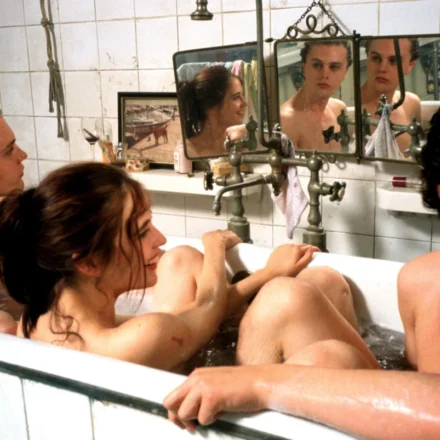
Notable screenings included Powell and Pressburger’s A Matter of Life and Death (1946), a film that served as a surreal, hopeful salve to a war-torn Czechoslovak public. The retrospective also highlighted the festival’s complex political history by showcasing suppressed works like Juraj Jakubisko’s Birds, Orphans and Fools (1969), a film that remained under lock and key until 1990. By juxtaposing these with international trailblazers—such as the debut of Glauber Rocha’s Barravento (1962)—the festival reminded audiences that KVIFF was a window to the wider world even when the Iron Curtain was at its most opaque. The inclusion of digital restorations, such as the razor-sharp Sexy Beast (2000) and Věra Chytilová’s psychosexual AIDS-era tragicomedy Tainted Horseplay (1988), underscored the festival’s role in preserving the aesthetic diversity of the late 20th century.
Contemporary Voices: Cannes Contenders and Competitive Innovation
While history served as the anchor, the festival’s pulse remained firmly set to the present. Two of the most discussed films, both featuring "time" in their titles, arrived with significant momentum from Cannes. Emmanuel Marre’s A Man of His Time proved to be a grueling, 155-minute exploration of the banality of evil. Set against the backdrop of the Vichy regime, the film uses stationary, observant cinematography to document a protagonist’s slow slide into the machinery of fascism. It is a sobering, relevant work that prioritizes the psychology of the mediocre collaborator over the spectacle of the villain.

Conversely, Sandra Wollner’s Everytime offered a more ethereal, memory-focused experience. Drawing thematic parallels to the grief-stricken intimacy of Charlotte Wells’ Aftersun, Wollner’s work is a hallucination of urban realism that trusts the medium of fiction to process trauma. Both films anchored the festival’s commitment to cinema that challenges the viewer to remain present, even when the subject matter is difficult to process.
In the competitive spheres, the Proxima section—now five years into its life as a global platform for emerging talent—awarded its Grand Prix to Martina Buchelová’s Lover, Not a Fighter. The film is a chaotic, vertical-video-infused love letter to the digital-native generation, capturing the scrappy, self-destructive nature of modern youth with an intimacy that feels less like a movie and more like a stolen glance at a friend’s private life.
Implications and Reflections: The Politics of the Screen
The most provocative entry, however, was Black Money for White Nights by Bulgarian duo Kristina Grozeva and Petar Valchanov. The film tells the story of an elderly couple who, despite a lifetime of petty corruption, are blindsided by the reality of the Russian invasion of Ukraine as they attempt to fulfill a lifelong dream of visiting St. Petersburg.

The film serves as a scathing, witty fable about the illusion of neutrality. By decorating the couple’s home with wallpaper depicting birch forests—a nod to the romanticized Russian literary tradition—the directors illustrate the painful collision between idealized culture and brutal contemporary reality. The fact that the film did not take home a prize is perhaps its own form of recognition; it touched a nerve, engaging directly with the geopolitical context that has defined KVIFF’s very existence.
Conclusion: Reclaiming the Past, Defining the Future
KVIFF 60/80 was a triumph of context. By choosing to face its communist inheritance—the Brutalist architecture, the state-mandated history, and the periods of suppression—with intellectual rigor and artistic flair, the festival has transformed its past from a burden into a foundation.
As the festival moves into its next decade, it remains a rare space where the cinema of the past is not merely preserved in amber, but actively used to interpret the present. The "Vary Special" edition proved that when a festival dares to look backward with honesty, it gains the necessary clarity to project its future. Whether through the lens of a 1946 melodrama or a 2026 digital experiment, the Karlovy Vary International Film Festival continues to be a vital, living institution—one that reminds us that, regardless of the political climate, the screen remains the most resilient place for human truth to reside.