The Architect of Will: Deconstructing the Masterful Third Episode of ‘Lanterns’

Editor’s Note: The following review contains comprehensive spoilers for “Lanterns” Episode 3, “OutKast,” including the final act. For a spoiler-free overview of the season’s trajectory, read our full season review.
“How do you make a Green Lantern?”
It is a question that strikes at the very heart of the DC mythology. For decades, the lore of the Green Lantern Corps has rested on a foundation of divine selection: an inanimate, sentient ring traverses the cosmos, searching for the singular soul capable of overcoming great fear. It is a process predicated on neutrality and cosmic destiny. But in its third episode, “OutKast,” HBO’s Lanterns dares to dismantle that myth, replacing the whims of a glowing bauble with the cold, calculated machinations of the Guardians of the Universe.
In this episode, the series pivots from a standard procedural mystery to a profound, character-driven examination of systemic inequality, the weight of inherited trauma, and the divergent paths of two men tasked with wielding the greatest power in the universe.
The Chronology of an Origin
The narrative of “OutKast” is a departure from the show’s established procedural rhythm. Eschewing the ongoing investigation into the Manhunters or the unfolding mystery in Nebraska, the episode functions as an extended, masterful flashback. We are taken back to the genesis of John Stewart (Aaron Pierre), not as a hero found by a ring, but as a man constructed by his family to fill a void in a system that was never designed for him.

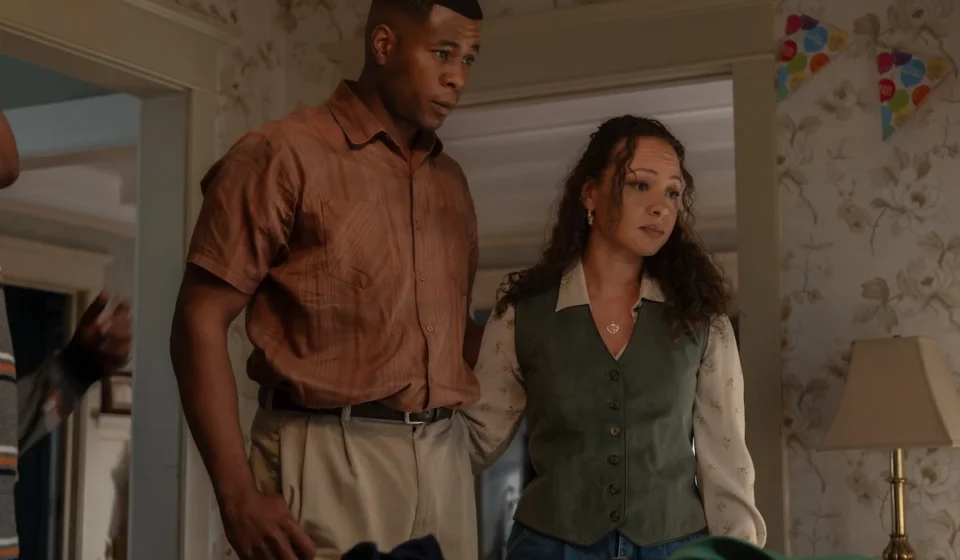
The episode opens with a chilling realization: John Stewart’s path to the Green Lantern Corps was paved long before he ever donned the mantle. We see his father, John Sr. (J. Alphonse Nicholson), attempting to undergo the trial of the ring. He fails, not through a lack of character, but through a lack of the specific, privilege-adjacent "fearlessness" the Guardians demand. The fallout of this failure fractures his family, turning a decorated Marine into a pariah in his own community.
It is at this point that Bernadette Stewart (Jasmine Cephas Jones) steps in, not as a passive observer, but as an architect of her son’s future. Following a clandestine visit from a Guardian—played with icy, detached precision by Laura Linney—Bernadette commits to an extreme, almost militant training regimen for her youngest son. The episode details a childhood defined by isolation, grueling marksmanship drills, and a psychological hardening that is as harrowing as it is impressive. John Jr. is raised to master his fear, even as he faces the daily, grinding reality of being a Black man in America.
Supporting Data: The Cost of Excellence
The episode’s strength lies in its unflinching look at the "price of admission" for success in a rigged system. The imagery of John Stewart waiting months in the wilderness, or sitting motionless for half a day to prepare for a singular moment of recognition, serves as a stark contrast to the effortless trajectory of Hal Jordan (Kyle Chandler).
While Hal represents the traditional, privileged hero who was "chosen" because he fit the mold, John represents the reality of those who must fight to be seen. The dialogue between Bernadette and the Guardian is the episode’s ideological anchor. When the Guardian questions the necessity of such extreme measures, Bernadette delivers the line that defines the series: “Do you understand how unfair it is to ask a Black man in America if he’s afraid?”
The episode also highlights the cultural disconnect between the Guardians and their subjects. The Guardians are god-like entities, yet they possess a profound, perhaps fatal, lack of understanding regarding human psychology. They view John as a "perfect" candidate because they have successfully programmed him, failing to realize that by drilling the "human" parts out of him, they may have created something far more volatile than the hero they envisioned.

Official Perspectives: The Guardian’s Blind Spot
The presence of Laura Linney’s Guardian serves as the primary antagonist of the episode’s internal logic. Her interactions with the Stewart family underscore a recurring theme in Lanterns: the arrogance of power. She represents the institutional body that has lost faith in Hal Jordan—partly due to the betrayal by his mentor, Sinestro—and is now actively engineering his replacement.
The revelation that John is in the room not to back up Hal, but to replace him, shifts the power dynamic of the entire series. It paints the Guardians not as benevolent cosmic arbiters, but as bureaucratic manipulators who treat Earth’s defenders as disposable assets. The Guardian’s disdain for Hal’s impulsivity is clear, yet she fails to recognize that her own cold, detached management style is exactly what caused the instability in the first place.
Implications: The Future of the Corps
“OutKast” poses a critical question for the remainder of the season: Can a man who was built to follow orders ever truly become a hero who defies them?
John Stewart has spent his entire life being told who to be. From his parents to the Marine Corps to the Guardians, his life has been a series of requirements met. However, the chemistry—and the tension—between him and Hal suggests a paradigm shift. In a typical police procedural, the partner’s influence is transformative. As John begins to operate alongside the wild, unpredictable, and undeniably human Hal Jordan, the programming he received as a child may begin to crack.
The bird imagery used throughout the episode serves as a powerful metaphor. John grew up believing birds were the eyes of the Guardians, tracking his every move. When he realizes this was a fabrication by his mother, the implication is profound: either he is constantly watched, or he is entirely alone. Whether he chooses to act as though he is under surveillance or decides to "fly his own course" will likely define the arc of the season.

Directional Brilliance and Aesthetic Choices
It is impossible to discuss “OutKast” without noting the direction of Stephen Williams. Having previously collaborated with showrunner Damon Lindelof on Watchmen—specifically the acclaimed episode “This Extraordinary Being”—Williams brings a similar visual and thematic weight to Lanterns.
The use of OutKast’s “Gasoline Dreams” as a diegetic centerpiece is not merely a stylistic flourish; it is a vital piece of the narrative puzzle. It serves as a flashpoint for John’s relationship with his brothers and his struggle with his own identity. The episode’s pacing, the deliberate use of silence, and the stark, grounded cinematography elevate it beyond the genre trappings of a typical superhero show.
Conclusion
“OutKast” is a triumph of narrative ambition. By slowing down the pace to focus exclusively on the "how" and "why" of John Stewart’s existence, Lanterns has successfully elevated its stakes. It is no longer just a show about space cops and extraterrestrial threats; it is a meditation on what it means to be worthy of power in a world—and a universe—that often refuses to acknowledge your humanity.
As we look toward the next installment, the central mystery is no longer just about who is pulling the strings in Nebraska. The real mystery is whether John Stewart will remain the weapon his parents and the Guardians forged, or if he will seize the ring and, for the first time in his life, define his own purpose.
Grade: A-

Lanterns airs new episodes Sundays at 9 p.m. ET on HBO and is available to stream on Max.