Amazon Transforms Prime Video Into an Interactive Hub with Deep Integration of Luna Cloud Gaming

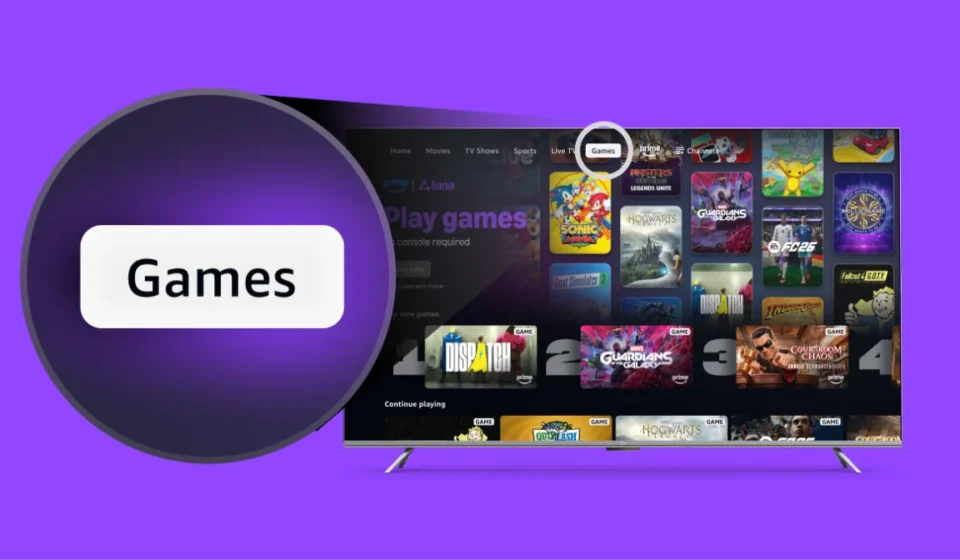
In a strategic maneuver that signals a significant evolution in the streaming wars, Amazon has officially integrated its Luna cloud gaming service directly into the Prime Video interface. For users equipped with Amazon Fire TV devices, the transition is seamless: a new “Games” tab now sits prominently alongside existing categories like “Movies,” “TV Shows,” “Live TV,” and “Sports.” This integration marks more than a mere software update; it represents Amazon’s most aggressive attempt to date to position Prime Video not just as a streaming repository, but as a holistic entertainment ecosystem.
Main Facts: The Convergence of Streaming and Play
Starting today, subscribers utilizing Fire TV hardware can access a curated selection of titles—ranging from heavy hitters like Hogwarts Legacy and EA Sports FC 26 to family-oriented titles such as Clue—without leaving the Prime Video environment. By embedding Luna’s cloud gaming capabilities, Amazon is removing the "friction of discovery" that has historically hindered cloud-based gaming services.
For the casual gamer, the user experience is designed to mirror the simplicity of selecting a film. Users can browse, click, and play instantaneously. This structural shift is designed to bridge the gap between passive consumption and active engagement, transforming the living room television into a multi-purpose gateway for interactive media.
A Chronological Look at Amazon’s Gaming Ambitions
Amazon’s journey into the gaming sector has been a decade-long exercise in persistence, often characterized by trial and error.
- The Early Years (2014–2018): Amazon began its foray into gaming with the acquisition of the streaming platform Twitch for $970 million, signaling an intent to own the gaming community’s social fabric. During this period, the company also launched Amazon Game Studios, though early efforts to produce high-budget original titles struggled to gain critical traction.
- The Luna Pivot (2020–2022): Recognizing the shift toward infrastructure-as-a-service, Amazon introduced Luna, a cloud gaming service built on AWS technology. This allowed users to bypass expensive hardware, instead streaming games directly from the cloud.
- The Integration Phase (2023–2024): Amazon began experimenting with "Games" sections on its Fire TV interface, testing the waters for a more unified experience.
- The Current Milestone (2025): The full integration of Luna into the Prime Video platform marks the culmination of this strategy. By housing the service under the Prime umbrella, Amazon is moving to normalize cloud gaming as a standard feature of a premium subscription, rather than a niche add-on.
Supporting Data: The Scale of the Cloud Gaming Market
While Amazon’s move is bold, analysts remain tempered in their expectations regarding the immediate disruption of the gaming industry. According to data provided by Ampere Analysis, the path to mainstream dominance is still long.
Piers Harding-Rolls, senior research director for games at Ampere Analysis, notes that pure-play cloud services, including Amazon Luna Premium, generated approximately $700 million in consumer spending in 2025. While impressive in isolation, this accounts for a mere 0.3% of global spending on gaming content and services.
"Cloud gaming services have a long way to go to challenge the established device categories of mobile, console, and PC," Harding-Rolls explains. However, he highlights that Amazon is uniquely positioned for this climb. "Companies like Amazon, who are better placed than many due to their AWS infrastructure and large-scale subscription businesses, have a distinct advantage. The sector is growing strongly, but it is years away from becoming a truly mainstream activity equivalent to console gaming."
Official Responses and Strategic Intent
Jeff Gattis, General Manager of Gaming at Amazon, is candid about the company’s history and its future outlook. "Amazon has been ticking away at the gaming space for over a decade now with varying degrees of success, but we have never really established Amazon as a destination where people come to play games," Gattis admits.
Regarding the decision to integrate Luna into Prime Video, Gattis views it as a utility play. "From a business perspective, we’re just going to drive a ton more discovery and awareness of this great benefit. Ideally, at the end of the day, it’s about getting more people playing video games."
Crucially, Amazon is not attempting to engage in a "console war" against the likes of Sony or Microsoft. Gattis argues that the traditional gaming market is already saturated. "Your PlayStations, your Xboxes, your Steam and PC players—they are already well-served. I might even argue they are over-served, where companies are largely just competing for the same pool of players. It’s a pool that’s really not growing in terms of the console install base."
Instead, Amazon is targeting the "three and a half billion people in the world who play video games," the vast majority of whom do not own high-end gaming hardware. By focusing on "approachable IP" with simple mechanics, Amazon believes it can capture a massive, untapped demographic of casual gamers.
Implications: The Future of Interactive Entertainment
The implications of this integration extend far beyond the immediate catalog of games. Amazon is signaling a paradigm shift in how it views its intellectual property.
1. Leveraging Existing IP
Amazon is doubling down on familiar, licensed IP. The success of Hogwarts Legacy on Luna has provided a blueprint: users prefer games that feel like an extension of their favorite film or book universes. Looking ahead, Gattis confirmed that Amazon is actively looking at the MGM library—which Amazon acquired in 2022—to bolster its game offerings. This includes plans for future James Bond titles and other iconic franchises.
2. Creating New Interactive Formats
Perhaps the most intriguing development is the focus on "interactive experiences." Amazon is currently exploring content like Courtroom Chaos – Starring Arnold Schwarzenegger, which utilizes generative AI to allow users to engage in a dialogue-driven game. Gattis envisions a future where "games" and "video" blur the lines. "I’m excited about creating new types of video games that feel a little more experiential—designed to complement or extend engagement with video IP."
3. The Competitive Landscape
Amazon is not alone in this race. Netflix has been aggressively building its own mobile-first gaming library, often leveraging party games and indie titles to keep subscribers engaged during "in-between" times. Similarly, Peacock has integrated titles based on its own IP, such as Law & Order and Jeopardy!.
The competition for the "living room share of time" is intensifying. By adding a "Games" tab, Prime Video is fighting to ensure that when a user finishes a movie, their next move is not to leave the app, but to start a game.
Conclusion: A New Era for Prime Video
As the streaming industry matures, the challenge shifts from subscriber acquisition to engagement and retention. By embedding Luna into the fabric of Prime Video, Amazon is betting that the future of home entertainment is not merely a choice between "watching" and "playing," but a unified experience where the two coexist.
Whether this move will successfully convert millions of Prime subscribers into gamers remains to be seen. However, by lowering the barrier to entry and utilizing its vast library of MGM and Amazon-owned IP, the company has cleared the most significant hurdle: making gaming as accessible as hitting ‘play’ on a television show. For Amazon, the endgame is clear: to ensure that the Prime Video platform remains the default destination for all forms of digital entertainment.