The Philosophical Chess Match: Deconstructing the Psychological Intensity of ‘Suzuki=Bakudan’

“Revenge and love aren’t equals.”
In the landscape of modern cinema, the "cat-and-mouse" thriller is a high-wire act. It requires a delicate balance of pacing, character psychology, and narrative tension to succeed. When executed with precision, these films transcend simple crime dramas, evolving into complex philosophical inquiries that challenge the audience’s moral compass. Akira Nagai’s latest feature, Suzuki=Bakudan (translated as Suzuki=Bomb), based on the acclaimed novel by Katsuhiro Go, stands as a premier example of this genre. It is a white-knuckle, claustrophobic experience that manages to feel simultaneously intimate and epic, turning a tiny, sterile interrogation room into the stage for a global existential crisis.
Main Facts: A Premise Built on Chaos
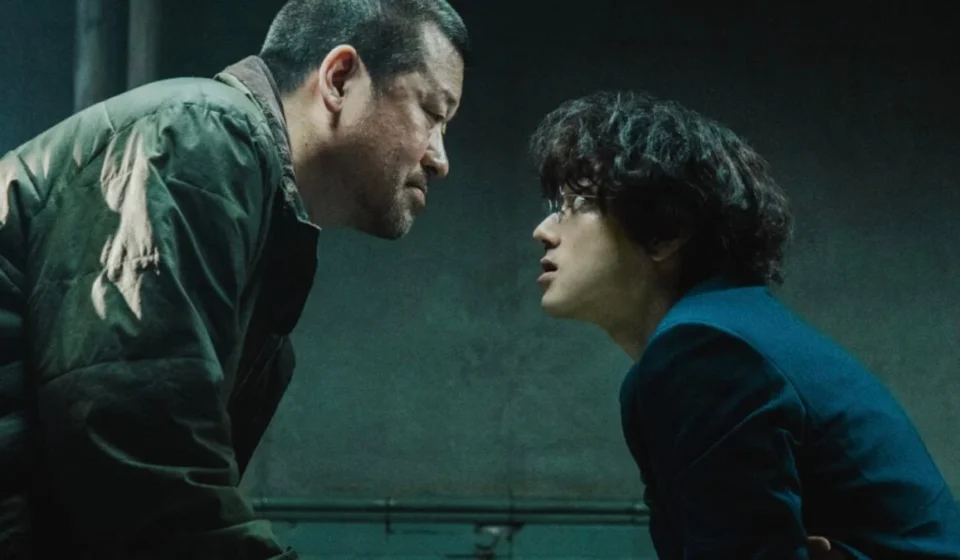
At the heart of Suzuki=Bakudan is a premise designed to unsettle. The narrative centers on Tagosaku Suzuki, portrayed with chilling, chameleonic brilliance by Jiro Sato. Suzuki is introduced as an unassuming, seemingly harmless outcast arrested on a minor charge of disorderly conduct. However, the veneer of the bumbling misfit vanishes the moment he enters the interrogation room.
Suzuki makes a staggering claim: he possesses clairvoyant abilities, and more importantly, he has foreseen a series of devastating bombings across Tokyo. As the police force—led by the skeptical but increasingly desperate investigator Todoroki (Shota Sometani)—grapples with the reality of Suzuki’s claims, they are pulled into a labyrinthine game of psychological warfare. Is Suzuki a deranged terrorist orchestrating the chaos, a reluctant psychic hero trying to prevent it, or a manifestation of something far more sinister? The film refuses to offer easy answers, forcing both the characters and the viewers to navigate a haze of deception where every word is a potential weapon.
![‘Suzuki=Bakudan’ Is a Sadistic Thriller That Blends the Psychic with the Psychological [Fantasia Review]](https://www.dreadcentral.com/wp-content/uploads/2026/07/Suzuki-Bakudan-Suzuki-Pushes-Back-Against-Todoroki-1200x675.jpg)
Chronology: The Anatomy of an Interrogation
The film’s structure is its most daring asset. While many thrillers rely on expansive settings and high-octane chase sequences, Suzuki=Bakudan anchors itself in the static environment of a police precinct.
The Hook
The film wastes no time establishing its stakes. From the opening act, the rhythm is frantic yet controlled. The audience is introduced to the bombings through the lens of the authorities, but the narrative pivot occurs the moment Suzuki is detained. The shift from an external urban disaster to an internal, verbal battle creates a sudden, jarring change in perspective that traps the viewer in the room with the suspects.
The Escalation
As the interrogation proceeds, the film utilizes lengthy, rambling monologues that, while initially anxiety-inducing and exhausting, serve a critical purpose. Nagai uses these sequences to mirror the experience of the interrogators. Just as Todoroki struggles to find the truth within Suzuki’s disjointed riddles, the audience is forced to sift through the noise, losing their footing in the process. This is not merely a stylistic choice; it is a calculated effort to immerse the viewer in the claustrophobia of the interrogation, making the mental fatigue of the characters a shared experience.
The Climax
The film maintains a relentless, snowballing tension that lasts for its full 135-minute runtime. It is a rare feat for a film so dialogue-heavy to maintain such a high level of kinetic energy, yet Suzuki=Bakudan accomplishes this by constantly undercutting its own tropes. Whenever the narrative threatens to fall into a predictable police-procedural rhythm, it abruptly shifts, destabilizing both the characters and the audience.
![‘Suzuki=Bakudan’ Is a Sadistic Thriller That Blends the Psychic with the Psychological [Fantasia Review]](https://www.dreadcentral.com/cdn-cgi/image/width=788%2Cheight=444%2Cfit=crop%2Cquality=75%2Cgravity=auto%2Csharpen=1%2Cmetadata=none%2Cformat=auto%2Conerror=redirect/wp-content/uploads/2026/07/Suzuki-Bakudan-Suzuki-Pushes-Back-Against-Todoroki.jpg)
Supporting Data: Performance and Directorial Vision
The success of Suzuki=Bakudan rests heavily on the shoulders of its lead, Jiro Sato. His performance is a masterclass in duality. Sato transitions between a pathetic, desperate drunk and a cold, calculating mastermind with such fluidity that the audience is left perpetually off-balance. His performance invites inevitable comparisons to iconic cinematic antagonists like the Joker or Jigsaw, yet Sato brings a unique, grounded nihilism to the role that feels distinctly his own.
Akira Nagai’s direction is equally vital. By treating the film like a "magic trick," Nagai keeps the audience looking at the wrong hand. He uses the camera to heighten the sense of confinement, turning the walls of the interrogation room into a closing vice. The technical proficiency displayed in the pacing of these scenes—knowing exactly when to let a moment breathe and when to accelerate the dialogue—is what elevates the film from a standard crime story to a taut, psychological thriller.
Official Responses and Thematic Implications
While the film is largely a success, it is not without its minor flaws. Critics have noted that a secondary narrative arc involving a high-ranking negotiator caught in a public scandal feels slightly extraneous. While this B-story attempts to provide context for Suzuki’s alleged psychic abilities, it occasionally disrupts the focus of the main narrative, acting as a minor distraction in an otherwise tightly wound script.
However, the thematic depth the film attempts to reach remains compelling. Suzuki=Bakudan poses uncomfortable questions about:
![‘Suzuki=Bakudan’ Is a Sadistic Thriller That Blends the Psychic with the Psychological [Fantasia Review]](https://www.dreadcentral.com/cdn-cgi/image/width=788%2Cheight=443%2Cfit=crop%2Cquality=75%2Cgravity=auto%2Csharpen=1%2Cmetadata=none%2Cformat=auto%2Conerror=redirect/wp-content/uploads/2026/07/Suzuki-Bakudan-Todoroki-Listens-To-Suzuki-Interrogation.jpg)
- The Nature of Anarchy: Does a society deserve to be saved if it is inherently selfish?
- Power and Justice: How do we define authority when the "bad guy" holds the key to our survival?
- Humanity’s Moral Decay: The film’s nihilistic undertones suggest that the "bombs" might just be a metaphor for the way society is already destroying itself from within.
While the film does not always provide a clear, coherent answer to these philosophical queries—often leaving them buried under layers of Suzuki’s unreliable dialogue—it successfully creates a space where these questions can be explored. The ambiguity is not a failure; it is a feature of the film’s design, mirroring the uncertainty of the characters themselves.
Conclusion: A Ride with No Brakes
Ultimately, Suzuki=Bakudan is a triumph of atmospheric tension. It is a film that understands the power of the spoken word and the terror of the unknown. By confining its most dangerous character to a single room, it amplifies the psychological stakes to an almost unbearable degree.
Though some may find the pacing demanding and the nihilistic themes occasionally glib, the film’s willingness to challenge its audience is refreshing. It is a story about the fragility of truth and the ease with which a narrative—or a person—can be manipulated. As the film moves toward its explosive conclusion, it leaves the viewer with the lingering sensation of having been part of a grand, dangerous game. Suzuki=Bakudan is a cinematic experience that, much like its protagonist, refuses to be ignored, demanding that you sit down, shut up, and listen to the ticking clock. It is a bold, confident, and unapologetically intense thriller that cements its place as one of the most intriguing entries in modern Japanese cinema.