The Gilded Cage: Unpacking the Cacophonous Legacy of Ilya Khrzhanovsky’s ‘DAU’

After two decades of meticulous construction, psychological experimentation, and persistent controversy, the cinematic project known simply as DAU has finally unveiled its “supreme” iteration. This three-and-a-half-hour feature, centered on the life of Greek-born Soviet physicist Lev Landau, arrives as the 14th installment carved from an impossibly sprawling mega-production. Directed by Ilya Khrzhanovsky, the film is less a traditional biopic and more a gargantuan, volatile artifact of an immersive social experiment that famously turned a corner of mid-century Moscow into a fully functioning, 24/7 totalitarian microcosm. While the making of the project is a narrative of morbid fascination and notorious allegations, the film itself serves as a sobering reminder that artistic ambition, when untethered from narrative rigor, often results in a profound disconnect.
The Genesis of a Totalitarian Microcosm
The origins of DAU trace back to the early 2000s, when Khrzhanovsky first envisioned a standard biographical film about Lev Landau. However, the scope of the project rapidly metastasized. What began as a screenplay morphed into an all-encompassing, living installation. Khrzhanovsky constructed a massive, closed-loop set where hundreds of non-professional actors lived, worked, and interacted under the rigid social codes of the Soviet Union for years on end.
Participants were not merely acting; they were forced to adopt the personas and daily hardships of the era. They wore period-accurate clothing, used archaic currency, and functioned within a hierarchy that mimicked the state-sponsored surveillance and paranoia of the Stalinist regime. This "Truman Show" of the Soviet era became an obsession for the director, who sought to dissolve the barrier between the performer and the reality of the historical subject. As an art project, it garnered international headlines for its audacity and the subsequent allegations of abuse that trailed its production—claims of psychological manipulation, non-consensual scenarios, and the creation of an environment that arguably crossed ethical boundaries in the name of "purity."
A Chronology of Artistic Excess
The path to this 2026 Venice Film Festival premiere has been long and fractured. Over the years, the massive archive of footage—reportedly hundreds of hours long—has been edited into various forms: standalone feature films like DAU. Natasha (2020) and DAU. Degeneration (2020), along with miniseries and digital installations.
The current three-and-a-half-hour film represents an attempt to distill the essence of the "Dau" experience into a coherent narrative. Yet, despite the decades of preparation, the result is ironically repetitive. The film follows Landau (played with erratic, unpredictable intensity by orchestral conductor Teodor Currentzis) as he navigates the intellectual freedom of his scientific pursuits against the crushing, suffocating reality of the Marxist utopia that, as the film suggests, curdled into a Big Brother state almost immediately.
The film’s structure is linear but feels disconnected, as if the director struggled to stitch together a narrative thread from the thousands of hours of improvised interactions. The viewer is frequently subjected to long, aimless sequences that lack the dramatic propulsion necessary to carry such a daunting runtime.

Supporting Data: The Aesthetic of Decay
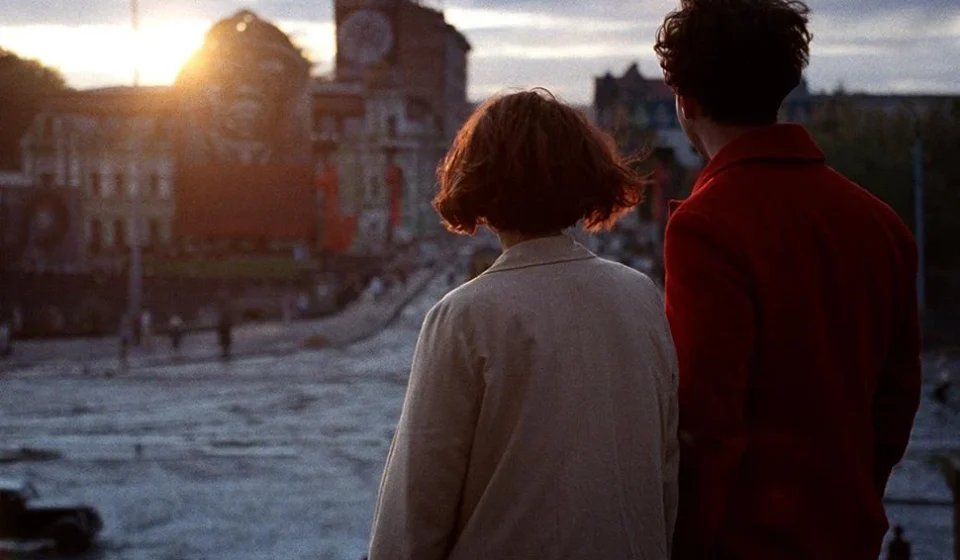
Visually, DAU is undeniable. Khrzhanovsky possesses a keen, almost painterly photographic eye. Every frame is saturated with the texture of mid-century celluloid, capturing the grime, the brutalist architecture, and the claustrophobic interiors of the Soviet era with haunting precision.
However, there is a fundamental distinction between being "photogenic" and being "cinematic." The film’s most striking scenes—conversations between Landau and his mentor, Pyotr Kryupitsa (Anatoly Vasiliev)—are staged in visually arresting locations, such as precarious grids or sharply angled slopes. These set pieces are triumphs of production design, yet they rarely resonate emotionally. The debates, while philosophically dense, recur with a lack of dramatic variation, rendering them tedious rather than profound.
The film’s sound design is equally abrasive, often mirroring the chaos of the production itself. While this cacophony is likely intentional—meant to evoke the screeching gears of a totalitarian machine—it creates a barrier to engagement. Unlike Christopher Nolan’s Oppenheimer, which utilized its internal tension to anchor the audience in the protagonist’s psyche, DAU keeps its lead at a distance, preferring to focus on the ambient environment of the set rather than the internal life of its subject.
Official Responses and Ethical Shadowing
The project has been met with both reverent awe from high-art critics and sharp condemnation from human rights advocates. The allegations of abuse—ranging from the treatment of the extras to the psychological stress placed on the lead actors—have become inseparable from the work itself. In the lead-up to its Venice premiere, the debate surrounding DAU focused heavily on whether the "authenticity" of the experience justified the methods used to achieve it.
Khrzhanovsky has generally maintained that the project was a search for truth, a way to capture human behavior in its most raw, unvarnished state. Yet, when viewed as a finished film, this justification feels thin. Hitchcock famously remarked that drama is "life with the dull bits cut out." By choosing to include the unedited, improvised, and often flailing performances of untrained actors—who frequently block the camera or lose their focus—Khrzhanovsky seems to have mistaken the inclusion of "life" for the inclusion of "drama." The film is a monument to the director’s ego, a sprawling exercise that prioritizes the act of filming over the art of storytelling.
Implications: The Failure of the Totalitarian Vision
What does DAU ultimately say about the Soviet experience? It succeeds in creating a palpable sense of paranoia. In scenes where KGB operatives force Landau’s inner circle to betray him, the film finally catches fire. The tension is real, the stakes are high, and the atmosphere of complicity is chilling. When an old friend returns from the Gulag in the 1950s, the film captures a quiet, creeping terror that is far more effective than its earlier, louder scenes.

Unfortunately, these moments of genuine cinematic power are fleeting, buried under hours of aimless, repetitive footage. The film’s decision to include a bloated, redundant epilogue—which hammers home themes that the audience has already processed—is a testament to the lack of editorial control.
The film’s central irony lies in its premise. Landau, at one point, muses, "It’s very distressing to know that you’re not god." One cannot help but apply this sentiment to Khrzhanovsky. Having spent 20 years playing the role of an all-powerful, all-seeing architect of a miniature world, he now finds himself in the position of a creator who can no longer dictate how his creation is received.
Conclusion: A Grade of C
DAU is a fascinating failure. It is a cautionary tale for any filmmaker who believes that by building a world, they have automatically created a story. While it serves as a testament to the power of production design and the potential for a new, immersive form of cinema, it lacks the soul, the rhythm, and the narrative focus required to be considered a masterpiece.
It is a project that demands to be looked at, but rarely requires to be engaged with. As it heads into the distribution market following its Venice debut, DAU will likely remain a polarizing footnote—a gargantuan, loud, and ultimately empty monument to the folly of total control.
Grade: C
“Dau” premiered at the 2026 Venice Film Festival and is currently seeking U.S. distribution.