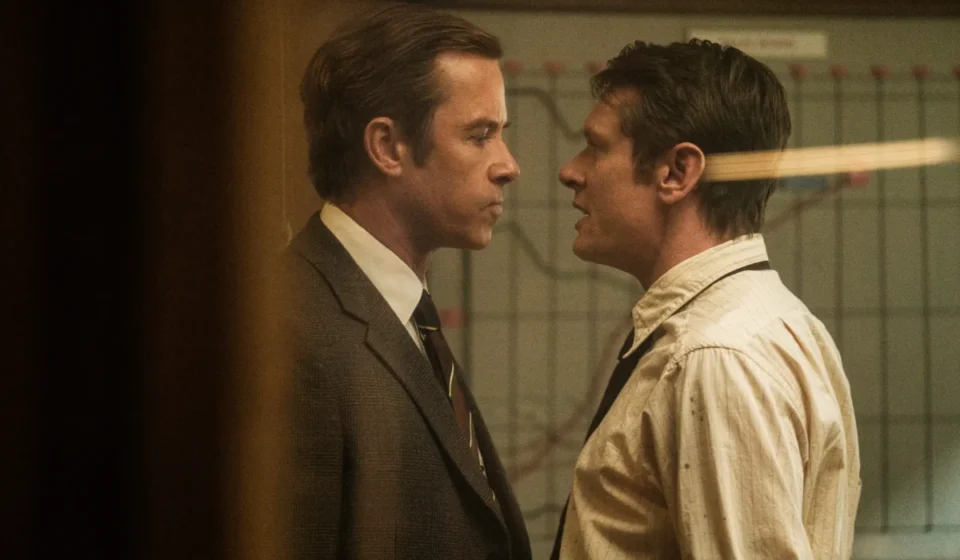

“People need stories,” declares Larry Lamb, the ambitious and beleaguered editor of The Sun, in a pivotal moment of Ink. Set in 1970, Lamb’s words serve as a chilling prophecy, predating the modern era where “storytelling” has become a ubiquitous, often hollow, buzzword for everything from hard journalism to corporate branding. In this propulsive cinematic adaptation of James Graham’s stage hit, director Danny Boyle and writer James Graham transform the historical makeover of British journalism into a high-octane, neon-soaked cautionary tale.
Ink is more than a period piece; it is an autopsy of the moment the fourth estate traded its dignity for circulation figures. Through a lens of sex, murder, and calculated scandal, the film traces a “straight-but-very-crooked line” from the acquisition of a struggling broadsheet by Australian magnate Rupert Murdoch to the fragmented, cynical media landscape of the 21st century.
Main Facts: The Relaunch of a Titan
At its core, Ink focuses on the 1969–1970 relaunch of The Sun newspaper. The film stars Jack O’Connell as Larry Lamb, a Yorkshire-born editor with a chip on his shoulder and a radical vision for populist media. Opposite him is Guy Pearce, portraying a young Rupert Murdoch with an "oily finesse" and a cold, calculating ambition that would eventually reshape global politics.
The narrative explores how Lamb and Murdoch dismantled the fusty, elitist traditions of Fleet Street to create a "Red Top" tabloid that prioritized entertainment over information. The film’s stylistic choices—shot by Alwin H. Küchler and edited by Fin Oates—mirror the very sensationalism it depicts. It utilizes a “driving punk rhythm,” aggressive zooms, and canted angles to immerse the audience in the frantic, often amoral world of deadline-driven scandal-mongering.
While the film takes creative liberties with certain historical details—such as Lamb’s previous employer—it remains anchored in the seismic shift of British journalistic standards. It highlights the introduction of "Page 3," the prioritization of "sleaze, sport, and sex," and the eventual moral crisis triggered by the kidnapping of Muriel McKay, the wife of Murdoch’s deputy, Alick McKay.
Chronology: The Transformation of Fleet Street
The chronological arc of Ink begins with a seduction. In the late 1960s, Rupert Murdoch, already a successful media proprietor in Australia, set his sights on the London market.
- The Acquisition (1969): The film opens with Murdoch attempting to lure Larry Lamb away from his post. In reality, Lamb worked at the Daily Mail, though the film places him at the Daily Mirror to heighten the sense of rivalry. Over a lavish dinner at London’s historic Rules restaurant, Murdoch presents a failing Sun—then a dying broadsheet—as a blank canvas.
- The Relaunch (November 1969): Lamb is given carte blanche to reinvent the paper. He abandons the high-minded aspirations of his predecessors, instead "focus-grouping" his own staff to determine what the working class actually wants. The result is a cocktail of human interest stories, horse racing, and the weather (because, as the film notes, the British are obsessed with it).
- The Rise of Page 3 (1970): To boost sales and thumb his nose at the "Establishment," Lamb introduces topless women to the paper’s third page. This move draws the ire of the Press Council and the Church of England, but as the film shows, the controversy only fuels the paper’s meteoric rise in the sales rankings.
- The Muriel McKay Kidnapping (December 1969 – January 1970): The narrative takes a dark turn when the wife of Murdoch’s deputy is kidnapped. Lamb treats the tragedy as "grabby headline fodder," ignoring police warnings that invasive reporting could jeopardize the victim’s life. This serves as the film’s moral climax, forcing the characters to confront the human cost of their "story-at-all-costs" philosophy.
Supporting Data: The Mechanics of Populism
The film meticulously details the "Five Ws" of journalism—Who, What, Where, When, and Why—and shows how Lamb perverted them into a commercial engine. The transformation of The Sun was not merely an editorial shift; it was a psychological one.
- Circulation as Validation: In the film, Lamb maintains a bulletin board in his office that tracks The Sun’s ascent through the national sales rankings. This data-driven obsession mirrors modern "clickbait" culture, where the value of a story is measured solely by its reach rather than its truth or social utility.
- The Gender Dynamic: Claire Foy delivers a standout performance as Joyce Hopkirk, the most senior female journalist on staff. Her character represents the moral compromise inherent in the era. While she oversees a more "progressive" women’s page, she accepts the "lowbrow misogyny" of Page 3 as a necessary evil for professional advancement and the "excitement" of the new media frontier.
- Aesthetic Evolution: Stylistically, the film begins in newsprint-grainy monochrome before flushing into a gold-filtered color palette. This visual transition represents the move from the "gray" reliability of traditional news to the "technicolor" allure of sensationalism. The sound design by Johnnie Burn and the score by Daniel Pemberton add a "churning, faintly industrial noise," suggesting that the tabloid press is a machine that, once started, cannot be easily stopped.
Official Responses and Critical Analysis
Critical reception of Ink has focused on its "can’t-look-away" energy and the complex performances of its leads. Jack O’Connell’s Lamb is described as a "bullish" and "charismatic" striver whose quest for vindication against the "posh old boys" of Fleet Street makes him an oddly sympathetic anti-hero.
Conversely, Guy Pearce’s Murdoch is portrayed with a "dry, wary conscience." Interestingly, the film suggests that Murdoch—now a global symbol of media manipulation—was initially the more hesitant of the two, occasionally wondering if his "bold new hire" had gone too far. This has led some critics to question if the film "goes too soft" on the mogul, allowing him moments of "I’ve-created-a-monster" reckoning that history might not support.
Director Danny Boyle’s "restless, dynamic strengths" are on full display here. By using the very tactics of the tabloid press—flash, dazzle, and a "sizzle-sizzle" sensibility—Boyle creates a meta-commentary on the audience’s own complicity. We are entertained by the very sleaze the film asks us to condemn.
Implications: From Fleet Street to the Digital Abyss
The final act of Ink makes explicit what its narrative implies throughout: the tactics pioneered by Lamb and Murdoch in 1970 laid the groundwork for the modern media crisis.
The De-standardization of Truth
By prioritizing "what the people want" over what they need to know, The Sun effectively de-standardized journalism. The film argues that this shift paved the way for a media landscape where "truth" is secondary to "engagement." This legacy is traced through a closing montage that connects the 1970s newsroom to Fox News, Facebook, and the unregulated cacophony of social media.
The Loss of the Moral Compass
The kidnapping of Muriel McKay serves as a warning that has gone unheeded. When Lamb counters police warnings by stating that his intention is to affect the case through reporting, he signals the end of the journalist as a detached observer. In the modern era of "mainstream media" versus "alternative facts," this blurring of the lines between reporting and interfering has become a standard operating procedure.
The Faustian Bargain of Populism
Ink poses a haunting question: "Is it vindication if it costs a man his soul?" Lamb’s success brought him power and fame, but years later, as the film notes, the real Larry Lamb admitted to regretting many of his innovations. The film suggests that the populist monster he helped create eventually outgrew its masters, leading to a world where the "Five Ws" have been replaced by an endless, algorithmic scream for attention.
In conclusion, Ink is a riveting, "needling" piece of cinema that leaves the viewer feeling "pretty awful"—not because of a lack of quality, but because of the uncomfortable truths it reveals. It is a story about the power of stories, and the devastating consequences of using that power without a conscience. Larry Lamb wanted to give the people what they wanted; Ink shows us exactly what we got.