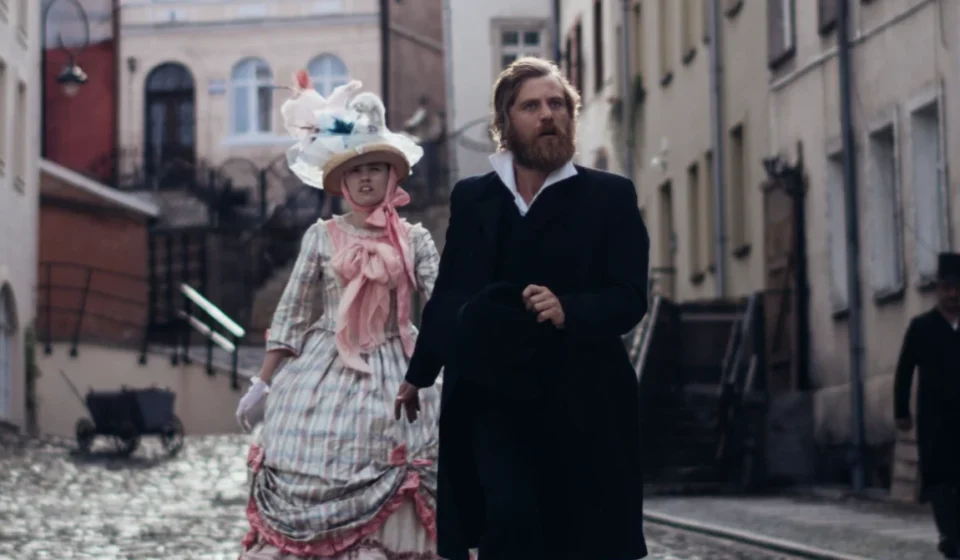
The Beautiful Agony: Dissecting the Surrealist Portrait of Fyodor Dostoevsky in "The Idiot(s)"

Great works of Russian literature have long been defined by a singular, paradoxical tension: the collision of painfully austere existential themes with an almost hallucinatory richness of imagination. This rapturous clash, filtered through the lens of a paranoid, guilt-ridden crime thriller, catapulted Fyodor Dostoevsky’s 1866 novel Crime and Punishment into the global pantheon of essential literature. However, for filmmakers Małgorzata Szumowska and Michał Englert, the focus of their latest project, The Idiot(s), is not the triumph of the pen, but the catastrophic friction of the creator’s life.
In a bold, semi-surreal cinematic interpretation of the author’s turbulent European honeymoon, Szumowska and Englert present a portrait of Dostoevsky that is as frustrating as it is visually breathtaking. Starring Johnny Flynn as the tormented novelist and Aimee Lou Wood as his long-suffering wife, Anna, the film explores the toxic, creative, and financial collapse that birthed one of history’s most profound literary achievements.
The Architecture of Genius and Decay
At its core, The Idiot(s) acts as a biographical fever dream, draped in production design that rivals the lush, theatrical artifice of Joe Wright’s Anna Karenina. Yet, for all its visual splendor, the film forces the audience to endure the same agonizing, slow-motion disaster that defined the Dostoevskys’ marriage during the mid-1860s.
The narrative begins in Baden, where the newlyweds find themselves adrift in a cycle of debt, gambling, and professional isolation. Fyodor, paralyzed by a debilitating writer’s block, is unable to translate his inner turmoil into the manuscript that would eventually become The Idiot. Instead, he externalizes his chaos, gambling away the couple’s meager resources while Anna—a woman whose devotion is as exhausting as it is unwavering—scrambles to maintain a veneer of stability.
A Chronology of Artistic Self-Destruction
To understand the trajectory of the film, one must look at the historical timeline it mirrors. The screenplay, penned by Szumowska, Englert, Kasper Bajon, and Bríd Arnstein, draws heavily from Andrew D. Kaufman’s biographical study, The Gambler Wife, as well as Anna Dostoevskaya’s own diaries and memoirs.
The Honeymoon Period (1866–1867)
The film captures the intense, high-pressure environment of the couple’s early days. Anna, originally hired as a stenographer to help the desperate novelist complete The Gambler in a frantic 26-day burst of labor, soon finds herself entangled in a web of mounting debts and the erratic health of her husband.
The Descent into Baden
As the narrative shifts to their time in European exile, the film introduces figures like the rival novelist Ivan Turgenev (played by Christian Friedel). These scenes serve to highlight the intellectual elitism and suffocating social pressures of the time. The suspense is not derived from traditional plot points, but from the "queasy allure" of watching a man rationalize his way toward ruin.

The Creation of "The Idiot"
The film’s second act focuses on the grueling process of writing the titular novel. For Dostoevsky, the work became an obsessive investigation into themes of innocence, jealousy, and the crushing weight of "goodness" in a corrupt world. The irony, as portrayed by the directors, is that while Fyodor writes of profound moral purity, his own behavior—marked by cruelty and instability—remains deeply antagonistic.
Supporting Data and Creative Choices
The film’s effectiveness hinges on the chemistry—and the conflict—between Flynn and Wood. Johnny Flynn delivers a performance that does not shy away from the ugliness of his subject; he is, by all measures, "profoundly hateable." He embodies the existential rot that defined Dostoevsky’s worst impulses.
Conversely, Aimee Lou Wood’s Anna is the film’s moral and emotional anchor. Wood navigates the shifting tones of the script with remarkable dexterity, swinging from moments of genuine terror to dark, humorous fantasies of her husband’s demise. Her character acts not as a mirror, but as a magnifying glass, intensifying both the genius and the grotesquerie of her husband’s temperament.
Production Design as Narrative Tool
Cinematographer and co-director Michał Englert works in tandem with production designer Ewa Mroczkowska to transform the setting into a character of its own. By utilizing dewy, naturalistic landscapes alongside decadent, suffocating interiors, the film creates a visual dichotomy. The "storybook-like decay" of cemeteries and sun-drenched European villas provides a constant reminder that for the Dostoevskys, suffering was not just a theme—it was an aesthetic.
The Spectral Presence of Fiction
A standout element of the film is the performance of Vicky Krieps as "Natasha F." This character, a spectral manifestation of the novel’s heroine Nastasya Filippovna, haunts the couple’s marriage. This choice blurs the line between reality and hallucination, serving as a reward for Dostoevsky scholars while simultaneously creating a barrier for the uninitiated viewer.
Official Context and Historical Accuracy
The film is not, nor does it claim to be, a straightforward historical biopic. It is a work of "factual slipperiness," acknowledging that the truth of the Dostoevsky household is buried beneath layers of trauma, memory, and literary myth-making.
The inclusion of the couple’s real-life tragedy—the death of their first child during their time abroad—is handled with a jarring, surrealist detachment that reflects the couple’s own coping mechanisms. By refusing to soften these blows, the filmmakers demand that the audience confront the "poisonous" nature of their devotion. As Fyodor famously contends in the film, "Pain and suffering purify the soul," a mantra that the directors use to justify the film’s punishing two-hour runtime.

The Implications of "The Idiot(s)"
What does The Idiot(s) tell us about the nature of creative genius? The film ultimately suggests that the interiority of a masterpiece like The Idiot is impossible to fully replicate on screen. The "dizzying experience" of imagining the novel’s depths will always dwarf any attempt to render it in live-action.
The Price of Greatness
The film leaves the viewer with a lingering, uncomfortable question: is a work of art worth the human destruction required to create it? The devotion shown by Anna—a woman who managed her husband’s epilepsy, his debts, his addictions, and his erratic professional life—is depicted as a profound, perhaps tragic, miscalculation. Even 150 years later, the film struggles to defend the love at the center of this madness.
The Critical Reception
Premiering to mixed but intrigued reactions at the 2026 Telluride Film Festival, the film has been categorized as an "intellectual exercise" that is, in many ways, richer than its rewards. It is a film for the cinephile and the bibliophile, though it risks alienating audiences who lack a foundational understanding of the Dostoevsky canon. By choosing to explore the themes of the novel without directly adapting them, the directors have created a companion piece that functions more like a psychological inquiry than a traditional narrative.
Final Assessment
In its final analysis, The Idiot(s) is a triumph of style and a challenging, if occasionally hollow, meditation on the cost of immortality. It succeeds in capturing the "beautiful agony" of the creative process, even if the portrait of the man behind the desk remains elusive.
Grade: C+
As the film concludes, it leaves us with the unsettling realization that while the years of suffering endured by the Dostoevskys may have been, in their own way, beautiful, they were also entirely unnecessary. The Idiot(s) stands as a testament to the fact that when we look into the abyss of a great writer’s life, we are often looking at a reflection of our own capacity for both creation and destruction. For those willing to navigate its surrealist detours, the film offers a haunting look at the price of genius—a price that, historically and cinematically, remains staggering.