The Art of Controlled Chaos: Matt Johnson and the Evolution of a Guerrilla Filmmaker

Anthony Bourdain once famously likened the environment of a professional restaurant kitchen to a pirate ship: a “dysfunctional, mercenary lot” of misfits united by an outlaw spirit, a desperate need for adrenaline, and a singular, unspoken camaraderie. It is a fitting metaphor, not only for the man himself but for the creative ethos of director Matt Johnson.
For the better part of a decade, Johnson has operated as the industry’s premier agent of cinematic anarchy. From the scrappy, low-budget ingenuity of The Dirties to the corporate-espionage thrill of BlackBerry and the surrealist antics of Nirvanna the Band the Show, Johnson has built a reputation on his ability to blur the lines between reality and fiction. Now, with his latest A24 feature, Tony—a biopic centered on the formative years of a young Anthony Bourdain—Johnson finds himself navigating the most significant transition of his career: moving from the deck of his own pirate ship to the bridge of a major studio production.
The Genesis of an Auteur: A Career Built on In-School Experimentation
To understand the stakes of Tony, one must look at the foundation upon which Johnson’s career was built. Speaking on a recent episode of the Filmmaker Toolkit podcast, the director reflected on the thematic consistency of his work.
"Every single movie I’ve ever made has basically been about a bunch of young men making a movie," Johnson admitted. Whether he is dissecting the frantic engineering culture at Research In Motion, tracking the destructive friendship in The Dirties, or embedding his crew at NASA for the faux-documentary Operation Avalanche, Johnson is consistently interrogating the same developmental milestone: the liminal space of post-adolescence.
"I’m constantly just reliving the feeling of being in film school, trying to figure out how to create myself and become an adult," he explained. For Johnson, filmmaking has never been a sterile pursuit of technical perfection; it has been a survival mechanism, a way to process the chaos of growing up while simultaneously documenting the attempt.

Chronology of the Guerrilla Method
Johnson’s rise is defined by a "run-and-gun" style that borders on the criminal. His early films were forged in the streets of Toronto, often utilizing techniques that would make a studio legal department break into a cold sweat. In Nirvanna the Band the Show the Movie, for instance, the production was so unorthodox that Johnson remains coy about the details of how his crew infiltrated secure locations like the CN Tower.
"I’ll just say the number one thing that gets bank robbers caught is they can’t help but brag about it," he told IndieWire, maintaining a mischievous silence.
This production model allowed for a level of narrative fluidity that is nearly impossible in traditional filmmaking. Johnson describes the process as a detective hunt: "I can pursue ideas that come up on set right to the end. We can create entirely new storylines from moments of improv, or from me meeting somebody on the street. We can chase down the story as if we’re detectives on the trail of a serial killer, and every single clue we get leads us closer."
However, Tony presented a sharp, often uncomfortable pivot. As his first American feature with the backing of a powerhouse like A24, the "guerrilla" approach was rendered impossible by the rigid requirements of a period piece and the narrative weight of depicting a cultural icon.
The "Tony" Transition: Shedding the Safety Net
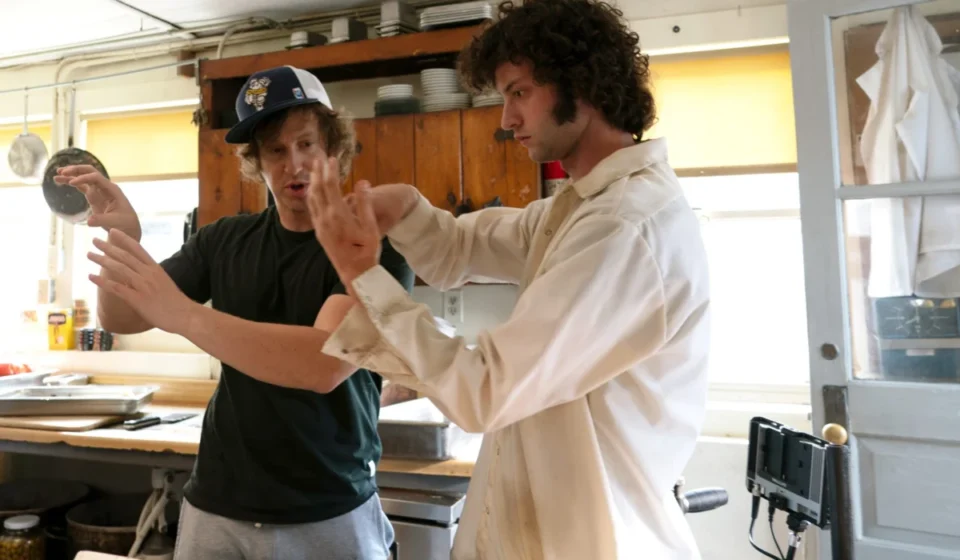
Tony tracks a 20-year-old Anthony Bourdain as he navigates the high-pressure environment of a Cape Cod kitchen. Starring Dominic Sessa, the film requires a level of structural discipline that stands in stark contrast to Johnson’s previous works.

"I was trying to challenge myself to just tell a story using only acting and writing; it’s something I’d never done before," Johnson noted. "It was a real shedding of what normally makes me comfortable… the struggle was that, for the first time, I was really locked into what we had planned."
The transition was not without its friction. Johnson openly admits to feeling "trapped" by the necessity of a pre-planned script. He credits his cinematographer, Michael Bauman—a veteran of Paul Thomas Anderson’s sets—with helping him navigate the technical demands of a structured production. Together, they sought a visual language that echoed the rhythm of Bourdain’s own prose, described by Johnson as "a storybook where the pages just turn."
Despite the success of the film, Johnson maintains a critical view of his own adherence to a plan. "My feeling is that the script and the plan is just your springboard for you to then discover something alive and out of control on the day," he explained. "Every single movie I’ve ever made, the things that work in the film are the things that were mistakes—accidents that happened in a way that I can’t control."
Industry Perspectives: The Philosophy of Enthusiasm
Johnson’s evolution is not happening in a vacuum. His recent proximity to Josh Safdie has provided him with a new framework for understanding the role of a director in high-stakes environments. The two are currently collaborating on a comedy project involving the TSA, and their shared sensibilities have proven to be a guiding light for Johnson.
"Josh said to me, ‘My job is to transfer enthusiasm from myself to the other people making this movie,’" Johnson recounted. He views Safdie as the benchmark for contemporary directors, noting that Safdie has mastered the art of building a "castle brick by brick" around him, ensuring that his unique, kinetic energy remains intact even as his budgets and production scales balloon.

This is a lesson Johnson is currently applying to his next major undertaking: a potential trilogy based on the collectible card game Magic: The Gathering. Reports suggest that Johnson may be inheriting the massive production apparatus previously utilized by Denis Villeneuve for the Dune series. It is a daunting leap, one that tests the limits of his "pirate ship" philosophy.
Implications for the Future
As Johnson matures, he remains acutely aware of the existential threat to his process: the risk of becoming a "technician" at the expense of his intuition.
"I’m not a technician," he insisted. "I actually don’t come to filmmaking from the point of view of someone who has images in his head that wants to create them. That’s not what draws me to movies."
The implications for his career are clear: he is at a crossroads. He can either lean into the studio system, adopting the massive scale of a blockbuster filmmaker, or he can continue to force that massive scale to conform to his "accidental" creative process. He seems uninterested in the former. "It’s not like now that I’ve made Tony I want to make a movie 10 times that size," he clarified.
The challenge for Johnson moving forward will be maintaining the soul of a student—that raw, inquisitive, and slightly dangerous spirit—while operating within the machinery of global entertainment. He is no longer the kid sneaking into the CN Tower to film a scene; he is a director responsible for the legacy of Anthony Bourdain and the expectations of a massive studio.

However, if his track record is any indication, the "pirate ship" is not sinking. It is merely finding new, more complex waters to navigate. For Johnson, the goal remains the same as it was in his film school days: to find the "alive" moments in the middle of a plan, to embrace the errors, and to ensure that, regardless of the budget, the film never stops feeling like it was made by a bunch of friends trying to figure out how to be human.
Tony is currently playing in theaters, with A24 expanding its nationwide release on Friday, August 21. For those looking to dive deeper into the mind of one of cinema’s most intriguing voices, the full conversation with Matt Johnson is available on the Filmmaker Toolkit podcast, streaming on Apple, Spotify, and all major platforms.