Tropical Terror: Christopher Smith’s ‘Spider Island’ Takes a Bite Out of Influencer Culture

Two decades ago, director Christopher Smith carved his name into the annals of modern horror with Creep, a claustrophobic descent into the subterranean nightmares of the London Underground. Today, Smith pivots from the damp, dark tunnels of his past to the sun-drenched, palm-fringed vistas of a tropical paradise. His latest offering, Spider Island, serves as a stylistic departure that maintains his penchant for visceral unease, even as it trades urban decay for a bite-sized arachnid apocalypse.
While the film is currently making waves at festivals like FrightFest, it presents a complex tapestry of social satire, monster-movie mechanics, and bold character choices that have left critics and audiences debating its ultimate impact.
The Premise: When Greed Meets Eight Legs
The narrative follows a curated group of obnoxious social media influencers who are lured to an isolated, pristine island under the guise of an exclusive resort opening. The architect of this scheme is David, played with a masterfully repulsive energy by Andy Nyman. David is a caricature of modern corporate greed—a ruthless, short-tempered opportunist who views human life as a secondary metric to profit margins and engagement rates.
The influencers, brought in to churn out low-effort, high-impact promotional content, serve as the perfect fodder for the island’s primary residents: a swarm of highly aggressive, native arachnids. As the influencers scramble to keep their follower counts high while their survival chances plummet, the film begins to peel back the layers of their vanity. Joining this ensemble is Claire (Rose Williams), a crusading environmentalist intent on dismantling David’s operation, and her father, Curtis (Tim McInnerny), a washed-up actor whose penchant for quoting Shakespeare in the middle of a life-or-death crisis provides the film’s most idiosyncratic comedic relief.
A Chronology of Chaos: From Vanity to Survival
The film’s pacing is deliberate, perhaps to a fault. The first act is entirely dedicated to the slow, methodical process of making the audience despise the protagonists. Writers David Quantick and Christopher Jolley clearly intended for the audience to feel a sense of poetic justice when the spiders eventually descend, and to that end, they succeed; the influencers are portrayed as vacuous, self-obsessed figures whose primary concern in the face of death is often the quality of their lighting.
However, this extended setup creates a narrative drag. The monster-movie elements—the core draw for Smith’s established horror fanbase—take a significant amount of time to gain momentum. The film trades immediate thrills for atmospheric world-building, utilizing the lush, stunning tropical cinematography to lull the viewer into a false sense of security before the arachnid rampage begins in earnest.
Once the shift occurs, the film evolves into a frantic struggle for survival. The action sequences are inventive, characterized by the use of makeshift weapons—fire extinguishers, local flora, and debris—as the cast attempts to hold back the tide of crawling, multi-legged predators.
Character Dynamics and the Environmental Narrative
Central to the film’s friction is the relationship between the characters, specifically the ideological clash between Claire and the corporate-minded David. While Nyman delivers a standout performance as the antagonist—a man who seems to embody a malice far more sinister than the spiders themselves—the film’s attempts at environmental commentary feel, at times, heavy-handed.
Claire’s dialogue is frequently punctuated by preachy environmental rhetoric. While the film’s subtext regarding the exploitation of nature is clear, the delivery often lacks the subtlety expected of a seasoned director like Smith. Her budding, yet ultimately underdeveloped, romance with fellow activist Ed (Justin Daniels Anene) further clutters the narrative, acting as a subplot that promises emotional stakes but never quite delivers on its potential.
![‘Spider Island’: A Preachy Yet Entertaining Creature Feature [FrightFest Review]](https://www.dreadcentral.com/wp-content/uploads/2026/07/Spider-Island-3.jpg)
Conversely, Tim McInnerny’s portrayal of Curtis provides a much-needed levity. His character, a former thespian whose career peak was a failed audition for a butler role in Tomb Raider, offers a humanizing element amidst the chaos. His habit of reciting the Bard during moments of extreme duress serves as a meta-commentary on the performative nature of all the characters on the island, including those who are supposedly "real."
The Arachnids: A New Breed of Monster
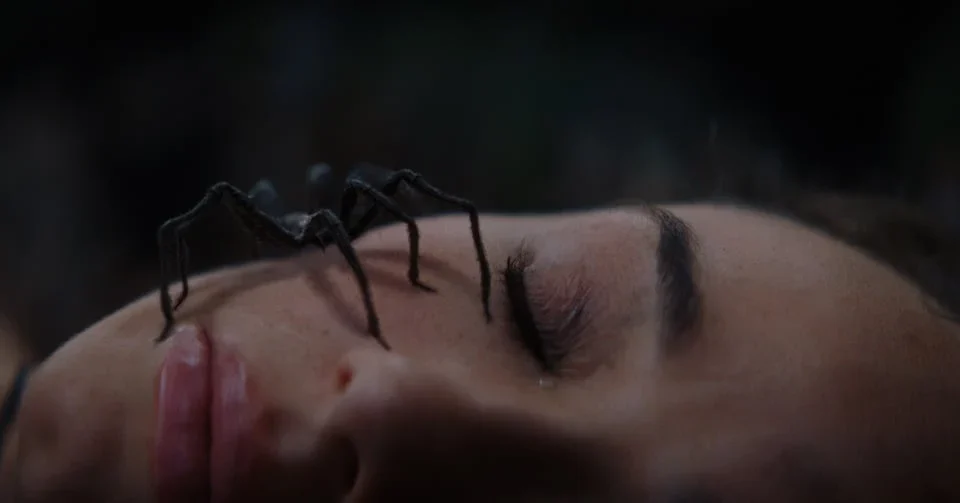
From a technical standpoint, the spiders themselves are the film’s crowning achievement. Smith eschews the traditional "giant monster" trope for something arguably more unsettling: small, numerous, and highly coordinated. Their movement—a series of stilted, jerky leg stretches and rapid, scuttling advances—is genuinely disturbing. The cinematography highlights their ability to crawl over, under, and through anything in their path, turning the tropical paradise into a claustrophobic cage.
Surprisingly, the film opts for a restraint rarely seen in Smith’s filmography. Despite his history with gore-heavy features like Severance and Black Death, Spider Island is largely bloodless. This stylistic choice is polarizing. For a film that allows its characters to drop F-bombs with reckless abandon, the lack of visceral carnage feels like a deliberate, albeit confusing, artistic decision. Does the lack of blood diminish the stakes? For some, yes. For others, the "creep factor" of thousands of tiny legs moving in unison is more than enough to satisfy the horror quotient.
Implications: The Death of the Influencer Age?
Beyond the horror, Spider Island functions as a harsh indictment of the influencer economy. Characters like Mongoose (Divian Ladwa), who specializes in dangerous drug-related stunts, represent the absolute bottom of the barrel of social media culture. The film’s inclusion of visual gags involving the licking of cane toads for a "high" is a dark, satirical jab at the extreme lengths creators will go to for a few thousand likes.
The implication is clear: in an era where we broadcast our every waking moment for the consumption of strangers, we have lost the ability to appreciate the physical world until it is too late. The spiders, in this reading, are a corrective force—a reminder that nature does not care about subscriber counts, engagement metrics, or viral trends.
Critical Reception and Industry Impact
The film has generated significant discussion within the horror community. While some critics argue that the environmental message and slow pacing hinder the film’s overall efficacy, others praise Smith for his willingness to experiment with tone.
The industry perspective, particularly following the announcement of the Creep remake, suggests that Smith is currently in a period of creative transition. Spider Island stands as a testament to his ability to craft memorable environments, even if the narrative script itself occasionally falters under the weight of its own message.
Ultimately, Spider Island is a film of contrasts: it is a monster movie without the gore, a social satire with a heart of darkness, and a vacation film that will make you think twice before booking your next tropical getaway. While it may not reach the same heights of terror as Creep, it remains a bold, fun, and frequently unsettling exploration of what happens when humanity’s worst impulses are met by the cold, unfeeling efficiency of nature.
For fans of Christopher Smith, the film is a necessary watch, serving as a reminder that even when he steps out of the dark tunnels of London and into the sunlight, he remains one of the most unpredictable voices in modern genre cinema. Whether or not the message sticks, the sight of those spindly, persistent legs crawling across the screen is something that will haunt viewers long after the final credits roll.