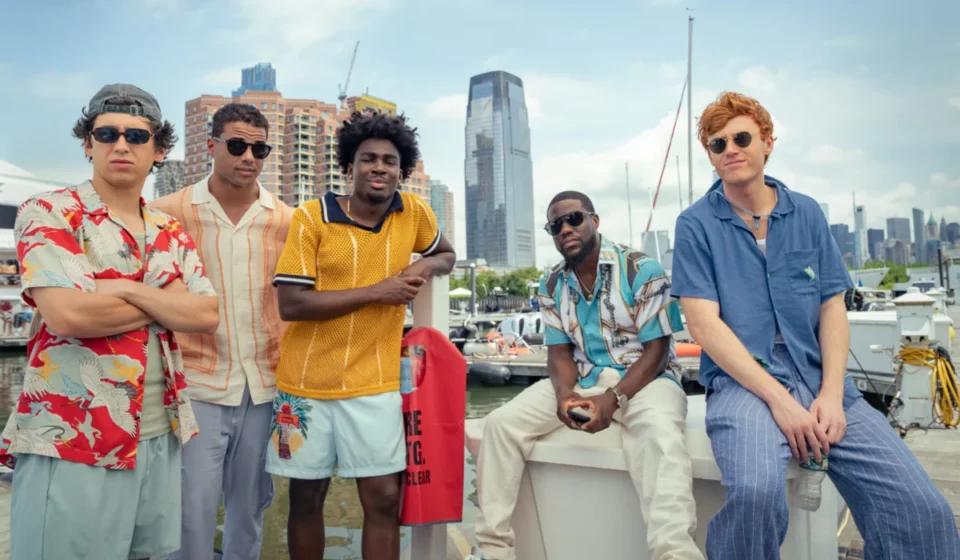

In the modern landscape of streaming, the "high-concept" comedy has become a rare, endangered species, often replaced by content designed specifically to satisfy the metrics of an algorithm rather than the sensibilities of an audience. Tim Story’s latest Netflix feature, 72 Hours, serves as a prime case study in this phenomenon. On paper, it is a classic fish-out-of-water farce; in practice, it is a glossy, exhausting exercise in brand synergy that struggles to justify its own existence.
The Premise: A Professional Crossroads
The narrative trajectory of 72 Hours centers on Joe, a veteran advertising executive played with an earnest, albeit constrained, commitment by Kevin Hart. Joe finds himself at a pivotal professional crossroads. His career trajectory toward the role of Chief Creative Officer is jeopardized when his superior casts doubt on his ability to connect with contemporary demographics. In a desperate bid to prove his relevance, Joe concocts a bizarre plan: he infiltrates a bachelor party trip to Miami, consisting of four frat-bros half his age, by offering to bankroll their excursion in exchange for their participation in his “market research.”
The premise is as simple as it is shaky. Joe is not merely an observer; he is a stranger inserting himself into a sacred, intimate rite of passage. This serves as the film’s primary engine, yet it is also where the gears begin to grind. The film’s insistence on repeatedly stating its premise—likely to accommodate the fragmented attention spans of multi-screen streaming viewers—drains the narrative of any natural momentum.
Chronology of a Comedy Misfire
The film’s structure follows the predictable beats of a weekend getaway, but it does so with a sense of frantic, manufactured urgency.
- The Inception: Joe accidentally stumbles into a group chat intended for a group of young men. Rather than deleting the thread, he seizes the opportunity to save his career.
- The Integration: Joe meets the group—Nick (Marcello Hernández), Mason (Mason Gooding), Freshman (Kam Patterson), and Hunter (Ben Marshall)—and attempts to pose as a "cool uncle" figure.
- The Escalation: The standard tropes of a Miami bachelor party are checked off with military precision: the wild yacht parties, the high-end nightclubs, and, inevitably, the accidental theft of 30 kilos of narcotics from a powerful cartel boss.
- The "Pathos" Turn: Mid-film, the comedy attempts a pivot toward sincerity. The characters engage in nightly “emotional check-ins,” a device intended to highlight the evolution of modern male friendships.
- The Climax: A chaotic, action-heavy resolution that clashes with the film’s earlier, more intimate attempts at character development.
Throughout this sequence, the film is plagued by a recurring friction. Marcello Hernández, playing the role of the skeptical younger peer, spends a disproportionate amount of screen time pointing out how bizarre it is that Joe is even present. While his character is objectively correct, the repetition of this critique highlights a failure in the script development process; the film acknowledges its own absurdity so frequently that it renders the premise impossible to take seriously.
Supporting Data: Demographic Disconnects and Genre Tropes
The film’s reliance on "generational commentary" feels less like a genuine exploration of youth culture and more like a focus-group-tested checklist. Joe’s habit of phoning his office to dictate his findings—treating these young men as if they are subjects in a Jane Goodall documentary—is meant to provide a satirical layer. However, the satire lacks teeth.

The film falls into the "Netflix Original" trap, a category characterized by a specific, glossy aesthetic and a tendency to blend genres until both are diluted. Much like Red Notice, 72 Hours struggles to balance its aspirations for high-octane action with its identity as a raunchy comedy. The action sequences feel perfunctory, and the comedic beats are often undermined by visual choices that defy logic, such as a notably poorly executed vomiting sequence that serves as a nadir for the production’s technical quality.
Perhaps most glaring is the subplot involving Hart’s character consuming cocaine, which triggers a transformation into a Spanish-speaking drug lord. It is a sequence that feels disconnected from the film’s internal logic, serving as a desperate bid for a laugh that feels increasingly alienating to the audience.
Official Perspectives and Industry Context
While Netflix has not released specific internal engagement metrics regarding 72 Hours, the film is a testament to the platform’s current strategy: producing "content" that is safe, recognizable, and optimized for "passive consumption."
Tim Story, a director with a long history in commercial-leaning comedy, approaches the material with a workmanlike efficiency. However, there is a lack of authorial voice in the finished product. The film feels less like a directed vision and more like a series of scenes designed to satisfy a demographic quota. The industry’s shift toward "content-first" filmmaking often means that the human element—the subtle, messy, and unpredictable nature of comedy—is scrubbed away in favor of clear, actionable beats that translate well across international markets.
The Implications: What 72 Hours Says About Modern Comedy
The failure of 72 Hours to land as a definitive comedy speaks to a broader, more existential crisis in the genre. When a film is built to be a "consumer product" first and a piece of art second, it becomes inherently uncool.
The tagline for the film—"He puts the ‘unc’ in ‘uncool’"—is ironically the most intelligent thing about the entire production. It demonstrates a level of self-awareness that is unfortunately missing from the screenplay itself. By trying so hard to understand "the youth," the film effectively exposes how disconnected the studio system has become from the very people it is trying to capture.

The Verdict: A Lost Opportunity
Ultimately, 72 Hours is a C-grade production. It is not an unwatchable disaster, and Kevin Hart remains a charismatic performer who is doing his best with a script that refuses to give him depth. However, the film is a hollow experience. It is a movie about a man trying to be relevant, created by a studio trying to be profitable, neither of which seems to understand that relevance cannot be engineered.
For the viewer, 72 Hours offers a mild distraction, but it fails to offer the kind of enduring, chaotic brilliance of the films it so desperately wants to emulate, such as The Hangover. It is a film that exists in the background, a product of the algorithm, destined to be forgotten as soon as the credits roll and the next recommendation pops up in the queue.
Final Thoughts
As the industry continues to grapple with the demands of the streaming age, 72 Hours stands as a cautionary tale. It proves that you can assemble a talented cast, a polished director, and a high-concept premise, but without a soul, you are left with nothing but a product. It is a flashy, expensive, and ultimately empty exercise in branding—a fitting fate for a film that treats its audience as a set of demographics to be managed rather than a community to be entertained.
Grade: C-
72 Hours is currently streaming on Netflix.