The Alchemy of Influence: Frieda Luk’s ‘Sacred Creatures’ and the Blurred Lines of Modern Divinity

The Edinburgh International Film Festival has long been a crucible for daring, genre-defying cinema, and this year’s main competition was no exception. Among the most talked-about entries is Sacred Creatures, the debut feature from Canadian writer-director Frieda Luk. A microbudget hothouse drama that defies easy categorization, the film has emerged as a poignant, if occasionally erratic, meditation on the nature of faith, the fragility of the human psyche, and the terrifying ease with which a "cult of personality" can be manufactured in the modern age.
At its core, Sacred Creatures is an exploration of how an outsider—marked by what some call madness and others call enlightenment—becomes a vessel for the projections of a bored, yearning public. Led by a haunting performance from Olivia Luccardi, the film uses the backdrop of a desaturated Northern Italy to ask uncomfortable questions about the thin membrane separating spiritual breakthrough from psychological collapse.
Main Facts: A Study in Contradiction and Couture
Sacred Creatures introduces us to Miriam (Luccardi), a young woman who has recently emerged from a mental health facility. Depending on who you ask, Miriam has either suffered a devastating psychotic break or experienced a profound spiritual awakening. When she travels to Northern Italy to visit her brother, Ray (James Cusati-Moyer), and his partner, Renzo (Antonio De Matteo), her presence acts as a catalyst for a series of events that spiral from a tense family reunion into a full-blown religious phenomenon.
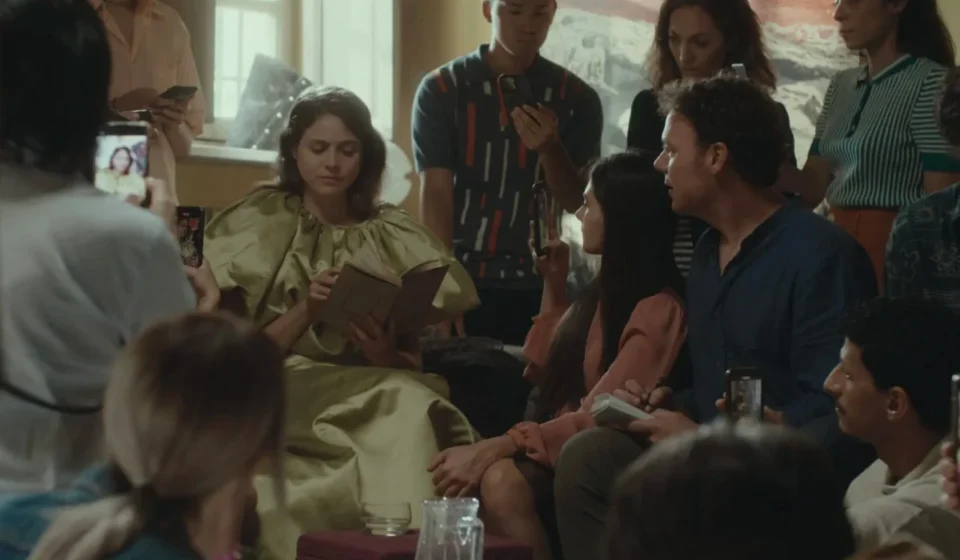
The film’s most striking visual element—and perhaps its most potent metaphor—is a single garment designed by Francesca Cibischino. Worn by Miriam for the majority of the film, the dress is a shapeless, shimmering enigma. In certain lights, it radiates a regal gold; in others, it takes on a "bilious chartreuse" hue. It is simultaneously high-fashion couture and a utilitarian military parachute. This dress becomes the uniform of Miriam’s accidental ascension, capturing the "otherworldly godliness" her followers see in her, while reflecting the "girlish absurdity" that the audience recognizes.
Director Frieda Luk, making her feature debut, eschews the traditional trappings of the "Tuscan sun" aesthetic. Instead, she places her characters in a landscape of light industry, retail parks, and farmland under "perennially overcast ecru skies." This setting mirrors the film’s tonal ambiguity, roving between barbed social satire, mythic fable, and dysfunctional family drama.
Chronology: From Fragile Reunion to Accidental Iconography
The narrative of Sacred Creatures unfolds with the disjointed logic of a fever dream, moving through several distinct phases of escalation:
The Arrival and the Unraveling
The story begins with the arrival of Ray’s two sisters at Renzo’s rambling, modern-art-filled country house. Ray, a Canadian struggling to find his footing in Renzo’s bohemian Italian world, finds himself caught between his partner’s hedonism and his family’s trauma. The arrival of Michelle (Romina d’Ugo), a Toronto career woman bristling with resentment, sets a tone of domestic friction. However, it is Miriam, the "baby" of the family, whose quiet, beatific presence dominates the atmosphere.
The Transformation
The turning point occurs at a party hosted by Renzo, where Miriam first dons the aforementioned gown. Renzo’s aspirational aunt (Pia Engelberth) becomes the first "convert," entranced by Miriam’s enigmatic aura. As Miriam, dazed and fragile, begins to recite passages from an obscure self-help book, the party-goers interpret her words as gnomic wisdom. What Miriam intends as a simple reflection of her internal state is received by the locals as a divine manifesto.
The Rise of the Acolytes
The film’s second act sees the house transformed into a pilgrimage site. Word of the "Sacred Creature" spreads through the local community, attracting a coterie of admirers who gather to fawn over Miriam. Luk’s script drily observes the mechanics of influence, showing how Miriam’s exoticism and spectacular dress provide a blank canvas for the locals’ spiritual hunger. Without the aid of social media, Miriam becomes a "micro-influencer" of a different sort—a living icon for a secular age desperate for a miracle.
The Breaking Point
In the final act, the film’s satirical footing gives way to something more surreal and unsettling. Miriam’s status evolves from a local curiosity to a literal cult leader. As the scope of her influence expands, the credibility of the narrative is pushed to its limits. The sibling drama that grounded the first half of the film begins to fade, replaced by a narrative structure that feels increasingly erratic, mirroring the "Consequences" parlor game where each new development wrenches the story in a fresh, unpredictable direction.
Supporting Data: Technical Execution and Creative Choices
The effectiveness of Sacred Creatures relies heavily on its technical palette, which compensates for its microbudget constraints through stylistic boldness.
- Cinematography: Director of Photography Nicolas Villegas employs a "queasy deployment of shallow focus" and a muted, desaturated color grade. This visual language creates a sense of claustrophobia and disorientation, emphasizing Miriam’s internal isolation even as she is surrounded by crowds.
- Sound Design: The film utilizes disorientingly muffled sound design at key moments, further blurring the line between Miriam’s subjective reality and the objective world of the Italian countryside.
- Costume Design: Francesca Cibischino’s work on the central gown is arguably the film’s most successful piece of world-building. By creating a garment that is "both shapeless and striking," Cibischino provides a visual anchor for the film’s themes of projection and perception.
- Performance: Olivia Luccardi’s performance is central to the film’s success. She maintains an ambiguity that leaves the audience questioning whether Miriam is a visionary, a victim of mental illness, or someone who simply knows "nothing at all." This "canny performance" prevents the film from becoming a one-dimensional critique of religion.
Official Responses and Critical Reception
While official statements from the production team emphasize the film’s exploration of "the intersection of mental health and spiritual yearning," critical reception following the Edinburgh premiere has been intrigued but cautious.
Critics have praised Frieda Luk’s "darkly airy tone," noting that her unique directorial voice is a significant asset. Variety noted that while the film’s narrative foundations might be "less than sturdy," the "overall curiosity factor" and the strength of the Euro-American cast make it a strong candidate for limited international distribution.
The film has been described as an "elusive debut," with some reviewers expressing frustration at its refusal to settle on a single style. However, many agree that the film’s "roving itchiness" between social satire and holy-fool fable is what makes it a compelling, if polarizing, viewing experience. The comparison to the "Consequences" parlor game suggests a film that is more interested in the journey and the aesthetic than a neatly tied-up conclusion.
Implications: Faith in the Age of the Influencer
Sacred Creatures arrives at a time when the concept of the "influencer" is under intense scrutiny. By stripping away the digital interface and placing the phenomenon in a rural, semi-industrial setting, Frieda Luk highlights the primal human need to follow and to worship.
The Commodification of Mental Health
The film raises uncomfortable questions about how society treats mental fragility. Miriam’s family sees a "psychotic breakdown" that needs to be managed, while the public sees a "spiritual breakthrough" to be exploited. The film implies that both perspectives are forms of erasure, failing to see Miriam as a human being in favor of seeing her as a problem or a solution.
The Power of the Aesthetic
The central role of the gown in Miriam’s "sanctification" serves as a commentary on the power of visual branding. It suggests that in the absence of a coherent message, a striking aesthetic can serve as a substitute for divinity. This has significant implications for how we understand modern celebrity and the "cults" that form around public figures.
A New Voice in Canadian Cinema
For Frieda Luk, Sacred Creatures marks the arrival of a filmmaker with a distinct, unsettling vision. While the film’s narrative experimentalism may alienate some viewers, its ability to hold attention through "unsettling stylistic flourishes" suggests a director capable of tackling complex, high-concept ideas on a limited budget. As the film moves toward international distribution, it stands as a testament to the enduring power of the "microbudget hothouse drama" to challenge and provoke.
In conclusion, Sacred Creatures is a film that, much like its central gown, changes color depending on the light in which you view it. It is a satire of influence, a tragedy of family, and a fable of faith, all wrapped in a garment that is as beautiful as it is absurd. Whether it is a "haute couture showstopper" or a "military parachute" for the soul remains, like Miriam herself, an open question.