The Unicorn That Wasn’t Invited: How ‘Buddy’ Crashed Halloween Horror Nights and Won the Internet

In the landscape of modern film marketing, few campaigns have managed to blur the lines between fiction and reality as effectively—or as disruptively—as the promotional run for Casper Kelly’s Buddy. The latest chapter in this bizarre saga unfolded on the opening night of Universal Studios Hollywood’s legendary Halloween Horror Nights (HHN), where the film’s titular character, a giant, unnerving, and deeply charismatic orange unicorn, attempted to infiltrate the event.
What followed was a surreal, viral confrontation that served as the perfect meta-commentary on the film’s themes. While the event was intended to be a celebration of horror, the appearance of a rogue, murderous unicorn—unauthorized and uninvited—quickly became the most discussed spectacle of the evening.
The Chronology of a Trespass: A Night at the Bridge
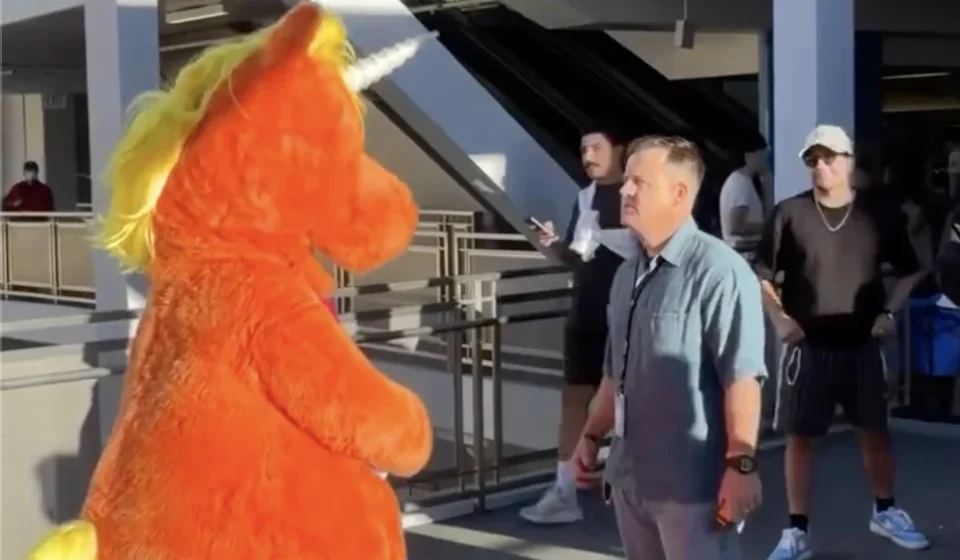
The incident began on a Thursday evening, just as the gates of Universal Studios were buzzing with the anticipation of horror enthusiasts. Positioned on a bridge overlooking a high-traffic pedestrian area near the park, the figure of Buddy—a towering, uncanny mascot—appeared, waving to guests and leaning into his persona as a misunderstood creature of nostalgia.
For those in the crowd, it was initially unclear whether this was a coordinated partnership between the studio and the film’s distributors, Saban Films. However, the veneer of a sanctioned appearance shattered quickly. In a video later uploaded to the official Buddy social media channels, the tone shifts from lighthearted fan engagement to a tense, real-world confrontation.
In the footage, Universal management and security personnel can be heard firmly informing the costumed performer that their presence is not permitted on the property. The discourse is grounded and administrative: the threat of the sheriff’s department being called to the scene is mentioned, effectively ending the unicorn’s short-lived stint as an unofficial HHN scare-actor.
Buddy’s response, captured in the video’s caption, was a masterclass in deadpan humor: “They said no costumes allowed at @horrornights, but i’m a unicorn.”
Following the eviction, the marketing team behind the film doubled down on the narrative. Rather than retreating, the figure of Buddy was spotted on nearby street corners and public pedestrian bridges outside the park gates, holding cardboard signs that read, “Security Kicked Me Out!” and “Honk if u <3 Buddy.” This pivot from the park premises to the public periphery ensured that the incident remained a part of the evening’s conversation long after the actual security escort had finished.

The Phenomenon Behind the Mask: Supporting Data
The stunt is merely the latest, albeit most public, move in a campaign that has seen Buddy evolve from a niche horror-comedy project into a bonafide theatrical success.
The film’s commercial performance has been nothing short of extraordinary. Opening with a domestic gross of $5.5 million, Buddy shattered expectations, effectively doubling its pre-release projections. This figure represents the largest opening in the history of Saban Films, a milestone that speaks to the power of the film’s viral marketing and the audience’s hunger for original, high-concept horror. As it heads into its second weekend, the film has already crossed the $8 million mark, signaling a level of word-of-mouth momentum that is increasingly rare in the current theatrical climate.
The critical and industry reception has been equally eclectic. In an unexpected nod to the film’s roots in nostalgia-horror, former Barney & Friends voice actor Dean Wendt publicly endorsed the film. Wendt’s praise for the production design and, specifically, the performance of Keegan-Michael Key as the titular unicorn, provided a layer of "street cred" to the film that few horror-comedies ever achieve. By bridging the gap between child-friendly mascots and adult-oriented horror, the marketing team has successfully tapped into a specific brand of modern, ironic anxiety.
The Creative Engine: Casper Kelly’s Vision
To understand why a unicorn crashing a theme park event feels so appropriate, one must look at the mind behind the madness. Casper Kelly, the auteur behind the cult-classic viral sensation Too Many Cooks, has long specialized in the subversion of wholesome, domestic imagery.
His work on the V/H/S/Halloween segment "Fun Size" further cemented his reputation for delivering horror that feels like a glitch in a familiar broadcast. Buddy is the culmination of this aesthetic, functioning as an "analog horror" piece that feeds on the audience’s nostalgic attachment to the colorful, costumed mascots of the late 20th century.
The cast, which includes the likes of Cristin Milioti, Topher Grace, Michael Shannon, and Patton Oswalt, provides a high-caliber foundation that allows the bizarre premise to thrive. However, the emotional (and terrifying) anchor of the film remains Keegan-Michael Key’s vocal performance. Key manages to imbue Buddy with a range of emotions that shift from endearing to predatory, a balance that is essential to the film’s success.
Implications for Future Film Marketing
The "eviction" of Buddy from Halloween Horror Nights serves as a case study in the evolution of guerrilla marketing. In an age where traditional advertising is often ignored or bypassed via ad-blockers and streaming, the "real-world stunt" has become a vital tool.

However, the risk involved is significant. By pushing the boundaries of what is considered a "sanctioned" appearance, the producers of Buddy engaged in a high-stakes gamble. If the interaction had turned hostile or resulted in legal repercussions beyond a simple escort from the premises, the narrative could have easily soured. Instead, the incident has been framed as a rebellious, "us against them" narrative that resonates deeply with the film’s target demographic.
Furthermore, this incident highlights the complex relationship between intellectual property owners and independent creators. Major theme parks like Universal are notoriously protective of their brand identity, especially during peak seasons like Halloween Horror Nights. The intrusion of an external, "non-sanctioned" character creates a brand conflict that studios are obligated to address. Yet, by turning that rejection into a publicity stunt, the Buddy marketing team managed to leverage Universal’s own security protocols as a promotional tool.
A Cultural Touchstone
As Buddy continues its theatrical run, the "Kicked out of HHN" saga will likely be remembered as the moment the film transcended its status as a horror-comedy and became a genuine pop-culture moment. It is a rare example of a marketing campaign that is as entertaining as the product it is promoting.
For audiences, the film offers a unique experience: a blend of childhood comfort and existential dread. For the industry, it offers a reminder that in a crowded marketplace, the most effective way to grab attention is to act in ways that are unexpected, slightly dangerous, and entirely, unapologetically weird.
While Buddy may not have been invited to haunt the halls of Universal Studios this year, he has certainly made his presence felt elsewhere. For those looking to experience the bizarre world of Casper Kelly’s creation, the film is currently in theaters. Just don’t expect to see the main character at the concessions stand—he’s likely still wandering the parking lot, looking for his next audience.