
By Editorial Staff
August 26, 2026
The American Western has long served as a canvas for exploring the fragility of human morality under the duress of isolation. In the latest contribution to this storied genre, Norwegian-American director Dara Van Dusen makes a striking feature-film debut with A Prayer for the Dying. Recently unveiled in a new official trailer by Quiver Distribution, the film promises a harrowing exploration of conscience, survival, and the corrosive nature of unchecked paranoia.
Far from a traditional gunslinging romp, the film—based on Stewart O’Nan’s acclaimed novel—positions itself as a stylish, atmospheric thriller. It arrives with significant pedigree, having made its initial impression at the 2026 Berlin Film Festival, where it was showcased in the "Perspectives" section. As the industry turns its attention toward the autumn release, audiences are being introduced to a story that finds its terror not in outlaws or bank robberies, but in the unseen, creeping threat of disease in the 19th-century wilderness.
The Premise: Friendship’s Desperate Hour
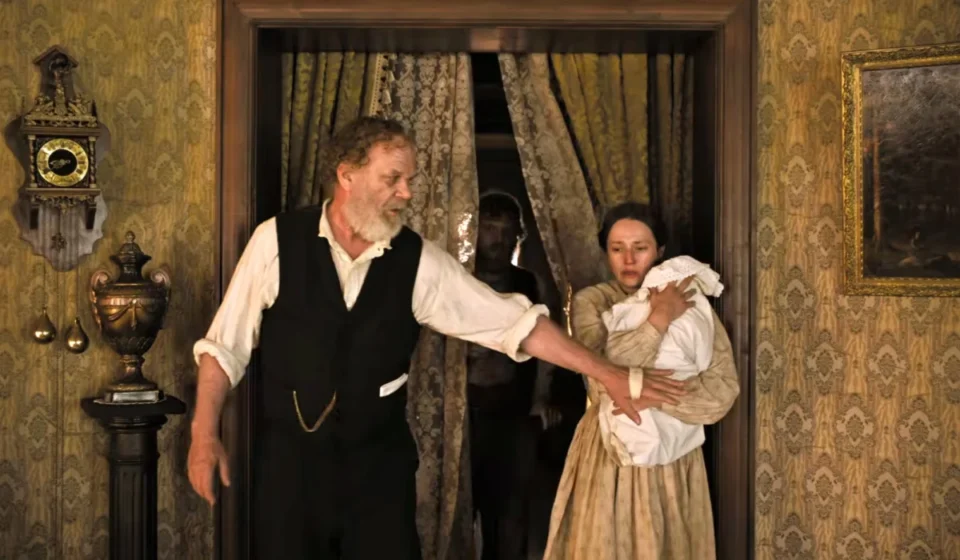
Set in the year 1870, the narrative unfolds in the isolated, sun-drenched settlement of Friendship, Wisconsin. The town, comprised largely of Scandinavian immigrants attempting to carve a life out of the unforgiving American landscape, is still reeling from the psychological scars of the American Civil War.
At the center of this microcosm is Jacob Hansen, portrayed with intense, brooding gravity by Johnny Flynn. Hansen is a decorated veteran who has attempted to find redemption through service. He is not merely a resident of Friendship; he is its multi-hyphenate backbone, serving simultaneously as the town’s sheriff, its undertaker, and its pastor. It is a self-imposed penance—a way to manage the violence that still haunts his subconscious from his time on the battlefield.

However, the fragile peace of the town is shattered when an unidentified, aggressive epidemic descends upon the settlers. The town doctor, played by a somber John C. Reilly, quickly realizes that he is outmatched. As bodies begin to mount, the town’s trust in Hansen is tested, and the social fabric begins to unravel. The central tension of the film arises from a singular, impossible dilemma: Does Hansen prioritize the safety of his own young family, or does he uphold the oath he made to protect the community that offered him a second chance at life?
Chronology of Production and Development
The journey of A Prayer for the Dying from page to screen has been a meticulous process of international collaboration.
- Literary Foundation: The project is based on the novel of the same name by Stewart O’Nan. It is important to clarify for audiences that this film is entirely distinct from the 1987 British thriller of the same name starring Mickey Rourke.
- Production Origins: The film was spearheaded by director Dara Van Dusen, an American filmmaker based in Oslo, Norway. Her transition from short films to a feature-length Western is characterized by a distinct Scandinavian-American fusion, reflected in the production involvement of Eye Eye Pictures, The Bureau, Garagefilm Intl., and Film i Väst.
- The Festival Circuit: The film’s public debut occurred at the 2026 Berlin Film Festival. The response within the "Perspectives" section was noted for its intensity and the visual language employed by Van Dusen to depict the claustrophobic nature of the town’s quarantine.
- The Promotional Rollout: Following the festival, Quiver Distribution acquired the rights, leading to the release of an initial teaser trailer that hinted at the film’s grim aesthetic. The official trailer, released on August 26, 2026, provides a more comprehensive look at the escalating conflict.
- Upcoming Release: The film is scheduled to hit select U.S. theaters on October 9, 2026, positioning it as a significant indie contender for the fall cinematic season.
Character Dynamics and Ensemble Performance
The success of A Prayer for the Dying hinges on its cast’s ability to navigate the thin line between stoicism and hysteria. Johnny Flynn’s portrayal of Jacob Hansen is reported to be the emotional anchor of the film. Flynn, known for his ability to convey deep-seated melancholy, captures the essence of a man who feels responsible for every soul in his jurisdiction.
John C. Reilly, in his role as the town doctor, provides a grounded, perhaps cynical counterpoint to Hansen’s idealism. The chemistry between the two—the man of faith and the man of science—is the fulcrum upon which the town’s survival rests. The supporting cast, including Kristine Kujath Thorp, Gustav Lindh, Hilton Pelser, and Andrew Whipp, represent the diverse voices of the immigrant community, each reacting to the encroaching disease in ways that highlight the varying degrees of desperation found in an isolated population.
Supporting Data: Themes of Isolation and Paranoia
The film’s thematic weight is best summarized by the recurring refrain in the trailer: "We need to quarantine now. The whole town!" This directive serves as the inciting incident for the town’s downfall. In the context of 1870, a quarantine was not just a medical precaution; it was a death sentence for trade, movement, and hope.

The film functions as a "disease thriller," a sub-genre that thrives on the breakdown of social hierarchies. When the fear of infection outweighs the fear of authority, the rule of law—represented by Hansen—begins to fail. Van Dusen reportedly utilizes the landscape of Wisconsin to mirror the internal rot of the characters. The dry, hot summer acts as an oppressive presence, stifling the town and accelerating the tension. The psychological toll of being an "outsider" in a new land, combined with the trauma of war, makes for a combustible mix that the director explores with clinical precision.
Official Responses and Industry Outlook
While critical reviews are still emerging following the limited festival screenings, the buzz surrounding the film has been largely positive, particularly regarding its visual direction. Critics have noted that Van Dusen avoids the "clean" look of many modern Westerns, opting instead for a grit that feels authentic to the period’s harshness.
Quiver Distribution’s decision to position this as an October release suggests confidence in the film’s ability to attract an audience looking for more cerebral, mature storytelling during the harvest season. The film’s status as an indie production allows for a level of stylistic risk-taking that larger studio projects might avoid, specifically in its uncompromising look at the moral ambiguity of its protagonist.
Implications: The Moral Burden of Leadership
The most compelling aspect of A Prayer for the Dying is its refusal to provide easy answers. It challenges the viewer to consider the nature of sacrifice. Is it righteous to save one’s family at the expense of one’s neighbor? Is it possible to atone for the sins of war while committing new, necessary sins to ensure survival?
As Jacob Hansen grapples with these questions, he serves as a mirror for the audience. The film suggests that the "Western" is not just about the expansion of territory, but about the expansion of one’s own conscience. The title itself—A Prayer for the Dying—is ambiguous. Is it a prayer for those suffering from the plague, or a prayer for the soul of the man who must decide who lives and who dies?

By the time the film reaches its final act, it is clear that Van Dusen has crafted more than a period piece; she has created a cautionary tale about the fragility of community. As modern audiences continue to navigate their own anxieties regarding health and security, the story of Friendship, Wisconsin, feels uncomfortably relevant.
When A Prayer for the Dying hits theaters on October 9th, it will undoubtedly invite debate on whether true leadership is defined by the ability to keep people alive, or the ability to remain human while the world falls apart around you. With its blend of historical detail, psychological depth, and visceral tension, it is poised to be one of the most discussed indie films of the year.
Key Takeaways for Viewers
- Genre: Indie Western / Psychological Thriller
- Director: Dara Van Dusen
- Starring: Johnny Flynn, John C. Reilly
- Release Date: October 9, 2026
- Distributor: Quiver Distribution
- Themes: Civil War trauma, medical ethics, isolationism, moral survival
For those seeking a film that demands deep engagement, A Prayer for the Dying represents a sophisticated addition to the Western genre, ensuring that the legacy of the American frontier remains as complex and unsettling as the history it reflects.