Venice-Bound: Parallax Picks Up Anuparna Roy’s ‘Lovers in the Blue Night’ Ahead of Global Premiere

In a major acquisition that underscores the growing international appetite for nuanced Indian independent cinema, sales powerhouse Parallax has secured the global distribution rights for Anuparna Roy’s highly anticipated sophomore feature, Lovers in the Blue Night. The film is slated for a prestigious world premiere in the Horizons (Orizzonti) competition at the upcoming Venice Film Festival, marking a significant return to the Lido for a filmmaker whose meteoric rise has captivated the global festival circuit.
A Return to the Lido: Building on a Legacy of Excellence
The selection of Lovers in the Blue Night for the Horizons competition is more than just a routine festival booking; it is a homecoming. Just one year ago, Anuparna Roy made history at the Venice Film Festival by becoming the first Indian filmmaker to secure the Horizons Best Director prize for her debut feature, Songs of Forgotten Trees.
That victory served as a watershed moment for Indian auteur cinema, signaling that the industry was ready to move beyond the traditional tropes of commercial Bollywood. With her latest project, Roy is tasked with the challenging "sophomore test"—proving that her debut was not a singular stroke of luck, but the manifestation of a profound and consistent artistic vision. By returning to the same platform that catapulted her to international recognition, Roy has solidified her status as a director of consequence, one whose work is now eagerly tracked by global distributors and cinephiles alike.
Narrative Tapestry: The Pulse of Mumbai’s Nightlife
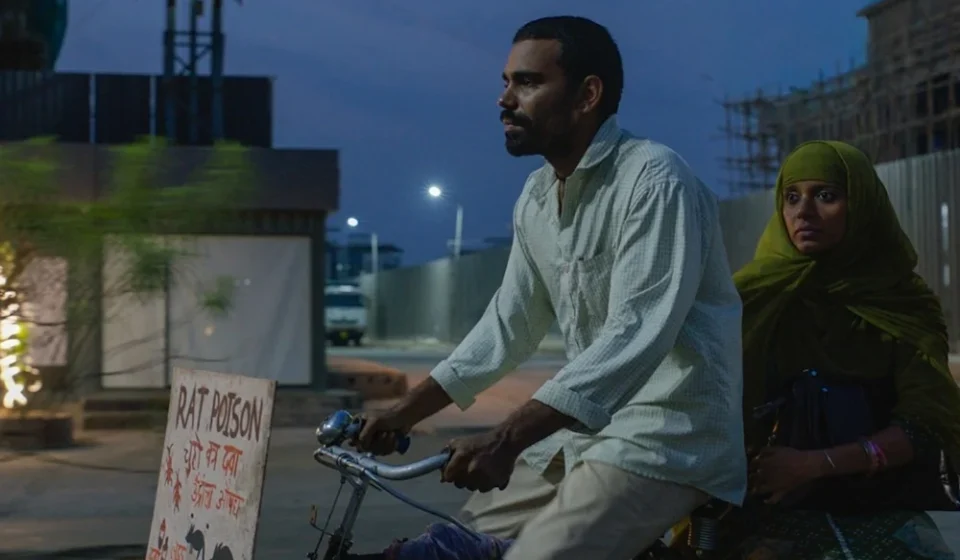
Lovers in the Blue Night is a sprawling, atmospheric exploration of the margins of society. Set against the kinetic, neon-drenched backdrop of Mumbai’s restless nightlife, the film weaves together the disparate lives of four migrants. Each character represents a different facet of the struggle for identity in a city that promises everything but offers little in the way of stability.
The narrative centers on a complex quartet: a husband grappling with the concealment of his sexuality; his lonely wife, who finds herself adrift while working in a Mumbai bar; a petty criminal struggling to navigate the city’s underworld; and a man surviving on the fringes through sex work.
Rather than focusing on a singular inciting incident, the film derives its power from the slow, deliberate convergence of these lives. Through the lenses of unlikely romance, deep-seated hidden longing, and a shared, visceral fight to belong, Roy paints a portrait of urban isolation. The film acts as a mirror to the millions who move to Mumbai in search of a better life, only to find themselves navigating the treacherous waters of anonymity and prejudice.
The Parallax Perspective: Why the Industry is Watching
The acquisition by Parallax represents a strategic investment in Roy’s burgeoning career. Liuying Cao, a key figure at Parallax, expressed deep admiration for the film’s tonal restraint—a hallmark of Roy’s directing style.
"We were deeply impressed by the film’s delicate and nuanced portrayal of human emotions," Cao said in a recent statement. "Rather than relying on dramatic gestures, it finds remarkable strength in subtle moments, which stayed with us long after the screening. We are also very excited by Anuparna Roy’s distinct directorial voice. We sincerely hope to accompany her and her future works on their international journey, beginning with Lovers in the Blue Night."
This acquisition is indicative of a broader trend: sales agents are increasingly looking for "auteur-driven" content that transcends cultural boundaries. By prioritizing the emotional resonance of the film over high-octane plot mechanics, Parallax is positioning the title as a contender for international arthouse markets, where such human-centric narratives often find sustained success on streaming platforms and in boutique cinema chains.
A Collaborative Force: The Production Architecture
The success of the project is owed to a robust production infrastructure that balances local expertise with a global perspective. The production is spearheaded by a core team that previously collaborated on Songs of Forgotten Trees: Vikas Kumar of Khan & Kumar Media, Sharib Khan of Ammi Media, Bibhanshu Rai, and Romil Modi.
Recognizing the global potential of Roy’s vision, the team has significantly expanded its reach for this production. The addition of U.S.-based producer Rhet Topham, U.S.-based executive producer Beesham Sreecharan, and London-based associate producer Amar Singh reflects a concerted effort to bridge the gap between Indian stories and global audiences. Working alongside executive producer Neeraj Churi, this international coalition has provided the film with the resources and strategic guidance necessary to compete on the world stage.
Technical Mastery: The Artisans Behind the Vision
While Roy’s narrative focus is the primary draw, Lovers in the Blue Night is elevated by a technical team that mirrors the film’s themes of intimacy and isolation. Roy, who also penned the screenplay, has collaborated with cinematographer Debjit Samanta to capture the gritty, ethereal beauty of Mumbai after dark. The visual language of the film—characterized by shadows, artificial light, and the frantic pace of the city—is expected to be a highlight of its festival presentation.
The editing, handled by Ketul Thakkar, is anticipated to be a masterclass in pacing, allowing the characters’ unspoken tensions to simmer beneath the surface. Rounding out the creative team is composer Nishant Ramtake, whose original score is tasked with capturing the melancholic, heartbeat-like rhythm of the city.
The ensemble cast, featuring Neelima Sharma, Pritam Pilania, Bhushan Shimpi, Jatin Sarin, Kajal Keshav, Swetha Mishra, and Vinod Suryavanshi, brings a sense of grounded realism to the screen. Their collective performance is being touted as the emotional anchor of the film, essential for translating the specificities of the migrant experience into a universal language.
Implications for the Indian Independent Sector
The trajectory of Lovers in the Blue Night provides a compelling case study for the current state of Indian independent cinema. For years, the industry was bifurcated between the massive, spectacle-heavy output of mainstream commercial cinema and the "festival circuit" films that often failed to find commercial viability.
Roy’s success, facilitated by a strong sales partner like Parallax and a diverse international production team, suggests a new model. By leveraging the prestige of platforms like Venice, and pairing it with aggressive international sales strategies, filmmakers like Roy are creating a sustainable pathway for high-quality, mid-budget, character-driven Indian cinema.
As the film prepares for its Venice debut, the industry will be watching closely. If Lovers in the Blue Night can replicate or exceed the critical success of Songs of Forgotten Trees, it will not only secure Anuparna Roy’s position as a leading global filmmaker but will also likely open doors for a new generation of Indian directors seeking to tell stories that are both deeply local and profoundly universal.
The journey for the film is only just beginning. From the back alleys of Mumbai to the red carpets of the Lido, Lovers in the Blue Night stands as a testament to the power of perseverance, the necessity of artistic risk, and the enduring, shared human desire to be seen and understood in a world that often keeps us in the dark.