The Multiverse of the Self: How ‘Cherry & Virgin’ Redefines the Modern Rom-Com

In the landscape of contemporary independent animation, few films dare to challenge the fundamental aesthetic language of the medium as audaciously as Masanao Kawajiri’s Cherry & Virgin. Premiering at the 2026 Tokyo International Film Festival, the film acts as both a meta-textual love letter to otaku culture and a devastatingly honest examination of social isolation, misogyny, and the messy, non-linear process of human connection. Through a radical, shifting visual grammar, Kawajiri explores the internal worlds of two social shut-ins, proving that sometimes, to tell the truth, one must embrace a multitude of artistic lies.
The Premise: Two Worlds, One Screen
The film opens with a blunt, disarming confession from Ryo (voiced by Takashi Okado), a creator of erotic manga who admits, “I draw erotic manga but have never even held a woman’s hand.” Ryo is a man defined by his own limitations, struggling to reconcile the fantasies he churns out for a living with the stark, empty reality of his personal life.
He is soon joined in this dance of isolation by Ami (Yaeko Kiyose), a part-time fujoshi (a fan of Boys Love fiction) who is equally entangled in her own projections of romance. The two meet through the modern digital crucible of dating apps, setting the stage for a story that is as much about the friction between our online personas and our physical realities as it is about courtship. The film’s brilliance lies in its recognition that Ryo and Ami are not just people; they are curators of their own identities, and Kawajiri uses the medium of animation to reflect that curation in real-time.
A Chronology of Artistic Evolution
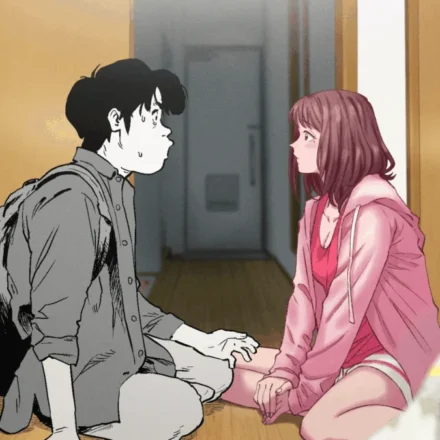
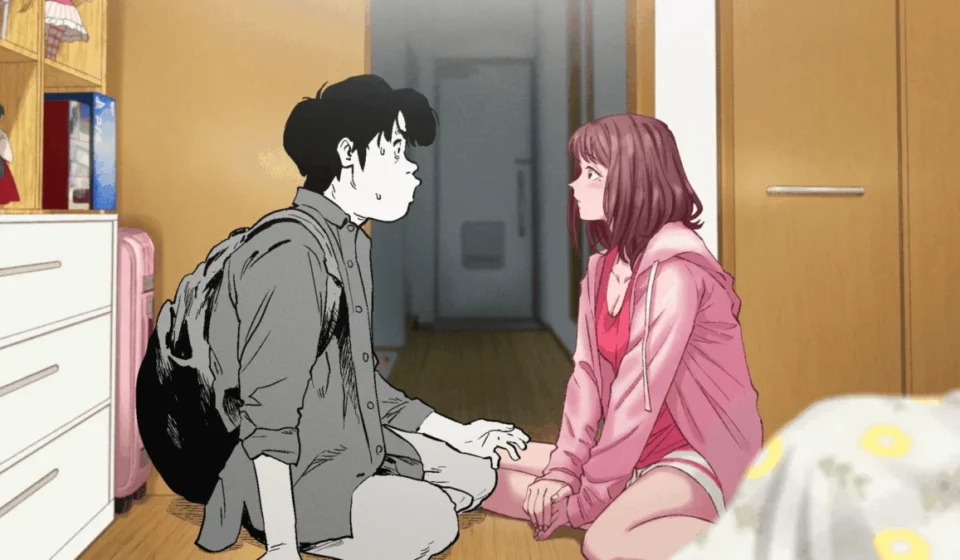
The most striking element of Cherry & Virgin is its visual schizophrenia, which serves as a narrative engine. Kawajiri does not use a single art style; instead, he assigns a specific visual identity to each character based on their own self-perception and their creative output.
Ryo is depicted in a gritty, textured black-and-white style reminiscent of “realist” manga artists like Inio Asano, complete with harsh screen-tone. Conversely, Ami is rendered in vibrant, high-saturation color, mimicking the aesthetic of popular Boys Love illustrations found on platforms like Pixiv.

As the film progresses, these styles do not remain static. During their first date—a sequence that serves as the film’s emotional anchor—the two characters literally begin to merge, their disparate visual languages bleeding into one another as they move toward genuine understanding. In moments of vulnerability or recollection, the animation reverts to cruder, more childlike line work, stripping away the polish of their “public” selves.
The film’s historical timeline, revealed through flashbacks, shows a evolution of these styles. Ami’s past, defined by the trauma of academic and social bullying, is rendered in a flat, “Microsoft Paint” aesthetic—a deliberate choice that highlights her feelings of imposter syndrome and the crushing weight of external criticism.
Supporting Data and Technical Innovation
The production of Cherry & Virgin is a testament to the power of community-backed cinema. As a crowd-funded project with a supportive, winking acknowledgment from Toei Animation, the film operates on a budget that prioritizes creative freedom over studio standardization.
The film utilizes a dizzying array of techniques, including:
- Rotoscoping: Used to bridge the gap between human movement and static illustration, the film employs a limited frame rate to avoid the "uncanny valley" effect, making the rotoscoping feel like a natural layer of the character’s reality rather than a jarring overlay.
- Mixed Media: The film periodically breaks its own fourth wall, incorporating live-action inserts, puppet theater sequences, and even 3D VTuber avatars that wander into the 2D frame.
- Manga Panelling: The frame itself often behaves like a comic book page, with characters navigating the physical layout of panels to underscore their psychological entrapment.
These choices are not merely stylistic flourishes; they are semiotic tools. When a character’s background shifts or a color tool is briefly visible on screen, it serves as a reminder that we are watching a performance—both on the part of the characters and the director.

Official Perspectives: The Philosophy of the "Lie"
Director Masanao Kawajiri has spoken extensively about the film’s central thesis: that all art is a form of deception. As Ryo notes in a pivotal debate with Ami: “All drawings are lies.”
This philosophy informs the film’s treatment of Ryo’s personal growth. The script, penned by Kaga Misato, is remarkably frank about the “incel” rhetoric that Ryo has internalized. The film does not shy away from the ugliness of his misogynistic tendencies, nor does it let him off the hook. By forcing Ryo to confront his habit of viewing women as side characters in his own narrative, the film makes his eventual path toward intimacy feel earned rather than forced.
Ami, while occasionally relegated to a secondary perspective, provides the essential counterpoint. Her own anxieties—stemming from the fear of being left behind while her peers move forward—are mirrored in the film’s constant visual shifts, portraying her life as a state of flux.
Cultural Implications: The Otaku Language
Cherry & Virgin functions as a complex encyclopedia of otaku culture. The film is dense with homages, ranging from the obvious to the obscure. Ryo’s relationship with his father is visually signified by the latter being drawn exactly like Gendo Ikari from Neon Genesis Evangelion, instantly communicating a lifetime of emotional distance and cold authority without a single line of dialogue.
These references serve a dual purpose:

- Characterization: They demonstrate how the characters use media as a shorthand for their own emotions. If you cannot articulate your feelings, you quote Mamoru Oshii; if you are embarrassed, you fall back on the visual language of a failed mecha pilot.
- Accessibility: Despite the high density of references, Kawajiri ensures that the film remains inviting. The inclusion of meme-adjacent imagery, such as the Ghanaian pallbearers, signals that the film is not a gatekeeping exercise. It is a bridge between the niche and the universal.
The Romantic Conclusion
Ultimately, Cherry & Virgin succeeds because it refuses to present a "perfect" version of romance. It depicts love as an act of deprogramming. By stripping away the layers of anime tropes and manga aesthetics, the characters are forced to deal with the raw, sometimes ugly truth of their partners.
The film’s conclusion—a hard-won, honest moment of human connection—is all the more powerful for the "lies" that preceded it. It suggests that while we may all be trapped in the art styles of our own design, true intimacy requires the courage to peel back the layer of illustration and look at the person standing on the other side of the frame.
As it currently seeks U.S. distribution, Cherry & Virgin stands as a frontrunner for one of the most innovative animated features of the decade. It is a film that understands that to find oneself, one must be willing to redraw the lines of who they think they are. It is, in every sense of the word, a masterpiece of the modern condition.