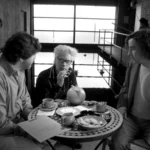
From the Margins to the Mainstream: Midi Z’s Cinematic Odyssey and the Genesis of ‘The Exiles’

In the rapidly evolving landscape of contemporary world cinema, few voices resonate with as much quiet, persistent authority as that of Midi Z. The Myanmar-born, Taiwan-based director, whose career has been defined by an unflinching gaze at the realities of migration and displacement, is now stepping into his most ambitious chapter yet. As he prepares his latest feature, The Exiles, for a 2027 release, the film stands as a testament to a filmmaker who has successfully bridged the gap between independent, humanistic storytelling and high-profile international collaboration.
Starring Sam Worthington, David Duchovny, and Ke-Xi Wu, The Exiles is a U.S.-Taiwan co-production that reimagines Joseph Conrad’s seminal literary classic, Heart of Darkness, through a contemporary lens. For Midi Z, the project represents more than just a stylistic shift; it is the culmination of a decade and a half of navigating the complexities of identity, colonial legacy, and the pursuit of a singular artistic voice.
The Genesis of a Filmmaker: A Chronology of Influence
Midi Z’s trajectory into the upper echelons of global cinema is anything but conventional. He did not emerge from the hallowed halls of prestigious film schools, nor was he the beneficiary of an industry pedigree. Instead, his education was forged in the digital frontier—through online film criticism, borrowed books, and an insatiable hunger for the craft.
The turning point arrived in 2009, when he was selected for the inaugural Golden Horse Film Academy in Taiwan. It was here that he crossed paths with Taiwanese auteur Hou Hsiao-hsien, a meeting that would fundamentally alter the trajectory of his life. Hou, recognizing the raw, untapped potential in the young director, took him under his wing. The mentorship was profound: Hou did not merely offer academic advice; he personally scouted locations in New Taipei City for Midi Z’s early, Myanmar-focused projects and invited him into the inner sanctum of the Taiwanese film elite.
Recalling those days, Midi Z shares anecdotes of surreal moments, such as karaoke sessions featuring international icons like Isabelle Huppert. Yet, the most significant takeaway from the experience was a piece of advice that would anchor his career: "You should go back and make films about your homeland."
Following this counsel, Midi Z spent the next fifteen years producing a body of work that dissected the Southeast Asian experience. From Ice Poison to The Road to Mandalay, his films became synonymous with the "margins" of cinema—stories of people living in the gaps between borders, cultures, and economic realities.
The Anatomy of ‘The Exiles’: A Modern Heart of Darkness
The Exiles represents a departure from the smaller, localized scale of his previous works, yet it remains firmly rooted in his thematic preoccupations. The film, which is being shot entirely in Taiwan with approximately 90% of its dialogue in English, serves as a high-stakes investigation into the human psyche.
"The story is inspired by a true crime I saw a few years ago in Southeast Asia," Midi Z explains during the Malaysia International Film Festival (MIFFest), where he served on the jury. "And while Heart of Darkness is a structural inspiration, my story is a total fiction."
By choosing to adapt the spirit of Conrad’s work rather than its period setting, Midi Z positions The Exiles within a tradition of ambitious genre-bending. Much like Francis Ford Coppola’s Apocalypse Now successfully transplanted the novel’s themes into the quagmire of the Vietnam War, Midi Z aims to explore the moral decay and psychological isolation of the modern global citizen. The inclusion of Hollywood stalwarts like Worthington and Duchovny alongside his frequent collaborator Ke-Xi Wu suggests a film that seeks to marry the commercial accessibility of a thriller with the existential weight of an art-house drama.
Supporting Data: The Fluidity of Global Production
The production of The Exiles is a reflection of the changing geography of filmmaking. As a U.S.-Taiwan co-production, it highlights the increasingly blurred lines of international finance and creative output. With the project now entering early post-production, the industry is watching closely to see how a director known for his "marginal", intimate style will handle the scale of a project with international star power.
Midi Z’s perspective on this is pragmatic. Having lived and worked across multiple borders, he rejects the notion that a filmmaker must be tethered to a single geography. He views the collaboration between the U.S. and Taiwan not as an imposition of one culture onto another, but as a synthesis of perspectives.
"Southeast Asian cinema is different from Chinese-language cinema," he notes. "It exists on the margins, and it is deeply personal. But the tools to tell these stories are universal."
Official Reflections: The Jury and the Voice of the Artist
Serving on the jury at the Malaysia International Film Festival—exactly 15 years after his directorial debut—provided Midi Z with a moment of reflection. Evaluating ten competition films, he noted the striking diversity of voices emerging from the region.
"I see completely different aesthetics and perspectives," he observed. "Every film has its own voice and its own identity."
However, he is also keenly aware of the pressures facing the next generation of filmmakers. In an era where streaming platforms and rapid-fire content consumption threaten to homogenize creative output, Midi Z is a vocal proponent of resistance. "Cinema is half art and half business," he says. "The biggest challenge isn’t learning how to make films. It’s how to remain original while trends and mainstream tastes constantly pull filmmakers in another direction."
His advice to aspiring creators is stark: "You don’t need to become mainstream. You need to protect your own voice."
Implications: Building Bridges Across Southeast Asia
Looking toward the future, Midi Z’s ambitions extend beyond his own filmography. He is actively looking to foster greater collaboration between the film industries of Malaysia, Thailand, and Myanmar. He identifies a shared history, particularly regarding the legacy of British colonialism, as a fertile ground for cross-border storytelling.
Thailand’s geographic proximity to Myanmar and Malaysia’s complex, multicultural identity provide, in his view, a "natural environment" for a new wave of regional cinema. For Midi Z, home is no longer a fixed geographic coordinate. It is a fluid state of being, a concept that allows him to move between projects and cultures with the freedom of an exile—a theme that clearly resonates with the title of his upcoming feature.
Conclusion: The Survival of the Independent Spirit
As The Exiles moves toward its 2027 release, the film is poised to be a litmus test for the sustainability of auteur-driven projects in an increasingly globalized market. Midi Z’s journey from a self-taught enthusiast in Myanmar to a globally recognized director who can command the attention of major Hollywood actors is a testament to the power of persistence and the necessity of keeping one’s artistic vision intact.
"Everyone has to find a way to survive, both physically and spiritually," he says, reflecting on his own life as a migrant and an artist. "The fluidity of identity and cultural belonging gives me the freedom to tell stories. It also gives me endless possibilities as a filmmaker."
In an industry often obsessed with the next big trend, Midi Z remains an outlier—a filmmaker who has successfully used his "marginal" origins to build a bridge to the center of global cinema, proving that the most resonant stories are often those that refuse to fit into the conventional mold. Whether The Exiles achieves the critical success of his earlier works remains to be seen, but one thing is certain: Midi Z will continue to walk his own path, fueled by the same curiosity that led him to pick up a camera fifteen years ago.