
Editor’s note: This review was originally published on September 10, 2026, during the 2026 Toronto International Film Festival. Apple will release the film in select theaters on Friday, November 6, and on Apple TV on Friday, November 13.
When Siân Heder’s CODA premiered at the 2021 Sundance Film Festival—unfolding during the industry’s unique “pandemic year” before mounting an improbable and historic run to the Best Picture Oscar—it established a distinct directorial signature. Heder demonstrated an uncanny ability to take the familiar, rhythmic beats of a coming-of-age drama and infuse them with a profound, lived-in authenticity. In her highly anticipated follow-up feature, Being Heumann, Heder proves that her success was no fluke. By eschewing the cradle-to-grave biopic format in favor of a laser-focused examination of a single, world-altering moment in the life of disability rights icon Judy Heumann, Heder has crafted a film that feels both historically urgent and vibrantly alive.
The Catalyst: A Life Defined by Agency
The film introduces us to Judy, portrayed with electrifying, sharp-witted magnetism by Ruth Madeley, in 1972. We find her zipping through the chaotic, unforgiving arteries of New York City in her wheelchair. For the uninitiated, this sequence is a visceral introduction to the systemic barriers of the era. With few, if any, curb cuts and a society that largely ignored the needs of those with physical disabilities, navigation was a constant, grueling act of defiance. When drivers yell or pedestrians stare, the brassy Brooklynite doesn’t shrink; she responds with a middle finger and keeps moving.
This opening establishes the central tension of the film, which Heder adapted from Heumann’s autobiography in collaboration with co-writer Rebekah Taussig. The question is not just whether Judy can survive the world as it exists, but how she will weaponize her indomitable spirit to reshape it. Heumann, who passed away in 2023, was a titan of civil rights, but the film wisely chooses not to summarize her entire biography. Instead, it anchors itself in the seminal struggle for the implementation of Section 504 of the Rehabilitation Act—a piece of legislation that, while passed in 1973, remained a toothless document for years due to bureaucratic inertia.

Chronology: The Road to 504
The narrative arc of Being Heumann is meticulously paced, jumping from the 1972 protests on Madison Avenue to the pivotal year of 1978. During this time, the disability rights movement faced a profound stalemate. Section 504 was the first federal legislation of its kind, designed to guarantee rights to accessibility and education for disabled citizens. Yet, despite its passage, the government refused to sign the necessary regulations to implement it.
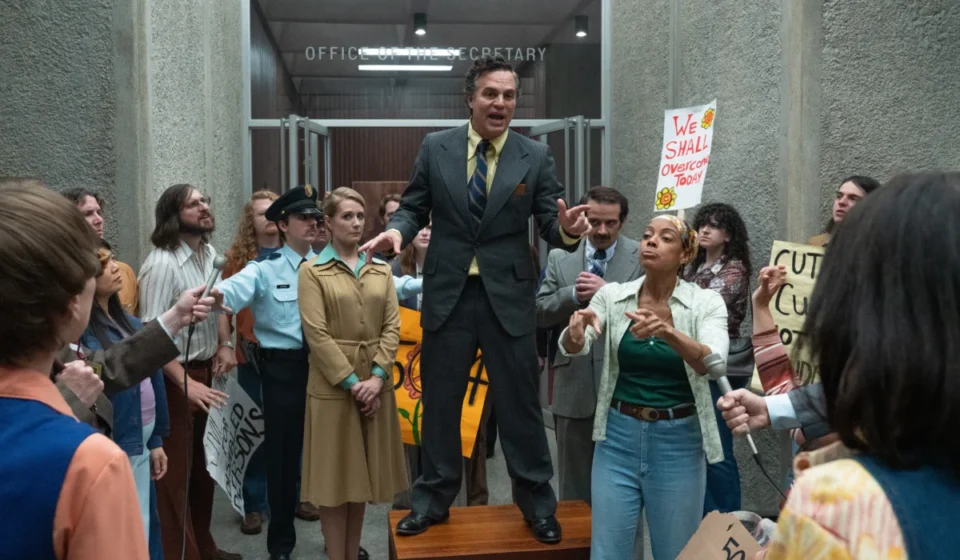
The primary antagonist in this bureaucratic dance is Joseph Califano, the newly installed Secretary of Health, Education, and Welfare, played with a weary, conflicted intensity by Mark Ruffalo. The film brilliantly distills the legal and political stakes: while the disabled community demands basic civil rights, the federal government is focused on austerity and budget cuts. Califano, a man who prides himself on his liberal credentials and his past support for the Selma marches, finds himself paralyzed by the political fallout of endorsing a costly civil rights expansion.
The film captures the frustration of this era perfectly. As the legislative machinery grinds to a halt, Judy and her fellow activists shift from lobbying to direct action, culminating in the historic, weeks-long sit-in at the federal building in San Francisco.
The Power of Authentic Casting
One of the most significant triumphs of Being Heumann is its commitment to representation. Much like her work on CODA, Heder insisted on casting disabled actors to play disabled figures. The result is a vibrant, ensemble-driven narrative that feels tactile and genuine.

Madeley’s performance as Judy is the heartbeat of the film, but she is bolstered by a stellar supporting cast. Madeline Delp shines as Kitty Cone, providing a crucial, diplomatic balance to Judy’s fire. The cast also features Andrew Pilkington as Hale Zukas, Antwan Tolliver as the charismatic Brad Lomax, and a standout turn from CODA alum Daniel Durant as Steve McCleeland. Roberta Colindrez and the burgeoning star Charlie Rush-Reese as Dennis Billups round out a group that brings humor, tension, and humanity to the screen.
The film’s production design, helmed by John P. Goldsmith, and Danny Glicker’s period-accurate costuming, ground these performances in a gritty, 1970s reality. It is a world that feels lived-in, smelling of stale coffee, mimeograph ink, and the sweat of people who have nowhere else to go.
Implications: Beyond the "Cultural Vegetable"
Perhaps the most surprising aspect of Being Heumann is its refusal to turn the story into a somber, didactic lecture on suffering. Instead, the film captures the "frisky and fun" reality of the activists. The sit-in, while high-stakes, was also a space for community building. The inclusion of details like the famous "sex tents" within the occupied building provides a refreshing, humanizing touch, reminding the audience that these were real people with full lives, desires, and senses of humor.
The implications of the 1978 sit-in were monumental. It was one of the largest and longest occupations of a federal building in U.S. history, and it forced the hand of the Carter administration, ultimately leading to the signing of the regulations. However, the film is careful not to paint this as a "happily ever after." It acknowledges the in-fighting, the burnout, and the toll that years of campaigning took on the participants.

Judy herself is not presented as a flawless saint. She is difficult, demanding, and occasionally stubborn. The film explores the friction that arises when a movement’s leader is unwilling to compromise, even when the pressure becomes suffocating. It serves as a reminder that the path to progress is rarely linear and almost always involves fighting one’s own instincts for safety.
A Call to Action
Being Heumann succeeds because it understands that inspiration is most potent when it is grounded in the mundane realities of hard work. The film does not merely document the past; it invites the viewer to reflect on the current state of disability rights and the ongoing necessity of collective action.
For audiences, the film serves as both a history lesson and a vibrant, emotional experience. It poses a question to the viewer: what are you willing to fight for? In an era where political discourse often feels performative, the raw, visceral reality of the 504 protests acts as a powerful corrective.
Ultimately, the film stands as a testament to the idea that true systemic change requires not just passion, but a willingness to be uncomfortable. Judy Heumann’s legacy is not just one of policy, but one of attitude. As the film poignantly illustrates, she was a woman who demanded the world change to accommodate her, and in doing so, she changed the world for everyone.

Final Verdict: A Masterclass in Human-Centric Storytelling
Being Heumann is a rare breed of biopic. It is intellectual without being academic, emotional without being sentimental, and radical without losing its sense of joy. By focusing on the humanity of its subjects rather than the abstraction of their achievements, Siân Heder has created a film that is destined to be discussed for years to come. It is, quite simply, one of the most important and uplifting films of the year.
Grade: B+
“Being Heumann” premieres at the 2026 Toronto International Film Festival. Apple will release the film in select theaters on Friday, November 6, and on Apple TV on Friday, November 13.