The Undead Reign Supreme: Sony’s ‘Resident Evil’ Shatters Franchise Records in Explosive Box Office Debut

As the crisp air of autumn begins to settle, signaling the arrival of the spooky season, moviegoers have clearly signaled a hunger for terror. Sony Pictures has capitalized on this seasonal shift with the theatrical release of Resident Evil, a bold, visceral reimagining of Capcom’s legendary video game franchise. The film has not only dominated the weekend box office but has effectively breathed new, terrifying life into a brand that has seen various cinematic iterations over the last two decades.
The Main Facts: A Franchise-Defining Opening
The numbers are, by all accounts, staggering. Resident Evil launched with a massive $26.3 million on its opening Friday, playing across 3,684 screens nationwide. Industry analysts, bolstered by the Friday performance, are projecting a weekend haul of approximately $55 million.
This performance represents a watershed moment for the franchise. To put the scale of this success into perspective, the previous record-holder, 2010’s Resident Evil: Afterlife, banked $26 million during its entire opening weekend. Sony’s new vision has effectively doubled the opening weekend standard of the series, proving that the appetite for Raccoon City’s horrors remains stronger than ever, provided the creative vision is sharp enough to capture the zeitgeist.
The Chronology of Production and Release
The path to this success was paved with both anticipation and skepticism. Directed by Zach Cregger—a filmmaker whose stock has risen exponentially following the critical and commercial success of his 2022 breakout Barbarian and the 2025 hit Weapons—the film was designed to be a departure from the established lore.
Cregger, working alongside co-writer Shay Hatten, made the controversial decision to pivot away from the familiar faces of the video game canon, such as Alice, Jill Valentine, or Leon Kennedy. Instead, the script focuses on a high-stakes, grounded premise: a medical courier, played by Austin Abrams, who finds himself trapped in the epicenter of a biological catastrophe while attempting to deliver supplies to the Raccoon City General Hospital.
Production moved quickly through the 2025 calendar year, with Sony banking on Cregger’s ability to blend high-concept horror with the kind of viral marketing that turned Barbarian into a cultural phenomenon. By the time the marketing campaign kicked into high gear in late summer, the focus was squarely on the film’s "original story" approach, a gamble that appears to have paid off in full.
Supporting Data: The Competitive Landscape
While Resident Evil claimed the top spot, the remainder of the box office top five reveals a diverse, if somewhat nostalgic, theatrical landscape.
The Witchy Follow-Up: Practical Magic 2
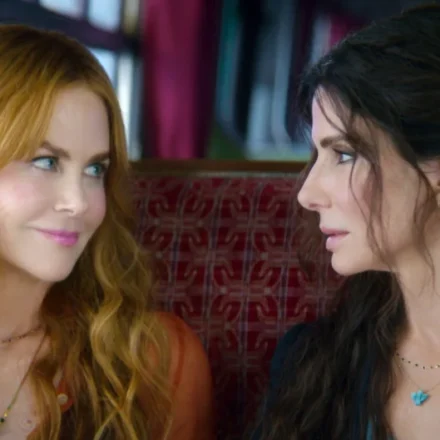
Holding the second-place position is the Warner Bros. sequel Practical Magic 2. Starring screen legends Nicole Kidman and Sandra Bullock, the film brought in $3.1 million on Friday, bringing its second-week trajectory toward a $10.4 million weekend. With a cumulative domestic total now sitting at $48.2 million, the film serves as a counter-programming staple for audiences looking for atmospheric, supernatural drama rather than outright zombie horror.
Legacy Blockbusters: Spider-Man and The Odyssey
The endurance of established intellectual property remains the bedrock of the modern box office. Sony’s Spider-Man: Brand New Day continues its historic run, adding $1.53 million to its coffers on Friday. The film has now reached an eye-watering $944.15 million in domestic gross, placing it in the pantheon of the highest-earning films in cinematic history. Meanwhile, Universal’s The Odyssey continues to perform with steady legs, bringing in $1.36 million on Friday for a total domestic haul of $609.8 million.
New Contenders and Animation
Vertical’s new release, The Weight, opened in fifth place. The historical thriller, which marks the directorial debut of Padraic McKinley, pulled in $1.17 million across 1,504 theaters. Featuring a gritty, star-studded performance from Ethan Hawke as a veteran smuggling gold through a dangerous wilderness, alongside Russell Crowe, the film is expected to stabilize at $2.3 million for the weekend.
Finally, GKids attempted to capture the family demographic with Shaun the Sheep: The Beast of Mossy Bottom. Opening to $540,000 on Friday across 2,173 screens, the animated feature is projected to earn $1.4 million. While modest, the film serves as an essential entry for younger audiences looking for lighthearted seasonal scares.
Critical Reception and Official Perspectives
The decision to eschew established characters was met with significant resistance from "die-hard" fans on social media. However, the critical consensus has shifted the narrative.
Variety critic Owen Gleiberman, who has been historically critical of the Resident Evil film franchise—referring to previous entries as "hyperviolent, hyperkinetic video-game zombie sludge"—offered a surprising endorsement of Cregger’s approach. He lauded the film as a "sweetly executed piece of escapist trivia," specifically praising the "quirky relatability" of the lead characters and the grounded intensity of the production design.
Sony executives, though not releasing official statements, are undoubtedly pleased with the return on investment. The performance of Weapons—which opened to $43 million and ultimately grossed $270 million globally—already established Cregger as a filmmaker capable of turning "original" horror concepts into financial juggernauts. By applying that same ethos to the Resident Evil brand, Sony has effectively reinvigorated a stagnant franchise without needing to rely on the baggage of its predecessors.
Implications for the Industry
The success of Resident Evil carries several implications for the future of Hollywood’s reliance on IP (Intellectual Property).
- The "Reboot" Paradox: This release suggests that audiences are not necessarily tired of established brands, but rather that they are fatigued by repetitive storytelling. By keeping the title but changing the narrative framework, Sony has satisfied both the brand-recognition requirement of modern studios and the audience’s desire for a fresh, unpredictable narrative.
- The Rise of the "Genre Auteur": Zach Cregger’s ascension marks a shift in how horror is produced. Major studios are increasingly willing to hand the keys of massive franchises to directors who have proven their worth in the independent or mid-budget horror space. The ability to craft tension, as demonstrated in Barbarian, is becoming more valuable to studio heads than the ability to manage massive CGI budgets.
- The "Fall" Window: The box office results prove that late-year releases, specifically those capitalizing on Halloween, remain a vital engine for the theatrical experience. While summer blockbusters usually dominate the headlines, the "spooky season" provides a unique environment where horror films can consistently outperform projections.
Looking Ahead: A Sustained Run?
As the weekend concludes, the focus shifts to whether Resident Evil can maintain its momentum. Given the strong word-of-mouth and the lack of major horror competition until late October, the film is well-positioned to maintain its lead for at least another two weeks.
For Sony, the goal now will be to analyze whether this "new take" can serve as a foundation for a new trilogy. If the financial metrics continue to hold, the industry may see a permanent pivot in how studios handle the Resident Evil property: moving away from the high-octane action of the past and toward the tense, survival-horror aesthetic that made the original video games a global phenomenon.
In an era where streaming services often threaten to cannibalize the theatrical experience, Resident Evil stands as a testament to the power of the "event horror" movie. When the premise is right and the director is dialed in, audiences will still flock to the local multiplex to be scared together in the dark. For now, the undead are not only walking—they are dominating the charts.