The Nightmare in the Playroom: Casper Kelly’s ‘Buddy’ Is a Meta-Horror Masterpiece

By [Your Name/Journalism Desk]
In the annals of subversive television and experimental cinema, few names carry as much weight—or as much delightful dread—as Casper Kelly. Since the 2014 viral phenomenon "Too Many Cooks," which deconstructed the cozy tropes of 1980s sitcoms into a surrealist fever dream, Kelly has carved out a singular niche as a master of the "media-within-media" subgenre. His latest feature film, Buddy, arrives in theaters on August 28 following a buzzy premiere at the 2026 Sundance Film Festival. It is, quite simply, the boldest expansion of his unique brand of existential, analog-horror satire to date.
Buddy manages a difficult tightrope walk: it is a high-concept, intellectually demanding meta-narrative that also functions as a visceral, "Barney"-esque nightmare. By blending the comforting aesthetics of mid-90s children’s programming with the cold, calculated cruelty of a slasher, Kelly has crafted what is arguably the first must-see cult classic of the year.
The Evolution of an Auteur
To understand Buddy, one must look at the trajectory of Kelly’s career. From the iconic, Cheddar-Goblin-infused insanity of Mandy to the layered, meta-textual terror of Adult Swim Yule Log and its 2024 sequel, Kelly has consistently explored the "disposable" nature of media. His work often fixates on the mechanical artifice of the late 20th century: the felt puppets, the garish neon set designs, and the inevitable, jarring presence of scrolling credits that signal the end of a safe, contained universe.
Kelly’s signature technique involves trapping his audience in a familiar format—a gentle, educational kid’s show—before systematically dismantling the boundaries between the medium and reality. In Buddy, this technique is applied to a feature-length canvas, allowing for a deeper exploration of themes like memory, institutional control, and the inherent darkness hiding behind the "happy" veneer of corporate-sanctioned childhood entertainment.

A Chronology of a Cursed Production
The narrative of Buddy operates on two distinct, parallel tracks that eventually collide in a shocking, reality-bending climax.
The World of the "Buddy" Show
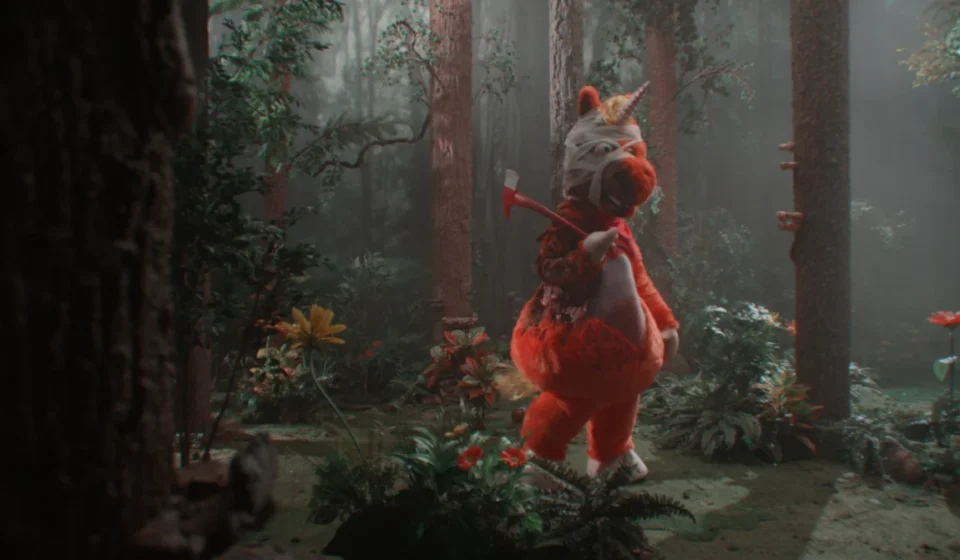
At the heart of the film is the show itself: Buddy. It is a perfectly replicated 1990s variety program centered around a talking orange unicorn, his rabbit roommate, and a host of sentient household items like "Strappy the Backpack." The show adheres to the rigid structure of educational programming: a 22-minute adventure, a moral lesson, a group hug, and a song.
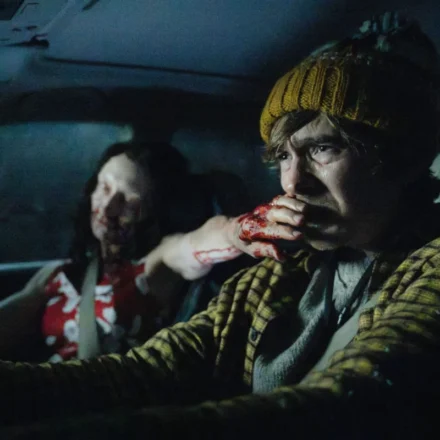
However, in this iteration, the "reset" button is literal. The children living in this world are trapped in a loop where physical damage is healed instantly and broken items are repaired by the unseen hands of production staff. The horror begins when the mascot, Buddy, transitions from a benevolent teacher into an erratic, homicidal entity. If a child disobeys, Buddy kills them, only for the child to be replaced by a new, identical version with no memory of the previous cycle. The children’s realization of this cycle—and their subsequent, futile attempts to escape—forms the backbone of the film’s mid-section.
The Existential Crisis of Grace
Simultaneously, we follow Grace (played with weary intensity by Cristin Milioti), a suburban mother grappling with a profound sense of loss. She and her husband, Ben (Topher Grace), live a seemingly idyllic life with two children. Yet, Grace is haunted by the unshakable conviction that they once had a third child—a child who has been erased from their memories and, apparently, from existence.
Her investigation leads her to the dark corners of the internet, where she discovers a forgotten, blacklisted children’s program from 1999 that seems to be the source of her grief. As her obsession threatens her marriage and her sanity, Grace’s odyssey becomes a desperate race to uncover the reality behind the Buddy broadcast.

Production Design: The Art of Analog Horror
One of the most remarkable aspects of Buddy is its aesthetic commitment. The film’s production team has gone to extraordinary lengths to recreate the low-budget, high-saturation look of 90s soundstages. The sets are not merely backgrounds; they are characters themselves. The texture of the felt, the unnatural lighting of the "backyard" sets, and the uncanny valley movements of the puppets create a tactile sense of unease.
Kelly’s decision to show what lies outside the soundstage—the industrial, cold, and desolate reality that powers the whimsical show—provides a stark, terrifying contrast. This visual storytelling elevates Buddy beyond a simple gimmick. It forces the audience to consider the cost of the media we consume, the artifice of the "happy ending," and the corporate machinery that creates our collective childhood nostalgia.
Official Perspectives and Industry Reception
Since its Sundance debut, Buddy has become a polarizing yet critically acclaimed piece of work. Distribution partners Roadside Attractions and Saban Films identified the film’s "cult potential" early, opting for a late-summer theatrical release designed to capitalize on the "midnight movie" crowd.
"Casper Kelly is operating on a frequency that very few filmmakers can even perceive, let alone master," noted one festival programmer during the January 2026 screening. While some early reviewers were unsettled by the film’s relentless pacing and bleak nihilism, the general consensus has been one of admiration for its technical execution. The juxtaposition of the "Barney-meets-slasher" premise with the grounded, emotional weight of the suburban storyline has drawn comparisons to the works of David Lynch and Charlie Kaufman, albeit filtered through a lens of twisted, internet-age humor.
Implications: The Future of Meta-Narratives
Buddy arrives at a pivotal moment in film history, where the lines between reality, digital content, and traditional cinema are increasingly blurred. By tackling the concept of "lost media" and the psychological impact of childhood programming, Kelly is speaking to a generation raised on the internet—a generation that finds comfort in the eerie and the unexplained.

The film’s implications for the genre are significant. It proves that there is a hunger for "high-concept horror" that does not rely on jump scares, but rather on the existential dread of a broken reality. Furthermore, it highlights the enduring power of practical effects and set design in an era dominated by CGI. By making the environment feel "real," Kelly ensures that the horror hits home.
Final Analysis
Buddy is not a film for everyone. Its dark humor is pitch-black, its narrative structure is intentionally disorienting, and its resolution offers more questions than answers. Yet, it is a triumph of vision. Casper Kelly has successfully taken the tropes of a dying medium and breathed into them a new, terrifying life.
For those who crave cinema that challenges the viewer, disrupts the status quo, and leaves them staring at the screen long after the credits roll, Buddy is an essential watch. It is a rare example of a film that understands its own artifice and uses that knowledge to construct a deeply unsettling, yet undeniably mesmerizing, experience.
Grade: B+
‘Buddy’ hits theaters nationwide on Friday, August 28. For more in-depth reviews and critical analysis of the year’s most provocative films, subscribe to the In Review newsletter.