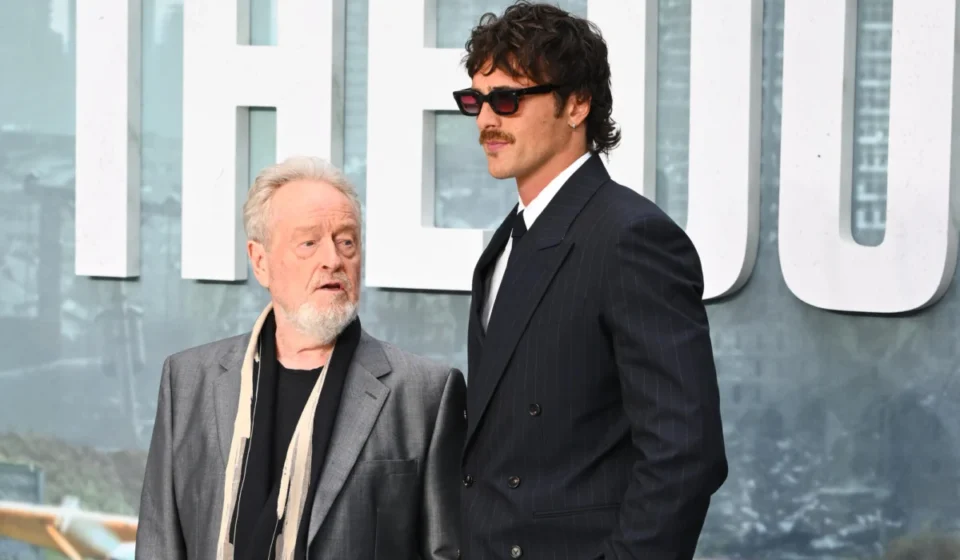
Beyond the Lens: Ridley Scott on the Architecture of Storytelling and the Legacy of ‘Blade Runner’

Ridley Scott is a titan of visual spectacle. Throughout a career spanning over five decades, he has redefined the boundaries of cinematic immersion. Whether he is orchestrating the sprawling, rain-slicked dystopias of Blade Runner, capturing the visceral, high-stakes chaos of the Battle of Waterloo in Napoleon, or crafting the claustrophobic terror of Alien, Scott’s name is synonymous with unparalleled world-building. Yet, as he prepares for the theatrical release of his latest feature, The Dog Stars, on August 28, the legendary director is offering a surprising admission: for all his technical mastery, he finds the written word to be the most formidable hurdle in the filmmaking process.
“Writing is the hardest possible thing to do,” Scott remarked during an upcoming appearance on IndieWire’s Filmmaker Toolkit podcast. While he has fostered legendary collaborations with writers ranging from the breakout talent of Callie Khouri on Thelma and Louise to seasoned industry veterans like Mark L. Smith, the scribe behind The Dog Stars and The Revenant, Scott reserves his highest praise—and his most complicated memories—for the man who helped him craft his greatest science-fiction triumph.
The Architect of Dystopia: The Fancher Connection
When discussing his most profound creative partnership, Scott points directly to Hampton Fancher, the screenwriter who distilled the dense, sprawling madness of Philip K. Dick’s Do Androids Dream of Electric Sheep? into the lean, existential masterpiece that became Blade Runner.
“Blade Runner was the best writer relationship I ever had,” Scott reflected. The challenge of adapting Dick’s work was immense; Scott noted that within the first 19 pages of the source material, there are roughly 200 disparate story threads. Fancher’s genius lay in his ability to isolate the core emotional pulse: the tragic, doomed romance between a bounty hunter and his target. By focusing on the hunter who falls in love with his quarry, Fancher provided the emotional anchor necessary to ground the film’s elaborate production design.
According to Scott, the film’s enduring status as a pillar of the genre is as much a result of Fancher’s narrative cadence as it is the director’s iconic visual flair. “The cadence is beautiful,” Scott said of Fancher’s work. “The grace of it was fantastic.”

A Methodology of Hypotheticals
Scott’s process with writers is rarely a static affair. He describes a collaborative environment defined by constant interrogation, where the duo would pose endless “what if” questions to expand the universe beyond the limitations of the screenplay. This intensive development process often birthed elaborate backstories that, while never explicitly appearing on screen, provided the essential structural integrity for the film’s production design.
The most iconic example of this methodology is the Tyrell Corporation’s pyramid. In the finished film, it stands as a monolithic symbol of corporate hubris and technological advancement. However, the genesis of this structure was rooted in a narrative deep dive into the character of Eldon Tyrell.
“The reason the pyramid happened is that I thought in any age, any time, any century, there will always be a disease we can’t figure out,” Scott explained. In their collaborative notes, Tyrell was not merely a CEO; he was a man obsessed with his own mortality. “Tyrell died from one of those diseases, but as he was dying for months and years, he built a pyramid in honor of himself. In the middle of the pyramid is a highly electronic sarcophagus, where he put himself to go to sleep until they found a cure. One year, there was a massive shutdown of power, and he melted in his sarcophagus and died.”
The corporate cover-up—where the company installed a “convincing clone” to maintain the illusion of the CEO’s continued leadership—was a narrative layer that ultimately hit the cutting room floor, yet it permeated the film’s atmosphere. It remains a testament to the depth of the collaboration between Scott and Fancher: the ability to build a foundation so solid that the audience can feel the weight of the history beneath the frame.
The Friction of Artistic Vision
Despite the brilliance of their collaboration, the relationship between Scott and Fancher was strained by the harsh realities of the film industry. Upon its 1982 release, Blade Runner was a commercial disappointment, failing to connect with general audiences who were perhaps unprepared for its somber, philosophical tone.

“Hampton was furious,” Scott admitted. “He said, ‘You ruined my script.’ I was really deeply hurt by that.”
The friction extended to the cast as well. Harrison Ford, portraying the weary blade runner Rick Deckard, famously struggled with the ambiguity of the character’s identity. The central debate—whether Deckard was human or a replicant—became a source of contention between actor and director. Scott, who has long maintained that the origami imagery throughout the film serves as a definitive clue, recalls telling his lead: “Dude, you’re a replicant!”
A Prescient Legacy
Decades removed from the initial release, the legacy of Blade Runner has shifted from commercial failure to cultural touchstone. For Scott, the bitterness of that early rejection has faded into a reflective appreciation for the film’s longevity. He harbors no ill will toward Fancher, viewing their past disagreements as a byproduct of being “so far ahead of the game.”
In the current climate, Scott finds his 1982 vision increasingly relevant. He draws parallels between the fictional Tyrell Corporation and the modern reality of billionaire-led conglomerates that wield influence rivaling that of sovereign nations.
“We’re headed there now,” Scott observed. “[Tyrell] has got one of the two corporations that’s running the world. Who’s to stop you from having an army of 10,000 people and 200 Black Hawks if you’ve got that kind of money? So, Blade Runner is coming to fruition as we speak.”

Looking Forward: The Dog Stars
As Scott pivots to his latest project, The Dog Stars, he brings with him the same rigor that defined his early career. The film, which features Jacob Elordi and Josh Brolin, promises to be another exercise in world-building and character-driven storytelling.
The shift from the epic historical scope of Napoleon to the intimate, post-apocalyptic narrative of The Dog Stars highlights Scott’s refusal to be categorized. While the director continues to push the boundaries of what is visually possible, his reliance on the “hardest possible thing”—the written word—remains the true North Star of his career. Whether it is through the cadence of dialogue or the hidden histories of his characters, Scott remains a master of ensuring that the world on screen is always supported by a narrative foundation built to last.
As the industry prepares for the release of The Dog Stars this Friday, fans and critics alike are reminded that behind the massive sets, the thousands of extras, and the cutting-edge visual effects, Ridley Scott’s primary focus remains the fundamental human questions that first drove him to film Blade Runner. The upcoming episode of the Filmmaker Toolkit podcast, which promises to dive deeper into these creative philosophies, will be a mandatory listen for those looking to understand the mind of a director who has spent his life chasing the intersection of visual perfection and narrative truth.
For those interested in the full conversation, the Ridley Scott episode of the Filmmaker Toolkit podcast will be available for streaming later this summer on Apple, Spotify, and all major podcast platforms.