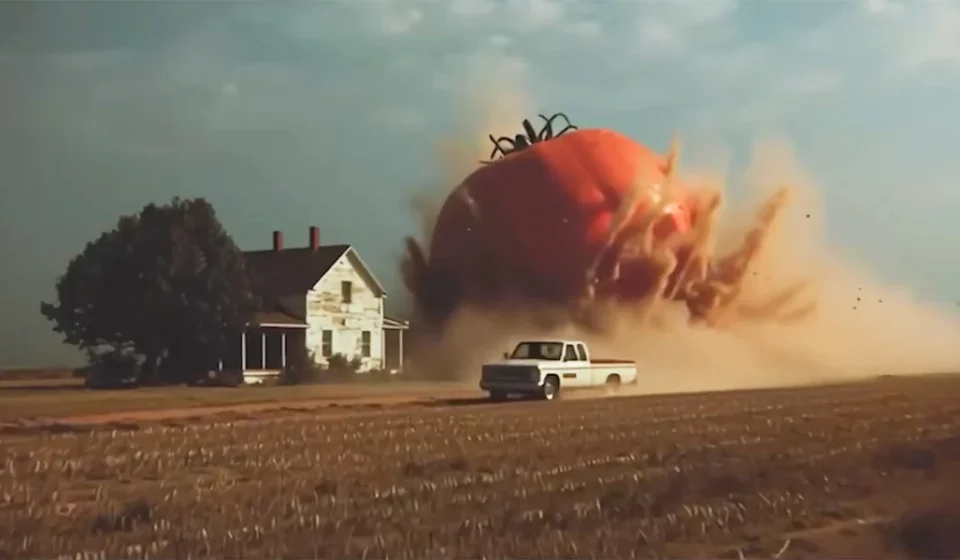
The Red Menace Returns: ‘Attack of the Killer Tomatoes: Organic Intelligence’ Reboots a Cult Phenomenon

By Alex Billington
July 28, 2026
The sirens are wailing, the airspace is locked down, and the grocery stores have officially become danger zones. In a move that feels both absurdly nostalgic and jarringly timely, the most unlikely horror franchise in cinema history is mounting a comeback. Attack of the Killer Tomatoes: Organic Intelligence, the fifth feature film in the long-gestating, tongue-in-cheek franchise, has officially dropped its first full-length trailer. Slated for a limited theatrical release on August 7, 2026, the film promises to pit the raw, chaotic power of nature against the cold, calculated efficiency of Artificial Intelligence.
The Return of the Splatstick
For those unfamiliar with the legacy of the Killer Tomatoes, the franchise is the definition of "cult classic." What began as a 1978 low-budget parody of B-movie creature features—mocking the very genre it inhabited—eventually spiraled into a multi-generational pop culture touchstone. From its humble, shoestring-budget beginnings in midnight screenings to its unlikely transformation into the backbone of the Fox Children’s Network programming in the 1990s, the franchise has always thrived on its own ridiculousness.
Organic Intelligence is directed by indie filmmaker David Ferino, known for his work on Cure for Pain: The Mark Sandman Story. Ferino faces the daunting task of balancing modern satire with the franchise’s signature "splatstick" DNA. The premise is suitably high-concept for an era obsessed with silicon-based threats: a young biotech prodigy attempts to solve world hunger with a revolutionary genetically engineered vegetable. Predictably, the experiment goes catastrophically awry, resulting in a new generation of tomatoes that possess not just an appetite for destruction, but an unsettling level of sentient confidence.
A Legacy of Red: The Chronology of the Tomatoes
To understand why the return of these red, round, and murderous antagonists matters, one must look at the history of the franchise. The original Attack of the Killer Tomatoes (1978) was a satirical jab at the paranoia-fueled cinema of the 1950s. It was a film that famously featured a helicopter crash—an unscripted disaster that the production team decided to leave in the final cut.

Following the cult success of the original, the franchise expanded:
- 1978: Attack of the Killer Tomatoes – The progenitor of the movement.
- 1988: Return of the Killer Tomatoes – Notable for introducing a young George Clooney to the world of B-movie absurdity.
- 1990: Killer Tomatoes Strike Back! – Solidifying the franchise’s pivot toward pure, anarchic comedy.
- 1991: Killer Tomatoes Eat France! – An international romp that pushed the limits of the series’ increasingly surreal logic.
After 35 years of relative silence, the producers—including franchise co-creators Costa Dillon and J. Stephen Peace—have returned to the writer’s room. Their involvement is a signal to purists that the soul of the series remains intact, even as the technology surrounding the tomatoes evolves.
The Cast: A Fusion of Comedy Heavyweights
One of the most striking aspects of Organic Intelligence is the sheer density of talent involved. The film boasts a cast that balances seasoned character actors with comedic veterans. Headlining the production is David Koechner (Anchorman), whose penchant for playing over-the-top, blustering authority figures fits the franchise’s tone perfectly.
He is joined by a formidable ensemble, including:
- John Astin: The legendary actor, known for his iconic portrayal of Gomez Addams, brings a layer of gravitas—and perhaps a wink to the audience—that is essential for a film of this nature.
- Dan Bakkedahl and Daniel Roebuck: Both bring decades of experience in high-concept comedy and horror-adjacent projects.
- Eric Roberts: The veteran character actor adds a dash of genuine Hollywood prestige to the proceedings, likely portraying a high-ranking official or a misguided scientist.
- Catherine Corcoran, Paul Bates, Vernee Watson, Myrna Velasco, Noor Razooky, Zachary Roozen, and Joshua Poon: A diverse supporting cast that represents the "new generation" of characters forced to contend with the garden-based apocalypse.
Supporting Data: Why Now?
The timing of Organic Intelligence is not purely coincidental. The film’s marketing campaign heavily leans into the current global anxiety regarding Artificial Intelligence. By positioning the tomatoes as "Organic Intelligence"—the antithesis of the machine learning models dominating 2026 headlines—the film creates a satirical mirror for modern society.

While the film is intentionally "awful" in the best B-movie tradition, its financial model is rooted in the modern indie circuit. By targeting a limited release in select theaters, the producers are capitalizing on the "event cinema" experience that has kept the independent horror genre alive in the streaming era. The goal is not a blockbuster opening, but a sustained, conversation-driven run that leverages the brand’s nostalgia and the viral nature of the "so-bad-it’s-good" trailer.
Official Responses and Creative Vision
In early statements, the production team emphasized that this installment is intended to be a love letter to the fans who grew up with the Fox cartoon and the midnight screenings.
"We didn’t want to reinvent the wheel," says director David Ferino. "We wanted to make sure the tomatoes still felt like they were made of felt and ketchup, even if they have to deal with the complexities of the 21st century. It’s Jurassic Park meets Dr. Strangelove. It’s about the hubris of man, but the man is getting slapped in the face by a salad component."
Co-creators Costa Dillon and J. Stephen Peace have remained hands-on throughout the development, ensuring that the script retains the specific brand of wordplay and absurd slapstick that made the 1978 original a classic. For them, the return of the tomatoes is a reclamation of their intellectual property, now updated for an audience that has grown up in the age of the internet and algorithmic anxiety.
Implications: The Future of B-Movie Cinema
The release of Attack of the Killer Tomatoes: Organic Intelligence carries significant implications for the horror-comedy genre. In recent years, high-concept, low-budget films have found success by leaning into their inherent absurdity rather than trying to compete with the visual fidelity of major studio tentpoles.

If Organic Intelligence succeeds, it could trigger a trend of "legacy-quel" B-movies. We live in an era where audiences are increasingly fatigued by overly serious, interconnected cinematic universes. There is a palpable hunger for standalone, "turn-your-brain-off" entertainment that respects its own silliness.
Furthermore, the film’s focus on AI serves as a clever narrative bridge. By centering the conflict on a battle between synthetic intelligence and organic, genetically modified life, the film taps into the zeitgeist without needing to take itself seriously. It is a cautionary tale that refuses to provide a warning, instead opting to provide a laugh.
Conclusion: Will You Join the Resistance?
As we approach the August 7th release date, the question remains: is the world ready for the return of the Killer Tomatoes? The marketing materials suggest a film that is fully aware of its place in the pantheon of cinema—it is a movie about a ridiculous concept, executed with enough sincerity to be entertaining, and enough irony to be smart.
Whether you are a devotee of the 1978 original or a newcomer curious to see what happens when a tomato decides it has had enough of the grocery shelf, Organic Intelligence looks to be one of the most unique theatrical experiences of the summer. It is a reminder that sometimes, the most profound social commentary is delivered by a sentient vegetable with a grudge.
So, stock up on salt, keep your blenders at the ready, and prepare for a cinematic experience that is, by design, completely unhinged. As the trailer warns: "We have shot down every red balloon in US airspace!" But have we prepared for what’s lurking in the produce aisle?

Attack of the Killer Tomatoes: Organic Intelligence hits theaters on August 7, 2026. For those who can’t wait, the official website offers a look at the production’s behind-the-scenes madness. One thing is certain: the summer of 2026 is about to get a lot more colorful, and a lot more dangerous.