
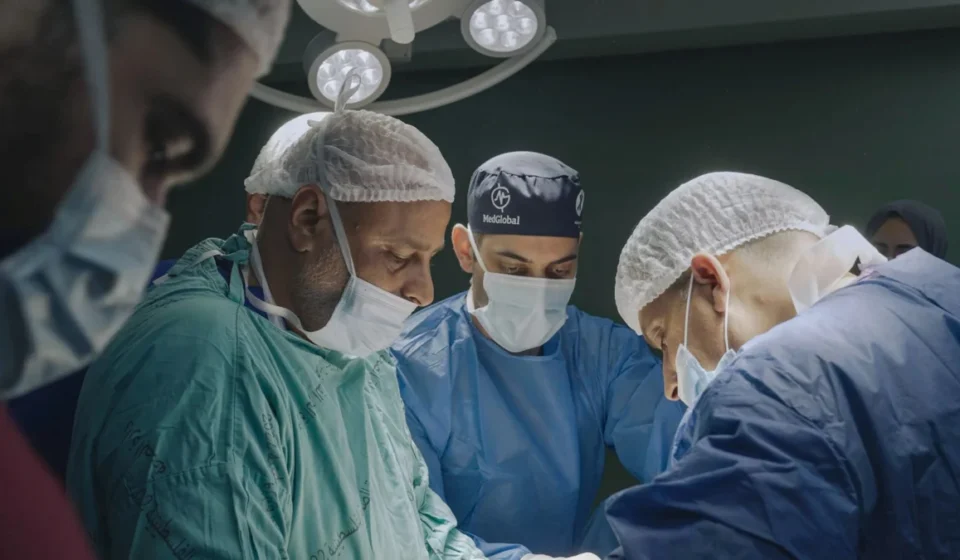

In an era defined by the rapid-fire consumption of geopolitical tragedy, the documentary American Doctor arrives not as a distant observation, but as a visceral confrontation with the limits of human intervention. Directed by Poh Si Teng—a former ABC News veteran who self-financed the project after walking away from the institutional constraints of mainstream media—the film is an uncompromising examination of the humanitarian catastrophe in Gaza.
Through the eyes of three medical professionals who journeyed to the Nasser Medical Complex, Teng captures a reality that transcends political talking points. The film is a harrowing synthesis of personal sacrifice, bureaucratic cruelty, and the persistent, gnawing question that haunts millions of observers worldwide: In the face of systemic annihilation, what can one person actually do?
The Anatomy of a Humanitarian Crisis
The documentary centers on three men: Dr. Mark Perlmutter, a blunt, seasoned physician; Dr. Feroze Sidhwa, a trauma surgeon of Pakistani descent; and Dr. Thaer Ahmad, a Chicago-based emergency physician. Each man brings a unique perspective and a different set of psychological burdens to their mission.
Dr. Perlmutter, a Jewish physician whose father once treated survivors of the Holocaust, approaches the crisis through the lens of historical memory and moral duty. Dr. Sidhwa, motivated by a visceral reaction to the realization that his tax dollars are subsidizing the destruction of civilian life, finds his only respite in the grueling labor of surgery. Dr. Ahmad, a Palestinian-American with deep roots in the West Bank, faces the most complex emotional terrain, grappling with the knowledge that his community is being erased while he navigates the relative safety of the United States.

Together, these men provide more than just medical care; they provide testimony. Their presence at the Nasser Medical Complex offers a terrifying window into a landscape where the Hippocratic Oath is constantly challenged by the reality of weaponized infrastructure.
A Chronology of Conscience and Conflict
The timeline of American Doctor is framed by the "ceasefire" period of late 2023, a window of relative calm that served only to highlight the routine, staggering violence of the occupation.
- The Departure: Driven by a sense of duty, the doctors leave their professional lives in the U.S. to enter a conflict zone where medical facilities have become primary targets.
- The Clinical Reality: At Nasser, the doctors operate alongside local Palestinian medical staff who continue to work even as their own families are targeted or lost. The film documents scenes of heartbreaking normalcy—laughter and routine care—interspersed with the abrupt, chaotic terror of drone strikes.
- The Diplomatic Failures: Upon returning, the doctors attempt to leverage their experiences to influence change in Washington. These efforts are met with indifference, most notably from the staff of lawmakers like Ted Cruz, who reportedly showed zero interest in the documentation of war crimes.
- The Aftermath: The film concludes with a grim montage of the destruction visited upon Nasser after the doctors’ departure, underscoring the futility of individual medical heroism against state-sponsored, systematic erasure.
Supporting Data and Institutional Complicity
The impact of American Doctor is bolstered by its refusal to sanitize the horrors of the war. It presents, with unflinching clarity, the reality that medical personnel and infrastructure in Gaza are being targeted with a frequency and impunity not seen in other modern conflicts, including the war in Ukraine.
Teng’s direction serves as a meta-commentary on the media’s role in this crisis. By juxtaposing the doctors’ raw testimonies with clips of mainstream media figures—such as CNN’s Dana Bash—the film highlights the "skeptical posture" often adopted by major news outlets. This skepticism, the film suggests, acts as a form of institutional complicity, normalizing the targeting of hospitals and the murder of civilians by framing verifiable war crimes as matters of "opinion" or "debate."

Official Responses and the Wall of Bureaucracy
A recurring theme in the film is the failure of the American political apparatus to address the reality on the ground. When Dr. Ahmad attempts to re-enter Gaza, he is barred due to his Palestinian heritage—a stark reminder of how apartheid bureaucracy operates even at the border of a slaughterhouse.
The film does not merely document these instances of exclusion; it frames them as the final, dehumanizing acts of a system designed to make the suffering of Palestinians invisible. The lack of engagement from Washington serves as a catalyst for the doctors’ mounting demoralization, proving that even the most compelling, firsthand evidence of genocide can be neutralized by a political establishment that refuses to acknowledge it.
The Burden of Witness: Psychological Implications
Perhaps the most powerful aspect of American Doctor is its exploration of the survivors’ guilt and the trauma of "returning." For Dr. Sidhwa, the transition back to the U.S. is marked by a profound sense of surrender. In a moment of vulnerability during a "Jews for Peace" conference, he confesses to the crowd that he has lost hope for the future of Gaza.
This moment of collapse, however, is met with an act of defiance from an audience member who reminds him of the long, grueling history of the anti-Vietnam War movement. It is a vital, if difficult, lesson: that despair is a luxury, and that the struggle for justice is a marathon, not a sprint. The film suggests that the "helplessness" felt by the viewer is not a sign of defeat, but an invitation to action.

Beyond the Screen: Why This Film Matters
American Doctor is not an easy watch, nor is it intended to be. By choosing to include (and, at times, carefully omit) the most graphic imagery of the conflict, Teng forces the viewer to confront their own boundaries of comfort.
The film posits that while no individual can stop the machinery of war alone, the cumulative impact of witnessing and testifying creates a friction that the perpetrators of genocide cannot fully silence. As Dr. Ahmad observes regarding his local community in Chicago, the act of bearing witness to the truth—and the existence of a Palestinian homeland—is an act of resistance in itself.
Conclusion: Turning Helplessness into Agency
The final message of American Doctor is one of defiant persistence. It acknowledges that the doctors, despite their courage, returned home more traumatized and demoralized than when they left. Yet, it also illuminates the ripple effect of their testimony.
We may not all be surgeons capable of operating in a war zone, but the film asserts that we are not without agency. If the medical professionals who risked their lives to treat the victims of this genocide can continue to speak, to organize, and to resist, then those of us watching from the outside have no excuse for silence.

American Doctor is a vital, necessary, and deeply painful piece of cinema. It is a reminder that while the machinery of destruction is powerful, the persistent, collective demand for humanity is the only force capable of challenging it. The film is currently playing in select theaters, serving as a beacon for those who refuse to look away from the unfolding tragedy in Gaza.