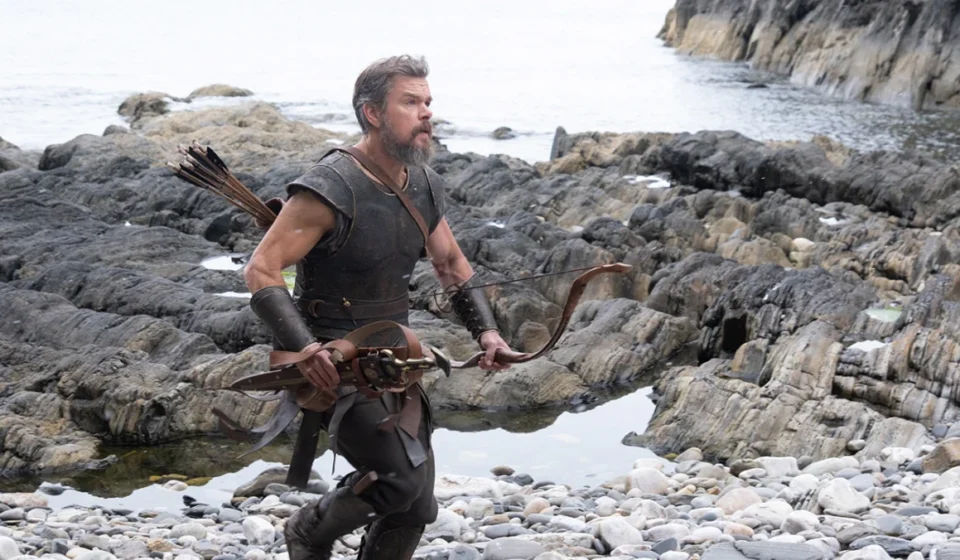

In an audacious move that signals a tectonic shift in the entertainment industry, the artificial intelligence-driven studio Fountain O has officially announced its second feature-length production, Odysseus: The Fall. Spearheaded by director Ash Koosha and media veteran Tom Rogers, the project arrives as a direct, albeit vastly more cost-effective, companion to Christopher Nolan’s upcoming $250 million blockbuster, The Odyssey.
By leveraging cutting-edge generative AI, Fountain O is attempting to bridge the chasm between experimental tech-demos and full-scale narrative cinema. The company is positioning Odysseus: The Fall not merely as a film, but as a provocation—a litmus test for whether audiences can find the same emotional resonance in a film generated by algorithms as they do in a production featuring the industry’s biggest stars, such as Matt Damon, Anne Hathaway, and Tom Holland.
The Genesis of a New Production Paradigm
The history of Fountain O is inextricably linked to the rapid evolution of generative AI. Ash Koosha, a visionary artist who previously made headlines with the Tribeca-debuted Dream of Violets—a film produced on a shoestring budget of just $2,000—has moved from the fringes of independent cinema into the crosshairs of global studio competition.
A Chronology of Innovation
- 2009: The Koosha brothers, Ash and Pooya, depart Iran, bringing with them a background in cloud computing and digital architecture.
- Post-2020: The brothers co-found Claigrid, a cloud-based AI personalization company, establishing a foundation for the technical infrastructure later used in Fountain O.
- 2024–2025: Ash Koosha directs Dream of Violets, an AI-generated exploration of the Iranian resistance. The project proves that long-form narrative content can be rendered entirely through AI models.
- July 2026: Fountain O announces Odysseus: The Fall, a 135-minute feature, intentionally timed to coincide with the release of Christopher Nolan’s The Odyssey.
- July 17, 2026: Dream of Violets hits the Fountain O streaming platform, marking the company’s first commercial push into the direct-to-consumer digital market.
Unlike traditional productions that rely on physical sets, sprawling camera crews, and months of principal photography, Odysseus: The Fall was constructed through a "human-in-the-loop" AI pipeline. Every visual frame, character movement, and environmental texture was generated via proprietary software and third-party models, including the Chinese-developed Kling AI and Google’s suite of research tools.
Behind the Curtain: The AI Stack
Fountain O’s production process is a sophisticated blend of human creativity and high-speed computation. According to the production team, the film utilizes a "synthetic pipeline" that replaces the traditional director of photography, set designer, and even the cast.
The Technical Ecosystem
The technical architecture of the film is a masterclass in modern AI stacking:
- Visual Rendering: The studio utilized Kling AI, a powerful video generation model that has emerged as a preferred alternative following the shuttering of OpenAI’s Sora project.
- Core Imagery: Google Nanobanana was employed for foundational frame development, providing the texture and atmospheric base for the film’s visual language.
- Language and Research: Claude AI served as the primary engine for script editing and structural refinement, while Google Gemini was tasked with historical and mythological research to ensure the narrative’s fidelity to the Homeric tradition.
- Proprietary Layer: Fountain O’s own internal software handled "world modeling," actor blocking, and frame accuracy—the crucial "glue" that prevents the flickering and inconsistency often associated with early-stage AI video.
Pooya Koosha, the film’s post-producer, emphasizes that this is not a "hands-off" process. "We are finding through experimentation with each film that we are creating new tools and techniques," he stated. "We are enabling ourselves to overcome challenges that put our filmmaking at the ultimate cutting edge."

Narrative Ambition: A Hero’s fractured Memory
While Nolan’s The Odyssey promises a grand-scale, star-studded interpretation of the Homeric epic, Odysseus: The Fall offers a more intimate, psychological, and existentialist take.
The synopsis released by Fountain O describes the 135-minute runtime as an exploration of "the fractured memory of a drowning man in his final minutes." Rather than a traditional linear adventure, the film functions as a trial of the soul, where every monster the protagonist encounters is a manifestation of his own "handwriting."
The film subverts the traditional "hero’s journey" trope. Instead of focusing on the physical return to Ithaca, it strips away the protagonist’s "cleverness"—a trait for which Odysseus is historically famous—and forces him to reckon with the moral cost of his survival. The story culminates not in a triumphant reunion, but in an act of forgiveness from the one person who truly understands his nature. This narrative choice underscores Koosha’s intent: to use the tool of AI to delve into the interiority of the human experience rather than just replicating the spectacle of a blockbuster.
The "Nolan Effect" and the Marketing Strategy
Perhaps the most aggressive element of Fountain O’s strategy is its decision to piggyback on the massive marketing machine of Christopher Nolan’s upcoming adaptation. By scheduling their release alongside the $250 million production, Fountain O is inviting a direct, unflinching comparison.
Tom Rogers, the executive chairman of Fountain O and a seasoned media executive who famously founded CNBC, frames this not as a conflict, but as a symbiotic opportunity. "We wanted to provide a basis of comparison," Rogers explained. "Moviegoers might be curious enough to see both films developed out of the same classic tale as a way to better understand the level at which AI is able to contribute to the art of filmmaking."
Ash Koosha added that he hopes Nolan’s film is a "raging success," believing that the cultural conversation surrounding the legend of Odysseus will inevitably draw curious eyes toward the AI-generated alternative. It is a bold, high-stakes bet that audiences are interested in the process of creation as much as the final product.
Official Responses and Philosophical Implications
The rise of Fountain O has reignited the debate over the role of the auteur in an era of automation. In his director’s statement, Ash Koosha addressed the fear that AI is replacing human storytellers.

"It’s a threat to nothing except distance—the distance between a person with a story and the means to tell it," Koosha stated. He compared the current AI revolution to the invention of the portable camera, which democratized filmmaking by allowing anyone to capture the world. For Koosha, the "tool" is irrelevant; it is the urgency of the narrative that defines the value of a work of art. "A tool has never made a film worth watching. A person with something urgent to say has made every one of them."
The Industry Challenge
Despite this idealistic outlook, the professional film industry remains cautious. To date, no major streamer or theatrical distributor has picked up Dream of Violets for wide release, leaving Fountain O to manage its own distribution via a direct-to-consumer model. The company will charge $9.99 for a per-title rental on its website—a price point that will test whether viewers are willing to pay "theatrical" rates for content created outside the traditional studio system.
The implications of this model are profound:
- Cost Disruption: If a "mid-five figure" budget can produce a 135-minute film, the traditional Hollywood "blockbuster" budget of $250 million may face severe market pressure.
- The Democratization of Scale: Technical barriers to entry, such as expensive location shoots, massive casts, and physical VFX, are being rapidly eroded.
- The "Quality" Gap: The ultimate question remains whether an AI, guided by human prompts, can capture the subtle, unscripted nuances of human performance that define great cinema.
Conclusion: A New Frontier
As the release dates for both The Odyssey and Odysseus: The Fall approach, the film industry stands at a crossroads. We are witnessing a clash of philosophies: the traditional, human-centric epic versus the synthetic, algorithmically-generated narrative.
Whether Odysseus: The Fall proves to be a landmark moment in the history of cinema or merely a footnote in the development of AI tools remains to be seen. However, one thing is certain: the Koosha brothers and their team at Fountain O have successfully forced a conversation about the nature of creativity that the entire industry can no longer ignore. By the end of this summer, audiences will be the final arbiters, deciding if the future of storytelling lies in the hands of the masters or the machines they have learned to command.