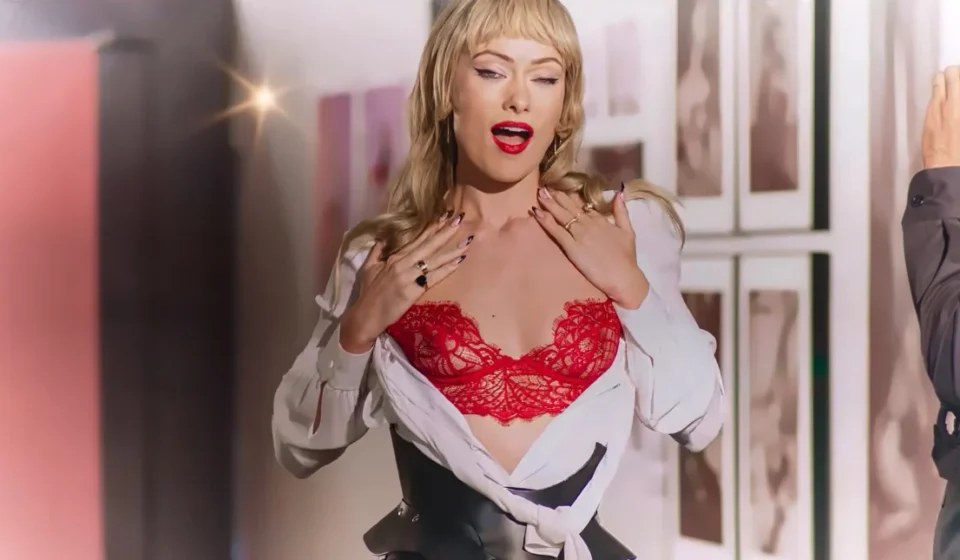
The Provocateur’s Mirror: Inside Gregg Araki’s Audacious New Film ‘I Want Your Sex’

In the landscape of contemporary independent cinema, few voices remain as consistently transgressive as Gregg Araki. With his latest feature, I Want Your Sex, set to hit theaters on July 31 via Magnolia Pictures, the director returns to his roots of high-concept, boundary-pushing storytelling. The film, which stars Olivia Wilde as the enigmatic artist Erika Tracy and Cooper Hoffman as her young assistant, Elliot, serves as both a neon-soaked comedy and a challenging Rorschach test regarding power dynamics, artistic integrity, and the evolving nature of human intimacy.
The Core Narrative: A Study in Ambiguity
At the center of I Want Your Sex is the volatile relationship between Erika, an artist whose work is as erotically charged as it is polarizing, and Elliot, the impressionable assistant drawn into her orbit. As the narrative unfolds, the audience is forced to grapple with a central, unsettling question: Is Erika a predator wielding her professional authority to exploit a subordinate, or is she a mentor providing her protégé with the vital, visceral experiences necessary for artistic growth?
The brilliance—and perhaps the frustration—of the film lies in its refusal to provide a definitive answer. Araki masterfully constructs scenes that oscillate between satire and celebration. Olivia Wilde delivers a performance of surgical precision; every flicker of her eyes and every sharp, calculated movement is timed to maximize comedic impact while maintaining an aura of dangerous mystery. It is a performance that demands the audience interrogate their own biases, as one’s interpretation of Erika is inevitably filtered through the lens of their own age, sexual history, and moral compass.
A Chronology of Artistic Intent
The inception of I Want Your Sex did not begin with a desire to make a statement, but rather from a place of genuine cultural bewilderment. Following reports suggesting that Gen Z is statistically less sexually active than previous generations, Araki found himself compelled to explore the implications of a "post-intimacy" society.
"Sex has been a really integral part of my journey as a person, and as an artist and filmmaker," Araki noted during an interview for an upcoming episode of the Filmmaker Toolkit podcast. "It’s really what formed me. So, when Erika and Elliot are sitting on the couch talking about this, it’s literally what I would say: ‘You guys are all about FOMO, and you don’t care about missing out on the sexual prime of your lives?’"

The project underwent a significant evolution during the scripting phase. Originally, the gender dynamics were reversed—the artist was a man and the assistant was a woman. However, in the wake of the #MeToo movement, Araki realized the narrative required a paradigm shift. He felt that the image of a woman being "dragged around" by a powerful man, even within a consensual fiction, was not a trope he wished to propagate. By flipping the roles, Araki found not only a more modern, compelling dynamic but a more liberated one. "It’s so much more interesting to me to have a woman Dom versus a male Dom and a female sub," he explained.
The Persona of the Provocateur
While the film operates as a work of fiction, it is deeply autobiographical in its thematic soul. Araki does not shy away from the fact that Erika Tracy is, in many ways, his own mouthpiece. She is a character who embodies the same controversy and audacity that has defined his own career.
"A lot of the things that Erika Tracy says in the first interview when Elliot is watching her on the laptop, they’re literally quotations of things that I’ve said in interviews," Araki confessed. While he admits the character is "a little nuts" and inherently narcissistic, he views her as a necessary vessel for his own artistic frustrations. He describes his initial vision for the character as "Madonna meets Robert Mapplethorpe," a synthesis that requires a performer of immense bravery.
Finding that performer was the film’s most critical hurdle. When casting for the role of Erika, Araki was blunt with candidates about the requirements: they needed to be fearless. "I remember in our first meeting telling her, whoever plays this role, they just can’t give a fuck about it," Araki said of his conversation with Olivia Wilde. "They can’t be worried, ‘Oh, this character does questionable things and sleeps with her employees.’ Olivia just totally got it and jumped in the pool and was ready to go for it."
Supporting Data: The Cultural Context of Intimacy
The film arrives at a time when the cultural conversation regarding sex, consent, and power is more fragmented than ever. By presenting a scenario that is ostensibly consensual yet fraught with power imbalances, Araki forces a dialogue that is increasingly rare in mainstream cinema, which often opts for moral clarity over nuance.

The "Gen Z sexual recession" mentioned by Araki is not merely a plot device; it is a point of genuine sociological concern for the director. By casting the younger Elliot as a character who is initially detached from the physical world, Araki creates a foil for Erika’s unfiltered, raw approach to life. The tension between their worldviews provides the structural backbone of the film, transforming it from a simple character study into a wider meditation on the generational divide regarding how we prioritize our own desires.
Official Responses and Director’s Vision
Araki is under no illusions about the reactions his film will elicit. In fact, he is counting on a degree of friction. He envisions the film as a "wild and crazy ride"—one that is meant to be pop-driven, fun, and visually arresting—but he is equally adamant that it serves a higher purpose.
"I’m not interested in lecturing anybody, but I really want to open that conversation," Araki told IndieWire. "The movie is a wild and crazy ride—it’s meant to be entertaining and fun and pop. But at the same time, it does have a lot of things on its mind, a lot of sort of conversation starters. And that’s what I hope, that people will have a good time and be entertained, but also leave the theater and start to talk about it, argue about it, get into fights about it."
This desire for debate is at the heart of the film’s marketing and distribution strategy. By positioning I Want Your Sex as an intellectual catalyst rather than a didactic lesson, Araki hopes to capture the spirit of his earlier, more radical works while engaging with a younger, digital-native audience.
Implications for the Future of Independent Film
The release of I Want Your Sex represents a significant moment for independent studios like Magnolia Pictures. In an era where mid-budget, character-driven dramas are increasingly relegated to streaming platforms, the decision to give this film a theatrical release is a testament to the enduring power of the "auteur" model.

The film poses a challenge to the industry: can audiences still handle films that prioritize ambiguity over comfort? If I Want Your Sex succeeds, it may encourage other filmmakers to lean into the "uncomfortable" spaces that Araki has occupied for decades. It suggests that there is still an audience hungry for art that does not offer moral platitudes, but instead asks the viewer to sit with their own discomfort and decide for themselves where the lines of morality truly lie.
As the film prepares to open on July 31, the discourse surrounding it will likely mirror the very debates Araki hopes to spark. Between the specific, calculated performances and the broader, systemic questions about power and passion, I Want Your Sex is poised to be one of the most discussed films of the year. Whether one walks away from the experience feeling that Erika Tracy is a revolutionary or a relic, the film has achieved its primary goal: it has forced a confrontation with the complexities of the modern human experience.
For those looking to deepen their understanding of the film’s production, the full conversation with Gregg Araki on the Filmmaker Toolkit podcast will air later this summer, offering further insight into his creative process and his perspective on the state of cinema today. Subscribers can find the podcast on Apple, Spotify, or their preferred platform to ensure they do not miss this deep dive into the mind of one of independent film’s most essential, and perpetually provocative, voices.