The Making of a Myth: How Matt Johnson’s ‘Tony’ Deconstructs the Legend of Anthony Bourdain

The culinary world has long held Anthony Bourdain in a state of hallowed reverence. From the gritty, sweat-stained trenches of New York’s late-night kitchens to the global stages of No Reservations and Parts Unknown, Bourdain was more than a chef—he was a cultural translator, a literary voice, and an icon of authentic human connection. Yet, before the accolades and the global fame, there was a summer in 1975 in Provincetown, Massachusetts. It is this formative, volatile, and deeply obscure period that serves as the foundation for the new A24 biopic, Tony.
Directed by the idiosyncratic filmmaker Matt Johnson, Tony is not a traditional cradle-to-grave biography. Instead, it is a surgical examination of a man in his infancy—a portrait of a "spoiled, miserable, narcissistic, self-destructive, and thoughtless young lout," as Bourdain himself once self-deprecatingly described his youth. By distilling three summers of labor into a single, high-stakes narrative arc, Johnson has crafted a film that seeks to understand how a directionless college student morphed into the man who would eventually redefine our relationship with food and culture.
The Genesis of an Icon: Chronology and Compression
The screenplay for Tony draws its primary DNA from the second and third chapters of Bourdain’s landmark memoir, Kitchen Confidential: Adventures in the Culinary Underbelly. In the book, these chapters detail the young Bourdain’s migration to the Cape Cod peninsula to work in the chaotic, high-pressure environment of Provincetown’s restaurant scene. However, where a traditional biopic might feel beholden to the rigid timelines of history, Johnson opts for a more fluid, creative approach.
"We’ve restricted our timeline to be one summer, but this movie really is about the genesis of an adult persona," Johnson explained during an upcoming episode of the Filmmaker Toolkit podcast. "To capture that transition, I had to compress years of development into a single season. I needed to draw in elements from later in his life to give the audience a complete picture of his trajectory."
This compression allows Tony to operate as a psychological study. By focusing on the summer of 1975, the film isolates the moment when the "young lout" began to acquire the hardened shell and the observant eye that would eventually make him a literary and television force.

The Art of the Self-Mythologizing Narrative
One of the most compelling aspects of Tony is its recognition that the source material—Bourdain’s own writing—was, in itself, an act of performance. Bourdain was a master of his own legend, frequently blurring the lines between autobiography and embellished narrative to serve a greater emotional truth.
In Kitchen Confidential, Bourdain famously glosses over his personal life during his Cape Cod tenure, noting that he had followed a college girlfriend to Provincetown, only to add, "the less said about that the better." Johnson found this omission to be a goldmine. Rather than viewing the lack of detail as a narrative hurdle, he viewed it as a mandate for creative license.
In the film, the role of the "girlfriend" is reimagined through the character of Nancy, played by Emilia Jones. She is not a romantic partner in the traditional sense, but rather a crush whom the protagonist follows to Provincetown under the misguided impression that he has a path forward, only to be confronted with the reality of his own immaturity.
"The attraction here was that there was so little information about it, and 95 percent of it was Bourdain’s own self-report," Johnson said. "I wasn’t just getting facts; I was getting the psychology of a 40-year-old man looking back and mythologizing his own youth. By inverting that—by seeing what he didn’t say—I was able to understand his true feelings about that time."
Johnson even utilized the 25th-anniversary edition of Kitchen Confidential, in which Bourdain annotated his own book with a black marker, crossing out the parts he admitted were lies. This act of self-correction became the structural backbone of the film, providing a roadmap of the insecurities and desires that shaped the young man.

Supporting Data: The Construction of the "Flagship"
The film’s setting is a masterclass in synthesis. The restaurant featured in Tony, dubbed "The Flagship," is an amalgamation of the real-world establishments where the young Bourdain cut his teeth. Johnson blended the identity of "The Dreadnaught"—the restaurant where Bourdain actually worked—with the atmosphere of "Ciro and Sal’s," an iconic Italian spot that was far more central to the local scene.
"Ciro and Sal’s was an Italian restaurant that was, in Bourdain’s words, much more popular," Johnson noted. By combining the two, he captured the essence of the work environment: the brutal, repetitive, and often transformative experience of the dishwasher-turned-line-cook.
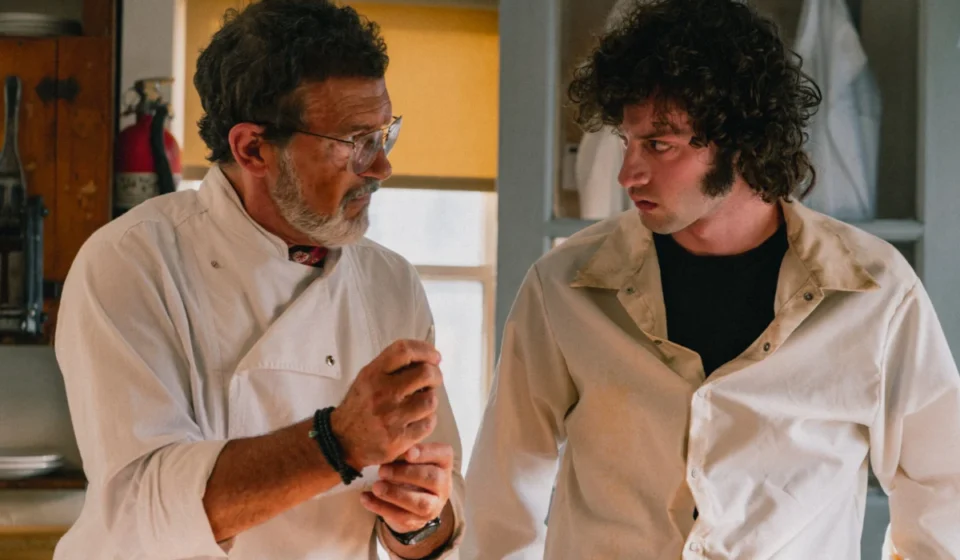
Furthermore, the film’s antagonist—the demanding, authoritative chef played by Antonio Banderas—is a composite figure. He is heavily inspired by "Bigfoot," the legendary, no-nonsense manager of a West Village restaurant where Bourdain worked during his time at the Culinary Institute of America. By transplanting the influence of Bigfoot into the Provincetown timeline, Johnson successfully externalizes the pressures that forged Bourdain’s professional identity.
Official Responses and the Director’s Perspective
The film marks a significant departure for Johnson, who is well known for directing and starring in his own meta-commentary films like The Dirties and Nirvanna the Band the Show the Movie. Tony is the first project where he steps entirely behind the camera, handing the reins of the title character to Dominic Sessa.
Sessa’s portrayal is described as hauntingly accurate, capturing the specific brand of aimless, intellectual angst that defined the 1970s culinary underground. Johnson admits that the film is as much a reflection of his own life as it is of Bourdain’s. The character of Bourdain’s mother, played by Dagmara Dominczyk, is a prime example. Her biting, dismissive attitude toward her son in the film serves as a catalyst for his escape to the Cape, and Johnson confirms that this dynamic is drawn directly from his own childhood experiences.

"The uncomfortable truth is I struggle in my other films to be honest about what my life was actually like," Johnson admitted. "By making this story about my own childhood as much as I could, I found the core of the film. I had to make it personal to make it authentic."
Implications: The Search for Truth in Provincetown
To ensure the film felt grounded in reality, Johnson took a bold step after the 2025 SXSW premiere of his previous film. He relocated to Provincetown during the off-season, living on Commercial Street—the very same strip where Bourdain had walked fifty years prior.
"I made it my mission to meet every single person who knew Anthony Bourdain," Johnson shared. "I heard amazing new stories, both confirming and denying accounts of what he wrote. I got taken everywhere, and all those things—the ghosts of those conversations—wound up in the screenplay."
The result is a film that functions on two levels. For the casual viewer, Tony is a vibrant, chaotic, and energetic look at the restaurant industry in the mid-70s. For the Bourdain devotee, it is a profound, albeit fictionalized, autopsy of an icon’s early psychological landscape.
The implications of Tony are clear: the legend of Anthony Bourdain is not a static monument, but a living, breathing entity that continues to evolve. By stripping away the prestige of the celebrity and focusing on the "lout" of 1975, Matt Johnson has given us a more honest, human, and vulnerable portrait than any documentary could provide. He reminds us that even the most celebrated voices began in a place of deep uncertainty, making their eventual rise all the more poignant.

Tony arrives in theaters nationwide on Friday, August 21. For those looking to dive deeper into the creative process, the full interview with Matt Johnson will be available on the Filmmaker Toolkit podcast starting August 20.