
In the landscape of modern streaming, few genres are as frequently churned out—or as consistently criticized—as the "high-concept" buddy comedy. Netflix’s latest entry into this saturated market, 72 Hours, arrives with a premise so transparently engineered by data analytics that it feels less like a narrative feature and more like a focus-grouped product launch. Directed by Tim Story and starring the indefatigable Kevin Hart, the film attempts to bridge the generational divide between Gen X and Gen Z. However, in its pursuit of broad appeal and demographic relevance, the movie often loses the very human spark it claims to be studying.
The Premise: A Professional at a Crossroads
The film centers on Joe (Kevin Hart), a mid-level advertising executive teetering on the edge of a professional precipice. His boss has placed his much-anticipated promotion to Chief Creative Officer on indefinite hold, citing a disconnect between the executive’s stale sensibilities and the rapidly evolving tastes of younger consumers.
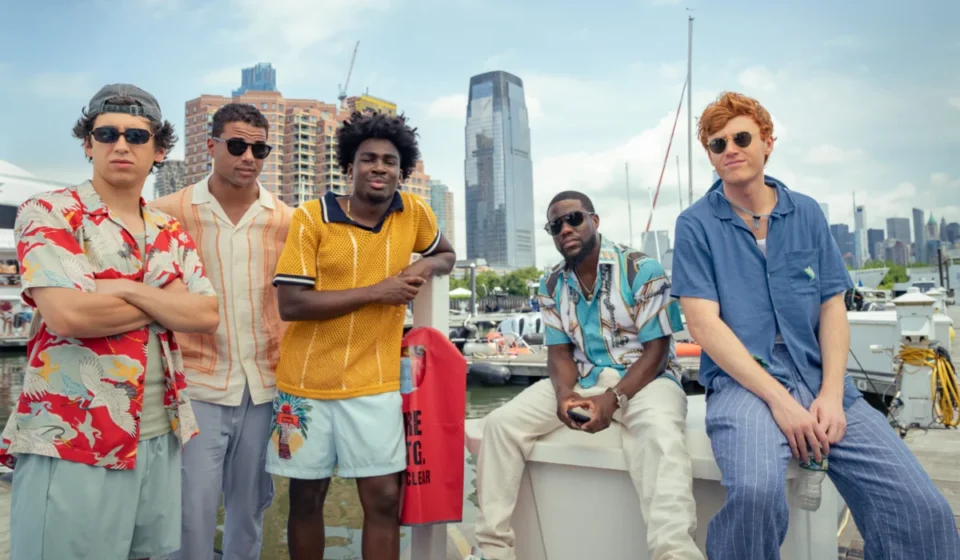
Desperate to prove his relevance, Joe stumbles into an unlikely opportunity: he is accidentally added to a group chat belonging to four frat-bro types half his age. Seeing a chance to conduct "market research" in the wild, Joe offers to bankroll their upcoming bachelor party trip to Miami. In exchange, the group allows him to tag along. What follows is a 72-hour exercise in culture-clash comedy, where the protagonist attempts to act as a fly-on-the-wall observer while inadvertently becoming the group’s honorary "unc."
A Chronology of Chaos
The narrative structure of 72 Hours is, to put it mildly, exhaustive. The film spends a disproportionate amount of time restating its premise, as if the screenwriters feared that viewers might lose their place while multitasking on their phones.
The timeline is straightforward but bloated. The first act is bogged down by the elaborate, often nonsensical hoops required to get Joe onto the plane to Miami. Once the group arrives in Florida, the film settles into a predictable rhythm of debauchery: yacht parties, nightclub escapades, and a bizarre, disjointed subplot involving the accidental theft of 30 kilos of cocaine from a local cartel boss.
The middle act attempts to pivot toward emotional vulnerability, contrasting the "old-school" stoicism of Joe with the surprisingly enlightened emotional intelligence of the younger men—Nick (Marcello Hernández), Mason (Mason Gooding), Freshman (Kam Patterson), and Hunter (Ben Marshall). Yet, even these moments of potential character development are undermined by a relentless need to return to slapstick, including an extended, poorly executed sequence of projectile vomiting that stands as a low point in the film’s physical comedy repertoire.

Supporting Data and Demographic Analysis
The core tension of 72 Hours—the friction between the "unc" and the "bros"—is played for laughs, but the film’s obsession with its own demographic framing is impossible to ignore. Joe’s character frequently breaks away from the group to make phone calls back to his office, documenting his "field notes" on youth culture with the clinical detachment of a primatologist.
This meta-commentary on advertising feels like a confession from the filmmakers themselves. The movie treats "Gen Z culture" as a collection of tropes to be analyzed rather than a lived experience. Marcello Hernández’s character, Nick, spends a significant portion of the film pointing out the absurdity of Hart’s presence, which serves as a clever, albeit repetitive, acknowledgment of the movie’s own narrative deficiencies. While Hernández is often correct in his assessment, the constant repetition of this observation suggests a script that lacked the confidence to move past its own irony.
Official Responses and Creative Direction
Tim Story, a veteran of studio comedies, brings a polished, slick aesthetic to 72 Hours, but the film’s tone is ultimately confused. It oscillates between the grounded, character-driven comedy of the "emotional check-ins" and the hyper-kinetic, low-stakes action of a standard Netflix original.
Critics have noted that the film suffers from a "noxious blend" of genres—it lacks the grit of a dark comedy and the heart of a genuine friendship story. The creative choices, particularly the decision to have Joe transform into a Spanish-speaking drug lord while under the influence of cocaine, feel like desperate attempts to inject "viral" moments into an otherwise beige narrative. It is the kind of creative decision that suggests a film produced for an algorithm rather than an audience.
Implications for the Streaming Model
The release of 72 Hours raises broader questions about the current state of original programming on major streaming platforms. As Netflix continues to prioritize volume and broad-market accessibility, there is an increasing trend of films that feel "soullessly engineered."
The film’s marketing tagline, "He puts the ‘unc’ in ‘uncool’," is undeniably sharp—a rare moment of self-awareness in a production that otherwise treats its audience as a collection of metrics. The implication is that the film knows exactly what it is: a flashy, disposable consumer product.

For the industry, this represents a shifting paradigm. When a film’s development process seems more concerned with "user engagement" than with narrative cohesion, the result is often a polished, professional, but ultimately hollow experience. 72 Hours is not a disaster by traditional standards; it is technically competent and features a dedicated performance from Hart, who remains a charismatic screen presence despite the material. However, it serves as a cautionary tale about the limitations of data-driven storytelling.
Conclusion: A Grade of C-
Ultimately, 72 Hours is a film that never aspires to be more than a weekend distraction. It shares more DNA with the hollow, high-budget spectacle of Red Notice than the genuine, character-driven humor of The Hangover. While it manages to elicit a few laughs, they are fleeting, overshadowed by the realization that the film is more interested in its own demographic breakdown than in the actual lives of its characters.
For viewers seeking a light, forgettable comedy, 72 Hours may suffice. But for those hoping for a more nuanced look at generational divides or a truly compelling buddy comedy, this is a product that promises much and delivers only the bare minimum. As it stands, the film earns a C-, serving as a testament to what happens when an idea is developed for the algorithm rather than the heart.
72 Hours is now streaming on Netflix.